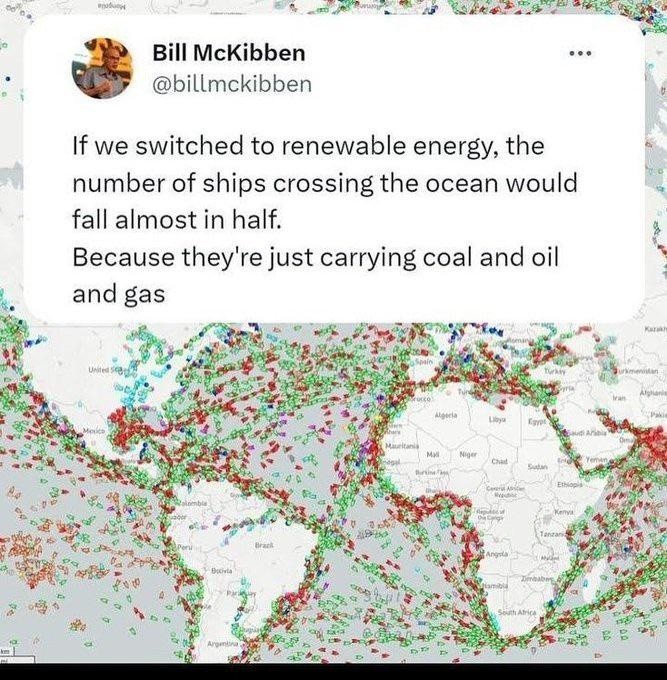
…and that would drop the amount of marine fuel needed. Compound interest.
which means we need to transport less fuel around, so less ships
And more unemployed seamen’s.
And more unemployed wharf whores.
Doesn’t anyone think about wharf whores!
Seaman certainly do.
I’m trying to pronounce the h’s here like Stewie Griffin.
Who whants a wharf whore with cool whip?
Sounds like a delectable combination.
I prefer my semen unemployed, thank you.
seamen’s
What kind of abomination is this?
i found them in my little brother’s sock
I really don’t know.
They can install solar panels or wire or something and not have to be away from their family for months at a time. Also the vast majority of seamen shipping oil are coerced captive workers from impoverished places with confiscated passports and no rights. Employed isn’t really the right word to use.
Employ them as the crew of an interplanetary solar sail expedition. We’ll be colonizing the moons of Jupiter in no time!
Just put some money into advanced sailing ship tech and in a decade we’ll have advanced clippers with many more seamen needed.
So overseas shipping rates drop and some of the companies convert their ships to give joy-rides in seas (because cheaper sea travel), while some seamen get to explore avenues like deep sea exploration (which seems to be a really underdeveloped field) and development.
Somehow I’m not seeing your average deck hand transitioning into deep sea exploration.
Well, the average deck hand can stay working at the normal ships that are shipping other stuff.
The above average ones can become a deck hand for the newer vehicles for deep sea operations.Both are probably already paid low enough that corporate can easily pay them while reducing shipping rates at the same time.
I’m thinking the deep sea exploration pays a bit more than a guy who can hook some cables on a crate.
But wtf do I know…
But of course, if the extra exploration rate can be afforded, then so can their salaries.
The only thing that matters is whether there will be someone wanting to do so.
Guy doing marine fuel enters the chat.
In the US, we use a lot of prime farmland to grow corn that we turn into ethanol - 30,000,000 acres. Thirty million acres!
That ethanol is combined with gas (making the gas less efficient, by the way) and powers our cars in the US.
If you look at the number of miles the ethanol powers in the US, and calculate how many acres of solar we’d need to power electric cars to go that number of miles, we’d need to convert less than a quarter of a million of those acres to solar. So let’s round up from 214,000 acres to the 250,000 because… inefficiencies, or whatever.
So we could gain 29,750,000 acres of land to grow more food or whatever and stop growing corn to turn into ethanol just to burn it in our cars.
For that matter, if we wanted to use that ethanol land (JUST the land we’re using for ethanol) to power ALL cars in the US, switching everyone over to electric, it would only take about two million acres. Sure, 2,000,000 acres is a lot, but that would still be freeing up TWENTY EIGHT MILLION ACRES of land we’re using JUST to grow corn we turn into ethanol.
It does ignore anything like the chaos of forcing everyone to buy a new electric car, setting that infrastructure up - I’m not saying this would be easy, but it is stunning how much land we could stop abusing to grow corn to burn in our cars.
Mandating solar PV in all building codes nationwide, and incentivizing onshoring of all of the processes that go into manufacturing solar PV panels (including using trade protectionism practices such as tariffs AFTER WE ALREADY HAVE PROCESSING AND MANUFACTURING CAPABILITIES IN THE USA) will do wonders for helping average people transition away from fossil fuel Internal Combustion Engine (ICE) cars to EVs.
Many people who cry foul about EVs and renewables adding too much load to a grid that is too old and just can’t handle it forget the main counter to disarm their arguments: colocating generation with utilization.
Having solar PV (and other renewable) generation closest to where that power wants to be used is the best for the grid infrastructure (maybe not the grid investors) because it reduces residential/commercial load while maintaining the needs of the original giga users of the grid: Industry.
There are solutions to SO many of today’s problems. We just have politicians that are bought and sold by billionaires and their corporations who won’t do the public’s bidding. Voting progressive politicians in, and preferably ones who vocally claim they’re Democratic Socialist or similar, is the strongest way we push back against Big Oil, Big Coal, Big Tech, and all the other mega industries.
If what you say is accurate, the other benefit would be that they wouldn’t even need prime, fertile real estate.
They’d just need any space with good sun capture.
Theres a lot of misunderstanding going on here about both corn and solar power.
Corn is not something that requires ideal or fertile real estate. People imagine corn being grown in the stereotypical midwestern river-adjacent and particularly fertile type of places, like Iowa or Ohio or whatever. The reality is that modern corn production requires a shitload of artificial nitrogen fertilization, so the actual fertility of the land is virtually unimportant. Believe it or not, Texas is actually one of the most productive places for corn farming, and in particularly hot and arid areas where you wouldnt be farming much else. More like typical ranching land, not prime farming land.
Now with solar power, at the current levels of efficiency (and unlike corn), having a cloudy day is a major killer. UV intensity at high elevation can be virtually nothing when it gets a little cloudy. Whereas on a sunny say it would be extremely high. So you need ideally somewhere that is as high altitude as possible, but where it is also sunny almost all the time. There are not a lot of places that meet that description, and even the few places that do are largely very expensive to acquire land in because people want to build houses and hotels and golf courses and whatever else in (or adjacent to) the mountains. Take Pueblo, CO, for example. It’s one of the solar hubs of the US. But its difficult to expand from there because you can either go east, down in elevation, and increase the number of cloudy days. Or you can try to go west and everything becomes exponentially more expensive the closer you get to the Rockies.
More importantly though, corn and solar production necessitate two completely different environments. No one is growing corn in Pueblo, and you wont find many solar fields in places where corn is grown effectively. Because a lot of the time people grow corn where it rains often, therefore those places have many more cloudy days in a year. Realistically you cant just take corn fields and turn them into solar fields
If this is true then solar dominance would be very efficient for our society in your’s and op’s description because in this scenario, corn will still always be grown… however, it would be marginalized to its regions that can only grow corn as you described.
I think that’s what you was coveying.
Are you just restating the numbers from the Technology Connections video? Or have you verified any of this research yourself?
I do watch Alec, but this came from my own - informal - work.
So we could gain 29,750,000 acres of land to grow more food or whatever and stop growing corn to turn into ethanol just to burn it in our cars.
What if there is another potato famine, (added: another potato destroying mold)? That corn creates food security because it can always be used as food while the ethanol is replaced with petrol.
Corn grown for ethanol is not edible by humans. Also, do you really think growing only 29,750,000 acres of corn instead of 30,000,000 acres is a meaningful difference? Because it’s not.
You suggest to grown none of those 30 million that are used for ethanol. That would be 30 million acres less out of 90 million that are used for corn. That’s a major chamge.
Corn grown for ethanol would not help in a food shortage, so for the idea of a food shortage, it is… not helpful.
We have plenty of land not being used right now that could be used to grow food.
But we don’t have a shortage of food. We have food being wasted and thrown away. We have plenty of excess food. This is like being worried about your driveway taking up valuable lawn space. It’s… not.
would not help in a food shortage
Others have pointed out that it can be eaten as staple food.
We have plenty of land not being used right now
Land doesn’t help if there is no food.
But we don’t have a shortage of food.
A reserve is for out of ordinary situations.
You can also scour the ground for pennies just in case you run out of money, too. It’ll technically bring in more money than you had before.
You could also keep a stash of aluminum cans to turn in for money as well in case you run out of money.
But the amounts of help these things would do is so incredibly minimal that there are much better uses of your time.
Yes. Technically. Growing less than one percent of the land we grow for ethanol corn would mean that extra less than one percent of corn we really don’t want to eat JUST IN CASE we needed that last tiny bit.
We could also easily open far more than that in farmland and grow other crops that are more edible first.
But yes, technically, we could grow food we neither want nor need.
Are you happy now?
I am sorry but I am not happy.
Yes. Technically. Growing less than one percent of the land we grow for ethanol
It was 30%.It could be used otherwise if we used elecrric cars but that wouldn’t create food security.
JUST IN CASE we needed
Well, not starving to death is a reasonable cause to do something.
We could also easily open far more than that in farmland and grow other crops
Then there is other surplus food that has to be thrown away, or also be turned into ethanol.
technically, we could grow food we neither want nor need.
For food it’s worth having a surplus. The bad part is that food is turned into ethanol while people starve to death.
You know the Irish wouldn’t have starved so bad if the Brits didn’t insist they export all food that wasn’t potatoes. Let’s not use bad policies as an example for why we can’t have good policies.
I meant to say that the problem could be another potato destroing mold. The famine could be avoided by switching to ethanol corn.
Not growing that corn would lead to the same result as exporting it.
In the US, we use a lot of prime farmland to grow corn that we turn into ethanol - 30,000,000 acres. Thirty million acres!
not actually true. This is oil and gas propaganda.
Most of the corn grown in the US is not edible. Barely 1.5%. Most of it is grown for sugars, oils and other industrial processes.
did you read the whole comment? alexander already stated that
Most of the corn grown in the US is not edible. Barely 1.5%. Most of it is grown for sugars, oils and other industrial processes.
not actually true. This is oil and sugar propaganda.
Most of the corn grown in the US is grass. 100% of it, in fact. Soybeans make up a large percentage of animal feed.
Most of the corn grown in the US is grass.
…grass? you mean feed?
or do you mean maise technically being a grass, but having diverged greatly from it’s original form via agricultural selection?
if that’s the case, when you say most, what’s the remainder then?
I was just posting nonsense in response to the commenter who didn’t read what they were responding to. But yeah, I did mean it in the sense that it is highly artificially selected grass. Most being all, the remainder being none
ty for the explanation
Bypassing the question of whether sugars and oils are edible (?), field corn is perfectly edible for humans. Field corn isn’t sweet corn, and doesn’t taste good as a vegetable. But we can eat it the same way most people throughout history have eaten corn - as a staple crop, as a grain like wheat, as corn flour, cornmeal, grits, parched corn, hominy, maza, etc, etc. We just choose not to.
And calling opposition to ethanol “oil and gas propaganda” is ridiculous. Like the comment you responded to point it out, ethanol is sold mixed with gasoline. The industries are synergistic, not competitive. They have a common interest in promoting internal combustion engine vehicles and opposing EVs.
🤫pssst,
this is one of the reasons fossil isn’t replaced as fast as it could and should beOr we could get rid of windmills and underfund solar incentives and research, occupy oil producing nations and try to drive this number higher? It’s 2026 people, let’s redefine what progress means! 🦅💪🎇
Inb4
Please think of the Poor Freight Captains and tHe eCoNoMy
Imagine dreaming of allocating resources to better uses. What a crazy idea!
tHe eCoNoMy
funnily enough renewable energy is probably gonna be the biggest driver of the economy in the next 10 years or so, considering that a lot of new infrastructure has to be built for it and they will generate a lot of power to drive further manufacturing.
THR GODDAMN ENERGY FALLS FROM THE SKY FOR FREE!!!
Yes, but you can’t resell it for a profit elsewhere easily. You want us to switch to sky energy, we need a way to make the output portable so someone can make money on it. I really hate capitalism and hope this is the fall at a global level. Though if anyone was watching, China has been making the right moves towards solar and transport. If they stop oppressing their people i’ll move all my soon to be worthless USD to YUAN.
I laughed.
But if you want to do anything with it other than heat something up, you need to build a contraption. And, we’ve only recently become good at building those contraptions.
If the post is even accurate, that likely doesn’t factor in secondary needs. Roads, tires, shampoo, soap, lubricants, hydrogen, solvents, medical plastics. So many things made from oil and oil byproducts.
All of these industries have to be looking into alternatives in parallel, if they are even aware.
shampoo, soap
We could reduce shipping needed for these if it became the norm to ship them dry and mix with water in the home. Bonus: they could be shipped in paper rather than plastic, and consumed from reusable glass bottles rather than plastic.
And set up a bottle deposit and return system that only needs to function at a local level. Haha, the solution to one of the big problems I saw with using glass instead of plastics for packaging. Just don’t ship it that way, ship it at scale dry in a paper container that collapses to nothing for the return trip, or holds some other good going back.
1000% this. I’ve been trying to get my household switched over to dry detergents whenever possible. I simply hate the idea of shipping water around, since it is bulky, heavy, and makes up like 70-90% of most household cleaners.
I agree, but the problem is how dangerous many of the chemicals are in dry concentrations.
People already mix household bleach with acidic cleaners. Imagine if they had dry sodium hypochlorite sitting around.
Bleach dispensers at the supermarket or pharmacy sound pretty dystopian but maybe shipping the concentrate and mixing at the PoS is safer.
Fwiw this idea does exist. Here’s one site that sells it. That site has handwash, general household cleaner, dishwashing powder & tablets, etc., as well as glass bottles to use them in. Also something called “bleach alternative”. All designed to be shipped dry.
Thanks! I’ll have to see if I can find something similar in my country.
Bleach dispensers at the supermarket or pharmacy sound pretty dystopian
Why?
Just how it sounds I guess. Things must not be going great when you have a need to dispense bleach haha.
Could also reduce the shipping needed on these by requiring standard container shapes that can properly be emptied. So many consumer product containers, even food containers, are designed so it is difficult to fully use the product. Companies see it as an uptick in sales because you’ll be buying that soap/ketchup/whatever more frequently since you can’t use 4 ounces out of the bottom, rather than seeing the cost-savings of not shipping 4oz x thousands of containers of weight pointlessly. (Personally, I go out of my way to empty every container fully, but many see it as a waste of effort.)
The vast majority of oil and gas consumption is just burning the shit in a pile
The oil companies want you to think about plastics to make you think all the oil we drill is important, but it’s actually only a tiny fraction. It’s all propaganda.
There is indeed propaganda going on, but there is also a reality that many supply chains need conversion, and that money needs to come from somewhere. Not saying it is right, nor that it is unsolvable, just a reality. Most often, the smaller businesses are destroyed by expensive switches to new methods. Which is all we need, more megacorps owning everything.
In a world with functioning governments, processes, grants, tax breaks, and such could be set up to help companies switch.
Asphalt for pavement and shingles is amaong the most recycled materials on the planet.
Soap and shampoo can be made from animal fat or vegetable oil.
Hydrogen can be made from water. You get oxygen too.
These are not unsolveable problems.
Never said unsolvable by any means, but they need to be solved yesterday. Blows the mind too, for all those capitalism-minded people, they have all this untapped “wealth” they could be getting into on the ground floor instead of clinging to oil.
They’re not problems that need to be solved. If we cut fossil fuel use by 90%, there’s hardly any impact on these uses.
Asphalt for pavement and shingles is amaong the most recycled materials on the planet.
Not how you think. The asphalt is ground up for the mineral content then mixed with new bitumen.
Soap and shampoo can be made from animal fat or vegetable oil.
Most of it is. Cheapest way to do it.
Hydrogen can be made from water. You get oxygen too.
By wasting a lot of electricity.
Hydrogen can be made from water. You get oxygen too.
By wasting a lot of electricity.
Just curious, how is the majority of hydrogen produced/mined/farmed now?
I kinda always assumed it was electrolysis just because the process is so simple.
Most hydrogen is currently produced from methane, meaning natural gas. It’s a huge source of carbon dioxide.
Those all can be produced from synthetic hydrocarbons made from atmospherically captured CO2. We don’t need to drill an oil well to make plastic.
Whoa, seriously? Okay that’s awesome to know. And pretty cool.
– Frost
I mean, yeah, lots of things are possible.
Whether or not they are economically feasible with current tech is a different question.
Given that oil-based fuel still exists, there’s no reason for anybody to try to actually create a feasible, sustainable, scalable process to do such a thing.
You forgot normal plastics. 99.99% of all plastic types are basically made from petroleum.
Yeah, didn’t want to hit every note. Medical specifically requires a higher tolerance and quality level that makes it more challenging to be replaced with alternatives like bioplastics. For most items, I’d be fine buying them in glass or cans again.
but then we’d have to ACTUALLY recycle our tin and aluminium cans. I would RATHER DIE
❤️
They don’t have to be though. We do not need petroleum to make plastics.
I didn’t say it has to be… It’s the reality. In the context of bioplastics the challenge is that the 17.5% of people in high-income countries are currently the only ones with the infrastructure and the disposable income to easily adopt expensive non-petroleum products and produce them as well. As for the other 82.5%, petroleum-based plastics remain the standard because they are significantly cheaper to produce and easier to manage in traditional waste streams. So, unless these replacement comes in cheap and easily producible forms we are far from replacing anything in the near future.
All of these industries have to be looking into alternatives in parallel, if they are even aware.
Why?
I mean, I think it would be good, but why would they have to be looking into alternatives? Why couldn’t we phase out fossil fuels for burning purposes, and then whenever that’s done start thinking about phasing them out for use in other products?
Plastics are a waste product of converting oil to useful fuels. That’s why they’re so cheap and used in the most unbelievably wasteful ways. They’ll remain inextricably linked. Fuel is expensive, plastics are incredibly cheap. If we ban the use of fossil fuels but still rely on oil based plastics, plastics will become very expensive and we’ll still be creating the fuel. We’ll just have a growing supply of worthless energy sitting around and decaying in storage.
I’m not saying it’s a bad idea as I’m not an expert by any means, but to keep plastics for essential uses like in medicine will likely require a heavily subsidized plastic industry at least. But hey we already subsidize the fossil fuel industry directly and by externalizing the planet destroying effects of their use…
plastics will become very expensive
Which will mean people will switch to cheaper alternatives whenever possible.
They can’t when it means their sleep mask doesn’t exist anymore and they die in their sleep, for example.
Also, it’s unlikely that countries would be manufacturing their own renewable infrastructure. You would still need ships to haul solar panels, wind turbines, and batteries from China to destination ports.
So many things made from oil and oil byproducts.
if i remember correctly, 97% of fossil fuels are actually used to generate energy from it, and only around 3% are used as material, i.e. turned into plastic and such.
Petrochemicals are barely 10% of oil usage, not really important by volume.
It was literally the byproduct of fuel production. They had to find uses for it and created the petrochemical revolution.
The issue was we already had ways of making all our products without petroleum byproducts. They also didn’t cause cancer which is kind of nice.
not to mention the big one, fertilizers
“We need the fossil fuels to get more fossil fuels to move the fossil fuels just to take the fossil-fuel thing to the fossil fuel store to get more fossil fuels!” -people that sell fossil fuels
It’s the rocket ship problem.
You need fuel to move the fuel that moves the fuel that moves the rocket
Sure, but when a lot of the things don’t need to carry the fuel with them and induction roadways do it all in the moment?
induction roadways
Do you mean railways?
No.
Here, let me DDG two words for you: https://www.enrx.com/en/Induction-Applications/Inductive-charging-and-power-applications/Dynamic-electric-roadway
This would be incredibly energy inefficient first of all, because a lit of energy gets lost when using induction and that rises really quickly with the distance from the source.
Second of all, that would be really expensive to build.
Third of all, this doesn’t solve the real problem of individualized travel. Cars are really inefficient, becuase: 1. Their infrastructure wastes a lot of space. Most people travel alone in their cars, which means, you have all this sourounding machinery you need to transport in addition, which is huge. Cars get into traffic jams, so the city decides to widen the rode. This moves the whole city further appart, which means people need the car more often, which means there are more traffic jams. 2. They are hugely energy inefficient, because (as said before), you need to move the whole car around just to transport one person 3. They are the most dangerous mode of travel and most often endanger bike drivers or pedestrians. 4. They are loud and stink
You could solve most of these problems with proper public transport. These “futuristic” ideas, like inductive roads or Musks Hyperloop are just a way for big companies to direct funding and attention away from public transport.
OK, well there’s a lot of engineers and scientists that you’ll have to find and explain how wrong they are. I wasn’t inventing induction roadways in my head, they’re a real thing and showing a lot of success for use cases like the trucking industry and use on highways where cars travel at speed most of the time.
If we could power vehicles on negativity and dismissiveness of electrifying fossil fuel infrastructure until everyone got the exact solution they wanted, we could all drive to the moon and back.
https://insideevs.com/news/777157/wireless-charging-highway-power/
https://www.prima.ca/en/project/inductive-electric-charging-road/
https://www.youtube.com/watch?v=UWW0wMahXfA
https://www.sciencedirect.com/science/article/pii/S2666691X22000458
https://newatlas.com/automotive/electreon-vinci-wireless-charging-motorway/
The thing is, we already have the solution though. It’s public transport. Railways can also be used to transport cargo. For longer routes you can still use ships.
Your solution is the unrealistic one. Because we would have to invest an insane amount of money into that infrastructure. We could invest a fraction if that into public transport and we would be so much better off.
I don’t care how many scientists agree with you. Just think critically for like 10 seconds about this. How would this really improve anything over public transport?
Also there are a lot if scientists agreeing with me, so…
And one day we even become fossil fuel…
We don’t, we decompose. Fossil fuels are basically plants that died and were subsumed millions of years before bacteria and fungi evolved to decompose them.That doesn’t happen anymore.
… it’s people!!
That means fuel will continue to get more expensive as other markets switch to renewable energy sources. That in turn will reduce the number of ships which will make the fuel harder to find, which will reduce the number of products using that fuel, which will eventually result in total elimination of that market.
Unless it’s officially propped up by governments at the behest of rich and powerful fossil fuel lobbies!
It’s inevitable that it will end some day, but not nearly as fast as it otherwise organically would.
The big costs comes from building the infrastructure for fossil fuels. So as soon as demand falls, you have a huge part of the bill has been paid already. So you get low fossil fuel prices. You need to keep in mind that most large oil producers are state owned. Therefore those states will try to shut down other suppliers production.
You can see that already with sanctions against Russia and Iran to keep US oil producers going strong.
markets don’t work that way. if you reduce demand (i.e. fewer people consume fossil fuels), and supply stays constant, that means that prices go down, which makes fossil fuels cheaper until people start using them again. eventually it balances out at an equilibrium state. supply and demand
Yes, thats assumed. However we are taking into account that machinery rusts away quickly. If you stop one refinery for example, that’s not a smooth change, its an abrupt step. If we stay steady below the usual high, then trying to come back will be expensive. For that reason we’ll see the price increase slowly…you need the fuel, so its a seller’s market, they need to get paid as if their load was double in case they need to double. At some point it might drop a bit until it becomes a luxury item.
Here’s an example where the price is going up became the supply keeps dropping and the demand keeps increasing regardless of the supply situation:

The same would happen to ice cars. People still want to use them if they have them, but the market keeps shrinking.
40 % of ships should probably be decomissioned anyway.
Imagine not having to rely on countries to pump up oil and polluting the earth by burning it.
We have the technology, but for some reason we want to rely on some other party and pay tons of money.
Renewables… And also reduction. People need to grow up and realize that driving a vanity tank for half a mile to get a gallon of milk is fundamentally unsustainable. Humanity and the planet can no longer afford to support this level of gross privilege, regardless of the “fuel” used.
Electric busses, and trains need to be part of the solution.
And walking. Cities shouldn’t be as spread out as they currently are, especially in the US.
Burn oil to pump oil
Burn oil to refine oil
Burn oil to ship oil
So we can burn oil at home.
cook oil to make plastic/chemicals
dump plastic/chemicals in the ocean
I read recently that they found bacteria in the ocean that’s actually metabolizing some (PET) plastics, so that’s kind of interesting. https://www.sciencedaily.com/releases/2025/11/251104013023.htm
Please always provide a source.
The actual statistic is from here I think.
Looks like a screenshot of www.marinetraffic.com - red ships are tankers.