If the post is even accurate, that likely doesn’t factor in secondary needs. Roads, tires, shampoo, soap, lubricants, hydrogen, solvents, medical plastics. So many things made from oil and oil byproducts.
All of these industries have to be looking into alternatives in parallel, if they are even aware.
We could reduce shipping needed for these if it became the norm to ship them dry and mix with water in the home. Bonus: they could be shipped in paper rather than plastic, and consumed from reusable glass bottles rather than plastic.
1000% this. I’ve been trying to get my household switched over to dry detergents whenever possible. I simply hate the idea of shipping water around, since it is bulky, heavy, and makes up like 70-90% of most household cleaners.
Fwiw this idea does exist. Here’s one site that sells it. That site has handwash, general household cleaner, dishwashing powder & tablets, etc., as well as glass bottles to use them in. Also something called “bleach alternative”. All designed to be shipped dry.
And set up a bottle deposit and return system that only needs to function at a local level. Haha, the solution to one of the big problems I saw with using glass instead of plastics for packaging. Just don’t ship it that way, ship it at scale dry in a paper container that collapses to nothing for the return trip, or holds some other good going back.
Could also reduce the shipping needed on these by requiring standard container shapes that can properly be emptied. So many consumer product containers, even food containers, are designed so it is difficult to fully use the product. Companies see it as an uptick in sales because you’ll be buying that soap/ketchup/whatever more frequently since you can’t use 4 ounces out of the bottom, rather than seeing the cost-savings of not shipping 4oz x thousands of containers of weight pointlessly. (Personally, I go out of my way to empty every container fully, but many see it as a waste of effort.)
The vast majority of oil and gas consumption is just burning the shit in a pile
The oil companies want you to think about plastics to make you think all the oil we drill is important, but it’s actually only a tiny fraction. It’s all propaganda.
There is indeed propaganda going on, but there is also a reality that many supply chains need conversion, and that money needs to come from somewhere. Not saying it is right, nor that it is unsolvable, just a reality. Most often, the smaller businesses are destroyed by expensive switches to new methods. Which is all we need, more megacorps owning everything.
In a world with functioning governments, processes, grants, tax breaks, and such could be set up to help companies switch.
Never said unsolvable by any means, but they need to be solved yesterday. Blows the mind too, for all those capitalism-minded people, they have all this untapped “wealth” they could be getting into on the ground floor instead of clinging to oil.
Whether or not they are economically feasible with current tech is a different question.
Given that oil-based fuel still exists, there’s no reason for anybody to try to actually create a feasible, sustainable, scalable process to do such a thing.
Yeah, didn’t want to hit every note. Medical specifically requires a higher tolerance and quality level that makes it more challenging to be replaced with alternatives like bioplastics. For most items, I’d be fine buying them in glass or cans again.
I didn’t say it has to be… It’s the reality.
In the context of bioplastics the challenge is that the 17.5% of people in high-income countries are currently the only ones with the infrastructure and the disposable income to easily adopt expensive non-petroleum products and produce them as well. As for the other 82.5%, petroleum-based plastics remain the standard because they are significantly cheaper to produce and easier to manage in traditional waste streams. So, unless these replacement comes in cheap and easily producible forms we are far from replacing anything in the near future.
All of these industries have to be looking into alternatives in parallel, if they are even aware.
Why?
I mean, I think it would be good, but why would they have to be looking into alternatives? Why couldn’t we phase out fossil fuels for burning purposes, and then whenever that’s done start thinking about phasing them out for use in other products?
Plastics are a waste product of converting oil to useful fuels. That’s why they’re so cheap and used in the most unbelievably wasteful ways. They’ll remain inextricably linked. Fuel is expensive, plastics are incredibly cheap. If we ban the use of fossil fuels but still rely on oil based plastics, plastics will become very expensive and we’ll still be creating the fuel. We’ll just have a growing supply of worthless energy sitting around and decaying in storage.
I’m not saying it’s a bad idea as I’m not an expert by any means, but to keep plastics for essential uses like in medicine will likely require a heavily subsidized plastic industry at least. But hey we already subsidize the fossil fuel industry directly and by externalizing the planet destroying effects of their use…
if i remember correctly, 97% of fossil fuels are actually used to generate energy from it, and only around 3% are used as material, i.e. turned into plastic and such.
Also, it’s unlikely that countries would be manufacturing their own renewable infrastructure. You would still need ships to haul solar panels, wind turbines, and batteries from China to destination ports.


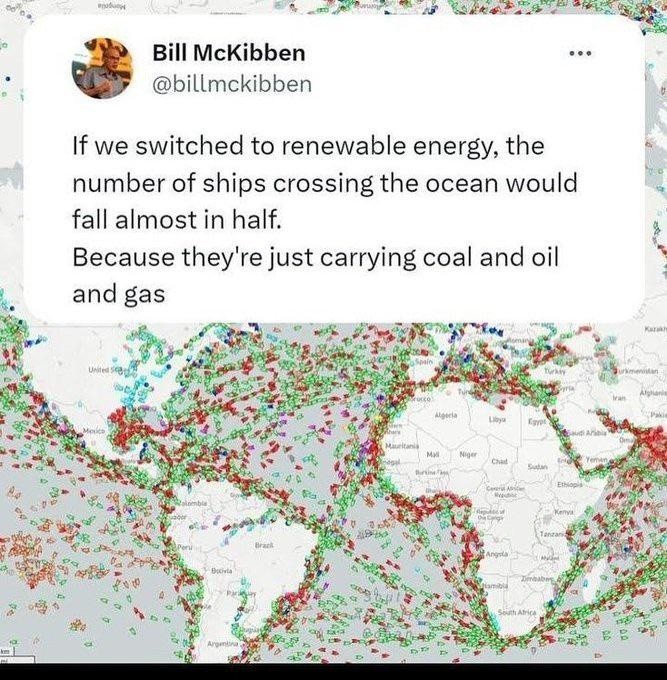
If the post is even accurate, that likely doesn’t factor in secondary needs. Roads, tires, shampoo, soap, lubricants, hydrogen, solvents, medical plastics. So many things made from oil and oil byproducts.
All of these industries have to be looking into alternatives in parallel, if they are even aware.
We could reduce shipping needed for these if it became the norm to ship them dry and mix with water in the home. Bonus: they could be shipped in paper rather than plastic, and consumed from reusable glass bottles rather than plastic.
1000% this. I’ve been trying to get my household switched over to dry detergents whenever possible. I simply hate the idea of shipping water around, since it is bulky, heavy, and makes up like 70-90% of most household cleaners.
I agree, but the problem is how dangerous many of the chemicals are in dry concentrations.
People already mix household bleach with acidic cleaners. Imagine if they had dry sodium hypochlorite sitting around.
Bleach dispensers at the supermarket or pharmacy sound pretty dystopian but maybe shipping the concentrate and mixing at the PoS is safer.
Fwiw this idea does exist. Here’s one site that sells it. That site has handwash, general household cleaner, dishwashing powder & tablets, etc., as well as glass bottles to use them in. Also something called “bleach alternative”. All designed to be shipped dry.
Thanks! I’ll have to see if I can find something similar in my country.
Why?
Just how it sounds I guess. Things must not be going great when you have a need to dispense bleach haha.
And set up a bottle deposit and return system that only needs to function at a local level. Haha, the solution to one of the big problems I saw with using glass instead of plastics for packaging. Just don’t ship it that way, ship it at scale dry in a paper container that collapses to nothing for the return trip, or holds some other good going back.
Could also reduce the shipping needed on these by requiring standard container shapes that can properly be emptied. So many consumer product containers, even food containers, are designed so it is difficult to fully use the product. Companies see it as an uptick in sales because you’ll be buying that soap/ketchup/whatever more frequently since you can’t use 4 ounces out of the bottom, rather than seeing the cost-savings of not shipping 4oz x thousands of containers of weight pointlessly. (Personally, I go out of my way to empty every container fully, but many see it as a waste of effort.)
The vast majority of oil and gas consumption is just burning the shit in a pile
The oil companies want you to think about plastics to make you think all the oil we drill is important, but it’s actually only a tiny fraction. It’s all propaganda.
There is indeed propaganda going on, but there is also a reality that many supply chains need conversion, and that money needs to come from somewhere. Not saying it is right, nor that it is unsolvable, just a reality. Most often, the smaller businesses are destroyed by expensive switches to new methods. Which is all we need, more megacorps owning everything.
In a world with functioning governments, processes, grants, tax breaks, and such could be set up to help companies switch.
Asphalt for pavement and shingles is amaong the most recycled materials on the planet.
Soap and shampoo can be made from animal fat or vegetable oil.
Hydrogen can be made from water. You get oxygen too.
These are not unsolveable problems.
Never said unsolvable by any means, but they need to be solved yesterday. Blows the mind too, for all those capitalism-minded people, they have all this untapped “wealth” they could be getting into on the ground floor instead of clinging to oil.
They’re not problems that need to be solved. If we cut fossil fuel use by 90%, there’s hardly any impact on these uses.
Not how you think. The asphalt is ground up for the mineral content then mixed with new bitumen.
Most of it is. Cheapest way to do it.
By wasting a lot of electricity.
Just curious, how is the majority of hydrogen produced/mined/farmed now?
I kinda always assumed it was electrolysis just because the process is so simple.
Most hydrogen is currently produced from methane, meaning natural gas. It’s a huge source of carbon dioxide.
Those all can be produced from synthetic hydrocarbons made from atmospherically captured CO2. We don’t need to drill an oil well to make plastic.
Whoa, seriously? Okay that’s awesome to know. And pretty cool.
– Frost
I mean, yeah, lots of things are possible.
Whether or not they are economically feasible with current tech is a different question.
Given that oil-based fuel still exists, there’s no reason for anybody to try to actually create a feasible, sustainable, scalable process to do such a thing.
You forgot normal plastics. 99.99% of all plastic types are basically made from petroleum.
Yeah, didn’t want to hit every note. Medical specifically requires a higher tolerance and quality level that makes it more challenging to be replaced with alternatives like bioplastics. For most items, I’d be fine buying them in glass or cans again.
but then we’d have to ACTUALLY recycle our tin and aluminium cans. I would RATHER DIE
❤️
They don’t have to be though. We do not need petroleum to make plastics.
I didn’t say it has to be… It’s the reality. In the context of bioplastics the challenge is that the 17.5% of people in high-income countries are currently the only ones with the infrastructure and the disposable income to easily adopt expensive non-petroleum products and produce them as well. As for the other 82.5%, petroleum-based plastics remain the standard because they are significantly cheaper to produce and easier to manage in traditional waste streams. So, unless these replacement comes in cheap and easily producible forms we are far from replacing anything in the near future.
Why?
I mean, I think it would be good, but why would they have to be looking into alternatives? Why couldn’t we phase out fossil fuels for burning purposes, and then whenever that’s done start thinking about phasing them out for use in other products?
Plastics are a waste product of converting oil to useful fuels. That’s why they’re so cheap and used in the most unbelievably wasteful ways. They’ll remain inextricably linked. Fuel is expensive, plastics are incredibly cheap. If we ban the use of fossil fuels but still rely on oil based plastics, plastics will become very expensive and we’ll still be creating the fuel. We’ll just have a growing supply of worthless energy sitting around and decaying in storage.
I’m not saying it’s a bad idea as I’m not an expert by any means, but to keep plastics for essential uses like in medicine will likely require a heavily subsidized plastic industry at least. But hey we already subsidize the fossil fuel industry directly and by externalizing the planet destroying effects of their use…
Which will mean people will switch to cheaper alternatives whenever possible.
They can’t when it means their sleep mask doesn’t exist anymore and they die in their sleep, for example.
if i remember correctly, 97% of fossil fuels are actually used to generate energy from it, and only around 3% are used as material, i.e. turned into plastic and such.
Also, it’s unlikely that countries would be manufacturing their own renewable infrastructure. You would still need ships to haul solar panels, wind turbines, and batteries from China to destination ports.
Petrochemicals are barely 10% of oil usage, not really important by volume.
It was literally the byproduct of fuel production. They had to find uses for it and created the petrochemical revolution.
The issue was we already had ways of making all our products without petroleum byproducts. They also didn’t cause cancer which is kind of nice.
not to mention the big one, fertilizers