
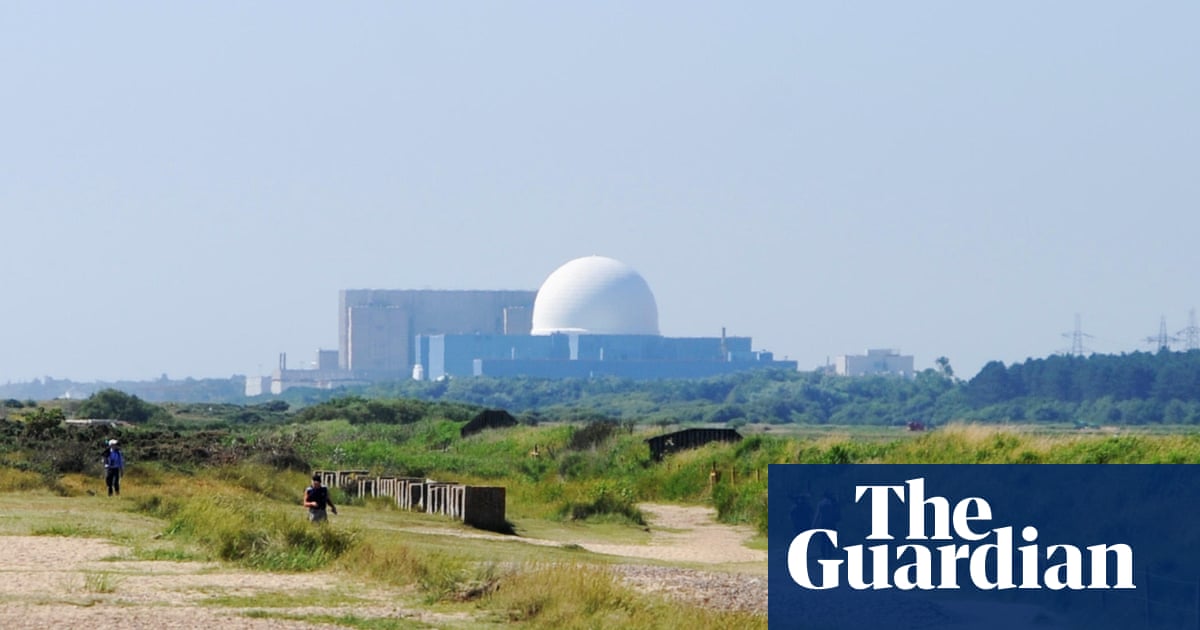
The motion, adopted at conference, removes a “blanket opposition to nuclear fission” and instead commits the Green party of England and Wales to assessing nuclear projects alongside other low-carbon technologies.
Its electricity generation policy still prioritises offshore wind, onshore wind and rooftop solar as the primary sources of electricity, but allows elected representatives to support new nuclear reactors on a case-by-case basis.
This was one or the few areas I didn’t align with the Green Party before, as I believe that a bit of nuclear is kind of necessary to help round out less consistent energy sources as things stand. I think this is a reasonable stance.
That makes sense. Once nuclear is built, using it is a no-brainer: you’ve already paid for it, so saying no to energy produced at the costs of a few truckloads of fuel a year is purity politics at its most asinine. Building new nuclear plants, with their high capital costs and long lead times, is another question altogether.
Nuclear is unaffordable so it doesn’t matter.
Solar plus batteries are by far the most cost effective and reliable method at the moment but we do have to keep investing in research on all technologies except dirty stuff that releases insane amounts of pollution and CO2.
True, and that means there needs not be an ideology ban of nuclear. We should just do whichever option that’s the best, and that won’t be nuclear.
This was one or the few areas I didn’t align with the Green Party before, as I believe that a bit of nuclear is kind of necessary to help round out less consistent energy sources as things stand. I think this is a reasonable stance.
Not to be too much of a dick but this is pretty typical of the pro-new nuclear mindset.
You “believe”? You don’t have to believe, there is plenty of hard data showing that new nuclear is a massive waste of money now renewables and storage are so cheap.
I think this is a reasonable stance.
It’s not, unless you want to pay more for electricity for absolutely no reason other than because you feel like you should.
I might just be behind the times.
I look over at France, who have managed to keep their energy prices low and keep their independence thanks to their large amount of Nuclear energy, and I’m jealous.
Maybe we have fixed the energy storage issue now, and I’m just not aware of it. It’s not my area of expertise.
I genuinely want us to have more renewables, but I was still under the impression that you needed a “base” energy source to round things out. I don’t want that to be coal or gas, so nuclear seems like the lesser evil.
But if that’s no longer an issue, then great!
there is plenty of hard data showing that new nuclear is a massive waste of money
Care to share some of it? Opinion seems pretty mixed from what I can tell.
This is a decent place to start:
https://www.lazard.com/media/kcfconhf/lazards-lcoeplus_vf.pdf
Solar PV + Storage—Utility - $61-$156
U.S. Nuclear - $175-$255
nuclear is a massive waste of money now renewables and storage are so cheap.
And how cheap are renewables when the wind doesn’t blow and the sun doesn’t shine?
Renewables and batteries are awesome and we need more. But they aren’t suited to all weather in all countries at all times. The UK has periods where there is not enough wind or sun or battery storage to sustain demand. Nuclear is not my first choice but it is a practical choice that can be helpful.
And how cheap are renewables when the wind doesn’t blow and the sun doesn’t shine?
That’s why I included storage in my comment. Wind and solar are very predictable across a longer time frame.
The UK has periods where there is not enough wind or sun or battery storage to sustain demand.
Really? Can you provide a source for this?
https://en.wikipedia.org/wiki/Dunkelflaute
The wikipedia article itself has many sources, I won’t pretend I have read them. Pretty sure I first heard of this in a modo energy video, but I couldn’t find it. Regardless it is a well researched phenomenon and is a real challenge we need to overcome.
Technically you could do it with enough battery storage but those batteries would be doing nothing most of the time when the weather is normal.
It’s right there in the article, “To ensure power during such periods flexible energy sources may be used, energy may be imported, and demand may be adjusted.”
flexible energy sources may be used
What do you think a flexible energy source is?
It also says:
Events that last more than two days over most of Europe happen about once every five years.
To be clear, I am in favor of importing electricity across borders but if most of Europe is affected by Dunkelflaute then I don’t think it would be sufficient. Lets hope for the best and plan for the worst.
What do you think a flexible energy source is?
NG or hydrogen peaker plants, hydro, tidal, flywheels, etc.
To be clear, I am in favor of importing electricity across borders but if most of Europe is affected by Dunkelflaute then I don’t think it would be sufficient. Let’s hope for the best and plan for the worst.
That’s why this looks like a great idea:
https://en.wikipedia.org/wiki/Xlinks_Morocco–UK_Power_Project
Yep I agree that is a great idea. I’m sure something like that will be developed at some point.
Also the sheer amount of land and wildlife destruction they require to build solar fields and windfarms…
I don’t see that as a problem, you don’t have to put solar on a nature reserve you can put it on a roof, carpark, canal. You can even put it on grazing land and it can increase biodiversity.
Besides the actual surface needed for solar is relatively small, you could power the UK with about as much surface area as is currently used by golf courses.
Ah, fair point then.
a bit of nuclear is kind of necessary to help round out less consistent energy sources a
I really don’t get how this argument still flies after all these years. From an economical perspective, nuclear is the worst type of energy generation you can pair renewables with. Putting the still unsolved nuclear waste debate aside for the moment, building nuclear plants is massively expensive and takes a lot of time, which is the exact opposite of what would complement renewables: Cheaply built capacity whose stand-by cost must be as low as possible.
Nuclear reactors need subsidies throughout its lifetime to compete with renewables on price and they need to run constantly.
Renewables already push the energy price into the negatives during peak production, so what you really need is batteries that can smooth out energy prices over a day or bridge a day with bad energy production, as well as energy generation that is cheap to build and keep in reserve, like gas plants that can burn a hydrogen mix.
When it comes to the economics, all nuclear power plants do is drive up the price set by renewables. England may have need for some nuclear power plants to keep up their stockpile of nuclear weapons, but when it comes to energy generation, hydrogen-burning powerplants will fit the need of renewable energy production much better in tge future.
How easy is it to recycle batteries?
For most type of batteries, relatively “easy”, that means you will recoved 99% of resources. The cost can be somewhat prohibitive, as using newely refined base materials can be cheaper.
Wikipedia is a good place to start if you are interested!
You’re not exactly wrong, nuclear is a terrible pairing with renewables for the reasons you listed, but it’s still probably cheaper than batteries under extreme conditions, which is something we do have to deal with.
90% renewables is cheap, 99% is more expensive, 100% is really really expensive. Batteries are great for 24 hour storage, but storing energy for longer starts to become uneconomical and to hit 100% you have to buy enough capacity for the absolute worst case scenario. Anything that baseline nuclear cuts off from renewable demand is potentially cheaper than the theoretical worst case 1% of renewables (eg if there’s no wind and it’s cloudy mid-winter, how much solar/wind do you need to power the country, or how much battery do you need to maintain power for weeks under these conditions?).
The funny thing is, every form of electricity production is better when coupled with batteries, even Nuclear. Because you can keep your power plants in the optimal production range.
I’m simply anti-nuclear anything with the large scale variety of other renewable energy alternatives out there with far fewer long term concerns.
I see a lot of old assumptions about fission here, but aren’t startups trying to make new reactors modular and quicker to assemble? Some even made in factories and transported to the site?
I wouldn’t stand in the way of that. It’ll get bought if it makes sense.
…Now. Fusion?
I think that’s a money black hole.
It’s cool in theory, kinda like living in space is cool in theory, but it solves problems that really aren’t that bad (waste storage, uranium supply), leaves bad problems unsolved or worse than fission (like higher neutron flux, capital costs), all for a stupendous amount of research money into something that won’t be ready anytime soon.
I’m sorry, but fusion didn’t work out like we hoped; stop funding it, dump that money into renewables like solar. Use those ignition masers for geothermal drilling, as some are already trying to do.
I think you’re missing the point of fusion research. The goal isn’t to find the power source of this decade or next, but to find the power source for the future. Fusion will be critical for the power demands of science and space exploration. Renewables are great for large populations, but not when you use the power demands of a city in a single building. Fusion makes fuel costs non-existent, and enables refueling of spacecraft from any source of hydrogen, which is abundant. There are still many problems to solve, but that’s why it’s being researched. Anyone selling fusion as the solution for climate change or to replace fossil fuels is a grifter or a shill.
Well, yeah, I agree with that.
But I’d argue that it draws from the same limited funding pool as renewables and other climate-important research.
The latter is urgent. We may not get to the point of effectively utilizing fusion unless we stabilize the planet, and the damage would be priceless. So if we have to trade one for the other, I’d say the bulk of funding should be diverted away from fusion and towards faster solutions, ones more immediately cost competitive with oil.
It’s not that we shouldn’t research it, eventually. There’s lots of long horizon concerns. But factoring in the time horizon is very important, and reducing emissions is needed yesterday.
I wish the Sierra Club here in the US and Greenpeace would do a similar transition.