Small clarification. My understanding is that it’s 40% by weight of goods carried, not 40% of ships. So still massive chunk, but not quite the same metric. Also some of those ships would still presumably be needed to move batteries and solar panels, At least for a while until we have enough for a closed loop recycling system (we can recycle like 99% of the lithium from lithium batteries, no idea how emerging sodium batteries will affect things)
Sodium based battery companies are, unfortunately, crashing right now, since lithium production has jumped so significantly that lithium prices have seen a major crash. Since price was the main economic driver for sodium batteries over lithium ones, many companies making sodium batteries are in big trouble right now, since lithium is more energy dense and at price parity
Which is still all due to investors not looking longer than 2 years since all of the crashing companies except Northvolt are startups. Lithium prices will always rise again at a much much higher rate than sodium.
Sodium was always better for grid storage due to temperature charging and discharging and still plenty cheaper than Lithium Iron Phosphate that it is a replacement for.
Once per installation per x years. While battery and solar replacement seem like a long time, the massive scale needed for a global buildout will require a continuous stream of shipping. It’s not free and will never be locally produced everywhere. Obviously a couple orders of magnitude less shipping, but energy related shipping is not disappearing entirely.
Actually I’d like to see someone do that math, out of curiosity. In a world with all renewables, does energy related shipping drop from 40% to 1%? 0.1%?
If you want green cargo shipping, it might be better to look to the past. Way back in the day, all shipping was very green, powered by wind. Maybe we could have a return of sailing ships?
Though, of course, sails do have some big disadvantages, which is why they were replaced in the first place. You’d definitely want an electric (or even fossil fuel) powertrain available to use as a backup or in emergencies. But when winds are favorable, why not set sail and let very green wind energy propel you across the ocean? As an extra bonus, sails are cheap and a very mature, well-understood technology. All you need to do is scale them up.
The biggest difference at the end of the day is that sailing ships are generally slower and require much more crew. So overseas shipping would be slower and possibly more expensive. (Though the massive fuel savings might offset the expense somewhat?) But I don’t necessarily think that slower and more expensive overseas shipping would be such a bad thing in the long run. It would encourage more local production and consumption.
Perhaps crew could be reduced with some form of automated sails? I dunno most of the terms, but can’t a motor set and unset the sail? Perhaps make the mast retractable and such things.
I forget the article I read about 3 years ago about a modern cargo ship using sails to reduce the amount of fuel they use. Can’t find it now but if I can find it I’ll try and post it in an edit here
I saw some science-entertainment videos. There’s also these rotating “sail” cylinders.
Most of it sounded not viable for mass transport and more like PoC or tryout state.
Going back to sails is a cool idea, but I don’t see how it’s viable, nor will batteries be. We’re going to need to settle on some sort of sustainable liquid fuel for a few uses like shipping and aviation.
Maybe this is even some good that can be driven by militaries
If the only reason oil is being extracted is to power aviation, the cost of fuel, and hence of flying, will be higher and the volume of flights will go down accordingly. Win/win for everyone but the oil and tourist industries.
It was viable in the 1800s because it was the best method available. We don’t use it today because it ultimately costs more. A wind-powered company would have to compete against others using extremely energy-dense fuels that enable hundreds of times more cargo (between increased speed and increased capacity) for the same time and money.
So, in other words, it’s perfectly viable … just not economically viable.
That’s a failure of our economy, not of the technology. Perhaps if all the externalities of fossil fuel emissions were included in the cost of fossil fuel shipping (say, with massive taxes on fossil fuels to fund environmental efforts and carbon capture), that would change the balance.
I’m not sure sail is even viable, as in not compatible with modern capitalism. Most shipping has some sort of schedule or deadline, and you can’t just take an extra month “ because we were becalmed”
Although I was also going to object based on more complex harbors, but that leads right to battery power. Right where all the shipping, all the emissions, all the pollution comes together where it can harm people ……. Why not battery-only, while in harbor?
That’s like saying, “So it’s perfectly possible … just not physically possible.” If you cannot afford to do something, then you can’t do it. It’s freaking tautological.


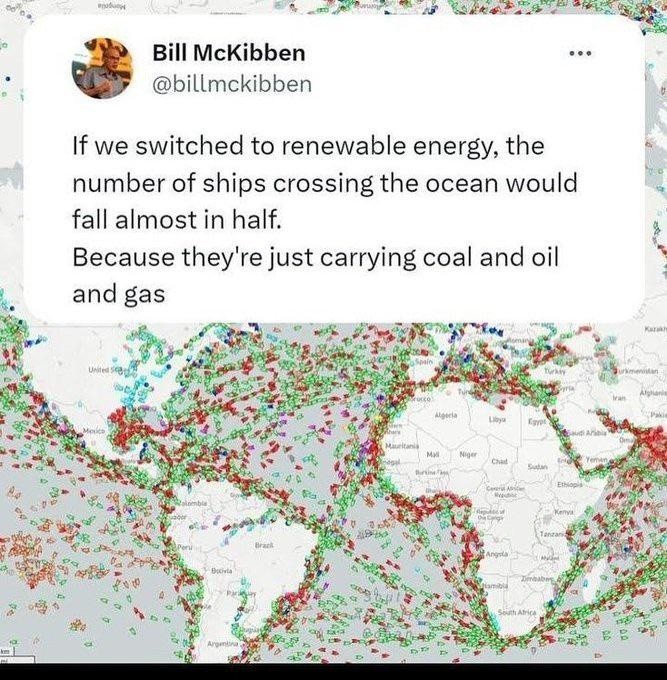
I don’t doubt that it’s a lot, but can anyone provide a source for the 40% of global ship traffic? I couldn’t find any statistics sadly
The data is from UNCTAD
Small clarification. My understanding is that it’s 40% by weight of goods carried, not 40% of ships. So still massive chunk, but not quite the same metric. Also some of those ships would still presumably be needed to move batteries and solar panels, At least for a while until we have enough for a closed loop recycling system (we can recycle like 99% of the lithium from lithium batteries, no idea how emerging sodium batteries will affect things)
Sodium based battery companies are, unfortunately, crashing right now, since lithium production has jumped so significantly that lithium prices have seen a major crash. Since price was the main economic driver for sodium batteries over lithium ones, many companies making sodium batteries are in big trouble right now, since lithium is more energy dense and at price parity
Which is still all due to investors not looking longer than 2 years since all of the crashing companies except Northvolt are startups. Lithium prices will always rise again at a much much higher rate than sodium.
Sodium was always better for grid storage due to temperature charging and discharging and still plenty cheaper than Lithium Iron Phosphate that it is a replacement for.
Also better performance in cold environments which is important to outperform ICE cars.
Lithium is also very abundant. OK, not as much as sodium, but still common.
CATL retooled to sodium and plans to produce both sodium/lithium hybrids and pure sodium packs.
You need to move batteries and panels ONCE per installation, not every time you need energy.
Once per installation per x years. While battery and solar replacement seem like a long time, the massive scale needed for a global buildout will require a continuous stream of shipping. It’s not free and will never be locally produced everywhere. Obviously a couple orders of magnitude less shipping, but energy related shipping is not disappearing entirely.
Actually I’d like to see someone do that math, out of curiosity. In a world with all renewables, does energy related shipping drop from 40% to 1%? 0.1%?
So, for estimation purposes, that’s essentially no shipping compared to the present fossil-fuel situation.
Recycling systems will become absolutely necessary, preferably before the battery boom happens.
You have to show the math for an absolute statement like that.
Do you happen to know how battery or fuel cell ships are doing atm?
There are some, but afaik they weren’t ready for global shipment yet, but more local, due to range.
If you want green cargo shipping, it might be better to look to the past. Way back in the day, all shipping was very green, powered by wind. Maybe we could have a return of sailing ships?
Though, of course, sails do have some big disadvantages, which is why they were replaced in the first place. You’d definitely want an electric (or even fossil fuel) powertrain available to use as a backup or in emergencies. But when winds are favorable, why not set sail and let very green wind energy propel you across the ocean? As an extra bonus, sails are cheap and a very mature, well-understood technology. All you need to do is scale them up.
The biggest difference at the end of the day is that sailing ships are generally slower and require much more crew. So overseas shipping would be slower and possibly more expensive. (Though the massive fuel savings might offset the expense somewhat?) But I don’t necessarily think that slower and more expensive overseas shipping would be such a bad thing in the long run. It would encourage more local production and consumption.
Lol, I didn’t even consider sails.
Perhaps crew could be reduced with some form of automated sails? I dunno most of the terms, but can’t a motor set and unset the sail? Perhaps make the mast retractable and such things.
I forget the article I read about 3 years ago about a modern cargo ship using sails to reduce the amount of fuel they use. Can’t find it now but if I can find it I’ll try and post it in an edit here
I saw some science-entertainment videos. There’s also these rotating “sail” cylinders. Most of it sounded not viable for mass transport and more like PoC or tryout state.
Going back to sails is a cool idea, but I don’t see how it’s viable, nor will batteries be. We’re going to need to settle on some sort of sustainable liquid fuel for a few uses like shipping and aviation.
Maybe this is even some good that can be driven by militaries
It was viable enough in the 1800s.
Yeah … aviation in particular will probably be mainly fossil fuels for a long time to come, because it really needs energy density.
The solution there is just for people to fly less. (Which could be partially accomplished by having fast electric train routes.)
If the only reason oil is being extracted is to power aviation, the cost of fuel, and hence of flying, will be higher and the volume of flights will go down accordingly. Win/win for everyone but the oil and tourist industries.
It was viable in the 1800s because it was the best method available. We don’t use it today because it ultimately costs more. A wind-powered company would have to compete against others using extremely energy-dense fuels that enable hundreds of times more cargo (between increased speed and increased capacity) for the same time and money.
So, in other words, it’s perfectly viable … just not economically viable.
That’s a failure of our economy, not of the technology. Perhaps if all the externalities of fossil fuel emissions were included in the cost of fossil fuel shipping (say, with massive taxes on fossil fuels to fund environmental efforts and carbon capture), that would change the balance.
I’m not sure sail is even viable, as in not compatible with modern capitalism. Most shipping has some sort of schedule or deadline, and you can’t just take an extra month “ because we were becalmed”
Although I was also going to object based on more complex harbors, but that leads right to battery power. Right where all the shipping, all the emissions, all the pollution comes together where it can harm people ……. Why not battery-only, while in harbor?
That’s like saying, “So it’s perfectly possible … just not physically possible.” If you cannot afford to do something, then you can’t do it. It’s freaking tautological.
I didn’t sorry.
China is putting the infrastructure in place internally along their big ass rivers.
That’s what the headline says: 40% of traffic, not 40% of ships.
deleted by creator
Excellent explanation! Thank you :)