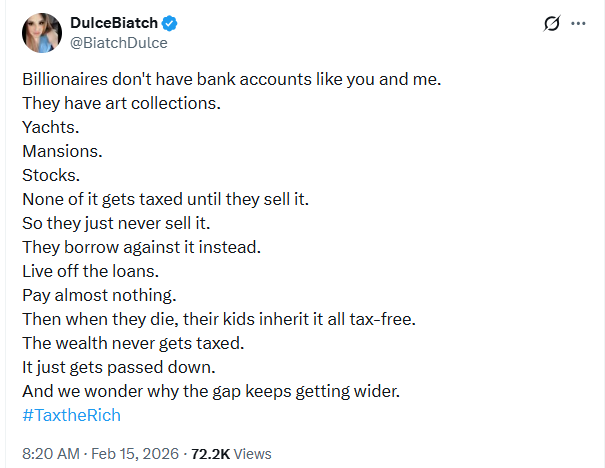
Yup, search for “Buy borrow die” and there are various articles about the technique.
This is basically urban legend at this point; “buy borrow die” is a tiny piece of the ultra-wealthy’s financial strategy, at least when it comes to the “borrow” part, which is what everyone’s focused on:
-
In reality, the ultra wealthy do not borrow against a large fraction of their unsold gains. On average from 2004 to 2022, the top 1% of wealth-holders only borrowed 1-2% of their annual economic income.
-
Borrowing while holding unrealized gains is, in fact, more of a middle-class activity than an ultra-wealthy one: Americans in the 50-90th percentiles borrowed 42% of their unrealized gains in 2022, compared to just 4% for the top 1% of wealth-holders.
-
The primary tax avoidance strategy for the top 1% is not to borrow, but simply not to sell appreciated assets.
On average from 2004 to 2022, the top 1% of wealth-holders only borrowed 1-2% of their annual economic income
What’s confusing to me is that there must be a reason they’re borrowing. When you borrow, you have to pay interest. If you’re someone who has a lot of money, why would you pay someone to lend you money? I guess the only thing that makes sense is that they think that whatever makes them rich, say Amazon shares or something, will go up at a rate that beats the interest rate they have to pay for the loan. OTOH, I guess they’re not so sure of that that they borrow in order to buy even more Amazon shares.
The primary tax avoidance strategy for the top 1% is not to borrow, but simply not to sell appreciated assets
I assume this means “not to sell all of their appreciated assets”, because they do spend a lot of money and it has to come from somewhere.
The reason the rich borrow money is to take advantage of tax loopholes. It’s not about being reasonable or what ought to make sense. They are gaming the system, that’s it. So, how does it work?
If they have investments in the stock market, then they get taxed when they sell those. So even though the investments are usually going up in value, they don’t want to sell too often. But they still need to buy things.
So, where do they get money for living, houses, cars, travel, etc? If they get paid for working a job, their income is taxed a lot, meh. If they sell their stocks, they get taxed a little, meh. But if they get a low-interest loan, that money is not taxed.
And you might say hey, money’s gotta be paid back some day. But remember, the goal is to find the loopholes, the places and times where either you don’t pay tax or you pay much less tax. And those loopholes are all over the place. In the end, the details are just boring. Most financial scams have just enough moving parts to look amazing, but if you take an hour to figure them out, it’s nothing exciting.
The reason the rich borrow money is to take advantage of tax loopholes
Ok, what tax loopholes?
A basic one is negative gearing + trusts + cheap loans.
Negative gearing allows you to deduct/combine different income streams together to reduce your taxable income, and hence tax liability.
Traditionally used by middle/upper middle class to deduct mortgage interest payments and reduce their taxable income.
Rich(er) people combine this with trusts to distribute income/expenses among trust beneficiaries for something more tax advantageous. Usually this is someone like a spouse, child, or extended family member.
Add on the fact that rich people get cheaper loans, which often makes it cheaper to finance day to day life with loans, and only draw down (ie realise capital gains) after shuffling around incomes/expenses for a year.
Tax loopholes are basically legal ways to shift the timing and benefiary of income/expenses. There’s a bunch of other ones, like
- choice of depreciation calculation
- purchasing things on behalf of a “trust” or “company”
- getting paid in low tax jurisdictions
- moving money into tax advantageous retirement accounts
None of that explains anything for wealth levels we’re talking about. Negative gearing implies a loss elsewhere, trusts max out at the same rate as all other inheritance they just avoid probate, retirement maxes out way earlier than what they have.
Nope, they definitely do. The specific assets and schemes differ across wealth levels and also across time as laws change, but the general principles of finding and exploiting loopholes remain the same.
The middle class negatively gears property despite the property gaining in capital terms. The ultra wealthy negatively gears sports teams despite the team gaining in capital terms.
The middle class deducts fancy electronics and cars as “hobbies”. The ultra wealthy deducts entire luxury hotels and horse racing clubs as “hobbies”.
The middle class stuffs income into retirement accounts. The ultra wealthy stuffs assets, which are way more fungible in value, into retirement accounts.
The Secret IRS Files Archives — ProPublica - https://www.propublica.org/series/the-secret-irs-files
Ten Ways Billionaires Avoid Taxes on an Epic Scale — ProPublica - https://www.propublica.org/article/billionaires-tax-avoidance-techniques-irs-files
More Than Half of America’s 100 Richest People Exploit Special Trusts to Avoid Estate Taxes — ProPublica - https://www.propublica.org/article/more-than-half-of-americas-100-richest-people-exploit-special-trusts-to-avoid-estate-taxes
Businesses. I’ve seen ‘the back end’ of an upper middle class family with a business, and the ways the mother (the tax genius of the scheme) moved money around and labeled various things as expenses for businesses was wild. None of it was illegal, it just was clearly not the intended purpose of the tax laws. One example I clearly remember was sticking five cattle on each of the properties they purchased, and all taxes just disappeared (went from thousands of dollars to just… dollars) due to agricultural exemptions. All of the cattle and their care suddenly became expenses, because the labor they hired to care for them was somehow completely deductible or expensable or however the law looked at it, which allowed them to shuffle money from another business to make it look negative…
and so on and so forth. I think they had more than four businesses that were legally separate (and incorporated, with the board being family members [and those family members are part of a trust that let even more shenanigans happen]) but supported the way money was shuffled. This was for a family that, at most, made ~ $500,000. Super high, above that 1% mark, but not even close to the insanity that the truly wealthy can pull off. Anything business related opens up an exponential number of ways to move money, even while using it, compared to the options a casual income-only tax-payer has.
As much as we can point at ‘Trump, dumb’ and tell ourselves that the rich are stupid but lucky, the majority are not at his level. They hire (multiple) people making six figures to manage their money because that investment pays off.
I cant blame them, honestly. And I think 99.99% of poor people would use the same strategies if they could. This is not about being morally superior, its about finding ways to keep your money. And this is something everyone is interested in.
Unfortunately only the rich can use this strategy in practice, but we all would if we could.
Neat doc, thanks for linking. I find this part very sensible in light of what you brought up
In most cases, the ultra wealthy don’t need to borrow, because their liquid, taxable income—salaries, business income, and capital gains—is significantly higher than their annual consumption.
That makes sense… I mean once you’re somehow generating millions or more every year in income, no need to borrow at all really. It’s making it to that upper tier of income vs. expenses that few reach.
Tax the Rich, the Old Fashioned Way: Raise Rates
That’s the key thing.
-
The oligarchs in the US are the utlimate power behind the destruction of our democracy. They have stolen the wealth from us for decades. And yet so many of our citizens defend them because they might be rich one day. Which they won’t. Because the ultrarich already there won’t let them.
Guillotines are long overdue.
We don’t wonder anything. If you were wondering, you never bothered to think about it for more than three minutes.
And your comment has what to do with mine?
There actually is an estate tax after death:
https://www.irs.gov/businesses/small-businesses-self-employed/estate-tax
Right now it only kicks in after 15 million. A decade ago it was still 5 million. But it doubles to 30 million for a couple.
For the really wealthy people, they need to pay to obfuscate the rest of the money thru trusts and offshore banking, which they’d rather not to pay to do.
Which is why they’re still pushing to raise the cap every year.
They donate it all to charities…. Charities they set up with their relatives on the boards of trustees, who then get paid salaries from the charity’s endowment.
No they don’t. You cannot buy yourself what they have with charity money. That’s just the influence part.
“The rich pay nintey-”
“They can pay fucken 100 percent, I dont give a shit. You want to be a world pillar? Here you go.”One word: Land value tax.
Every time I see a post like this I am disappointed that NO ONE mentions Henry George.
People, please, go educate yourself. Taxes were solved before ww1.
Technically three words.
I’m german speaking. So for me, this is one word ;)
Fun fact, in German the entire Bible is just one word!
deleted by creator
We Swedes can get in on the verylongcompoundword fun too
Why’s that? You stated your opinion knowing that many people are ignorant of it, but failed to back it up. Why should we research your idea when we have ideas of our own? Don’t suggest we’re ignorant if you’re not willing to take the first step in educating us. Your contempt feels good but doesn’t solve any problems. Ciao
I feel you and I’m glad you asked. The goal of my comment is to invoke interest so one can go down the rabbithole on ones own terms. This has a much more sustainable effect than just serving information on a boilerplate nobody asked for. Much like a catchy title/thumbnail on a yt video generates clicks, but the actual information does not.
There are a lot of resources about LVT out there including some educational videos in an entertainning way. Pick your own poison: https://www.youtube.com/results?search_query=georgism
My Standpoint: Our present tax system is bad (almost worldwide): Tax based on value generated (like income, sales and import taxes) costs society a lot (real costs but also opportunity costs) while simultaniously not solving a lot of todays issues (f.e. tax evasion, old money, zone planning / car centric design, pollution, etc.). Land Value Tax (or more precicely: Resource Tax) solves this by getting rid of the penalty for being productive or creating value while simultaniously taxing those being exponantionally wasteful with resources and/or pollute.
With LVT, there is now a penalty free incentive to increase profits and/or efficiency. On the other hand, if you consume and/or occupy resources like land, oil or air pollution, you’ll have to pay tax for that derived from the resources scarcity. The sum of the tax would be similar or higher than todays sum and would finance all government spending including a citizens dividend which could be interpreted today as unconditional basic income which would provide for basic human needs.
Georgism is PRO Economy and PRO Humanity. Win Win. Regardless of your political flavor, you should be in favor 😏
Winners: Society, everyone from poor to rich, resourceful entrepreneurs
Losers: old money, polluters, unrighteous beneficiaries of today’s flawed legal situation
That’s a great pitch, thank you, I’m sold. appreciate the work
I worked for 5 years to promote LVT.
In real life it’s far more complex to administer than a straight property tax, that’s why it will never be popular. It also creates bizarre outcomes where where it rewards some land uses and punishes others and creates weird incentives about land topology and parcelization.
Who is going to assess the value of the land as distinct from improvements? Geologists? Environmentalists? Different parents will presume different values and push those values. Property taxes are assumed basically based on other similar properties on the market, in terms of size, age, and space. But 2 parcels of 2 acre right next to each other could be radically different values depending in there topology and environments. I lived on a 2 acre parcel once, and our neighbors had 1/4 acre plots, but our 2 acres was mostly swampy low lying land that was not adjacent to the part the land our house was on that was regular. It was also weirdly shaped and the ‘access’ to it was a narrow 10ft corridor. It was essentially… useless land attached to our parcel, we couldn’t even develop it because in order to clear it you’d have to get permission form your neighbor to drive construction equipment across their driveway/lawn and destroy it. The extra ‘land’ in our case added 0 value to our property and in fact removed value, as houses around us were often selling for more due to the extra liability our extra land came with.
It introduces just as many problems as it those it claims to solve. It makes sense in some limited contexts, like say, urban land use across small and regular parcels, but not all land is urban land.
You forget that George was writing when society 70% agricultural and rural and working off a model of undeveloped land. in 2026 only 17% of the USA population lives outside of cities.
Finally a fellow georgist. How does one work to promote LVT? You mean you got paid to do it and despite that, you are now against georgism?
IMHO, your reasoning is weird and blown out of proportion. Measuring value of land and housing is easy and is done today for the market, for insurance and for taxing purposes. This could be a reason for georgism to become unpopular, but it isn’t a reason against georgism.
in our case added 0 value to our property and in fact removed value
The common reasoning with negative value land. This is only brought up because it is an issue in todays world. It wouldn’t even be an issue with an LVT. If a strip of land is only costing money, just give it back to the Gov so they need to take care for it, you’re not a charity. Otherwise it has a measurable value which you are denying to win an argument.
It introduces just as many problems as it those it claims to solve.
No it doesn’t. I see one “Problem” LVT doesn’t solve, but you haven’t mentioned this one yet.
It makes sense in some limited contexts, like say, urban land use across small and regular parcels, but not all land is urban land. You forget that George was writing when society 70% agricultural and rural and working off a model of undeveloped land.
This is not valid. George focused on New York. It did include everything from agriculture to fully developed Manhattan. It’s called Land Value Tax, not Land Tax.
No, i actually worked with economists, lawyers, and assessors on research projects. And everyone of them loved LVT in theory, but in practice sucked balls. Again and again, the research showed poor and awful outcomes when the direct implementation of the tax was studied and various municipalities that have tried it have totally and utterly failed and gone back to a property tax due, largely due to the overwhelming overhead costs involved with assessing and administering a LVT.
There is a huge gulf between theory and practice. Georgists sit around all day and theorize and idealize but never actually go into the trenches of tax law, tax policy, and tax enforcement.
Very interesting. Do you have any sources to share so I can read into that?
Also, I believe there are 2x publicly known sources for LVT being applied on a wide scale: Alaska and Singapore. Both are very successful and comfortably perform far above average compared to other US states / other countries. This somewhat directly contradicts your statements. So maybe your experience is not representative for LVT’s performance, but rather your specific execution of it.
Just to be clear, LVT is just one form of resource tax. Actually all resource use including pollution and oil extraction etc. fall under my understanding of georgism.
No. It was 20 years ago but people I worked with included Karl Case. The guy who founded the housing index. You can go find your own search for the 100s of papers on the topic. In my 5 years working there I probably saw 30+ papers published relating to it. All the work was in the continental USA.
And I have no doubt it works in Singapore, because it’s a city-state. Just like I said in another comment it works great in the context of small regularized parcels of land. Singapore also has super restrictive laws about land ownership. But you can’t generalize that to the whole of the USA, let alone most USA cities/states due to the massive geological differences.
And yes, in theory if you just abolished all existing laws and land rights and property values and just divided up the entire USA into 1 acre square parcels, it would make sense to use a LVT. But again that’s an ideal theory that in no way will ever become reflecting of reality. Land ownership and use and regulations are highly irregular in America and often subject to 4-5+ levels of government regulation.
Georgism is an ideology.
They think the LVT will solve all social problems ever. That’s the premise of the book he wrote about it.
He’s basically like Marx, but instead of communal ownership of production he thinks taxing land value will solve all society’s problems. Like communists, Georgists think if you just read this book and BELIEVE poverty will disappear.
The LVT has a lot of merits, but it has lots of drawbacks. It’s difficult to value land as district from property, for one. It would also be highly inaccurate in the case of mineral rights and other factors.
Your comment doesn’t have any value.
let me use it for capitalism:
Capitalism is an ideology.
They think the market will solve all problems ever.
He’s basically like Marx, but instead of charging for the use of something, he thinks taxing work and output will solve all society’s problems. Like communists, Capitalists think if you just understand economy and BELIEVE poverty will disappear.
Capitalism has a lot of merits, but it has lots of drawbacks. It’s difficult to punish someone for working, for one. It would also be highly inaccurate in the case of different amount of use of resources.
That’s true of all ideologies, they are ideal theories that have no basis in reality.
Reality is a mix of various ideological systems and beliefs interacting with each other.
This doesn’t make any sense. How are the loans getting paid back?
This is the process, extremely simplified:
- It’s 1970. You inherit $10M from your rich dad who worked hard.
- Buy $10M index fund stock.
- Borrow $10M against stock.
- Live tax free off that $10M loan for 30 years (you can do that because you started in 1970 when it was cheap to buy a house).
- Your stock is now worth $58M (avg 6% per year for 30 years)
- Your kids inherit the stock at its current value and immediately sell $10M worth to pay off original loan. They pay no capital gains tax because the stock barely moved in the time between when they took ownership and selling it. All of the value growth since original purchase in 1970 is now tax free. The kids now start with $48M.
- Repeat
Obviously, there is more to it than this. For example, this does not account for interest in the loan, or diversification of investments, or ability to hire accountants to maximize on the process.
Your kids inherit the stock at its current value and immediately sell $10M worth to pay off original loan
And the bank says “um, what about the rest?” In the 1970s and early 80s the inflation rate was, at times, above 10%, so your loan’s interest rate would have been above that. But say on average the loan’s interest rate was 5% per year over 30 years… the bank isn’t going to be content for just the original $10M.
All that matters is that your portfolio grows faster than the interest rate.
That’s what success looks like. But, you don’t know if you’re going to be successful when you take out the loan. If there’s a market downturn you’re on the hook for the loan and your portfolio has crashed. If you sold a few stocks instead of taking out a loan, you’re insulated from that possibility.
You think they’re giving out low rate 30-50 year rolling personal loans in the tens or hundreds of millions of dollars range? This I find hard to believe. The premise makes sense, but I don’t think these loans usually exist.
You might find it hard to believe, but nevertheless it is true. These are considered to be extremely safe loans, so they give out sweetheart rates to get them.
It’s actually a real thing.
Since taxes are paid when an asset is sold, not when it goes up in value, your net worth goes up with no tax liability change. When you die, the purchase price for tax purposes resets. Now the inheritor sells the assets. Since the sale price is essentially the same as the taxation price, there’s no taxes.
You’re borrowing today’s money against tomorrow’s value and taking the difference out of your death messing with taxes to free up the value.
From a financial perspective the time horizon for return doesn’t matter, only that the return is balanced against the time. From that perspective, the people giving the loan have no reason to really care since it makes them look good and they’ll at least not be working there when and if it goes wrong.They get a painting worth 10K, get a loan for that, then get it appraised for 30K, get a loan on that from somewhere else and pay off the other one. That’s one idea.
The second is they like assets that provide passive income and appreciate. You’ll find a lot get into land as well and rental units.
For the individual wealthy, they aren’t. Some loans might get paid off by taking another loan, but the goal is to take the loan to the grave. The loan would get paid after death because then the estate can sell the stocks without paying any capital gains tax.
Let’s say you buy 1 million worth of stocks. The day before you die that stock is worth 51 million. If you cash out that stock you’re paying capital gains tax on 50 million. Let’s say the capital gains tax is 20% which means you’d pay 10 mil in taxes. So you get 41 million from the sale. Let’s say the loan is exactly 41 million so to pay off the loan you get nothing.
But if you die and that stock goes to the estate they haven’t gained any capital from the stock so when they sell it they pay no tax on it. The estate then sells the stock tax free to pay off whatever debt there was (the estate sells only 41 million worth of stocks keeping the 10 million on stocks). That 10 million is effectively free money that goes to the inheritor.
Basically it’s all just tax evasion for the ultrawealthy. Except it’s legal so technically it’s not tax evasion. And realistically the numbers are even more astronomical than what I used as an example.
Look, the rich people wrote the laws. You think they didn’t leave loopholes for themselves? … Tax law doesn’t have to make sense.
Since the 1970s governments have been continually printing more money. This means that if you can get a low enough interest loan (i.e. by having a ton of money already so that you’re low risk), the money you owe will devalue faster than interest accrues. You just keep doing that, and/or use it to invest.
the stocks pay dividends,
Ancap (ie, right wing) friend sent me this off shitter:
Unrealized gains tax for Gen-Z:
You buy a Pokémon card for $50.
Someone offers you $500 for it. You say no. You love that card. You’re keeping it.
The government says: “Cool, but that card is worth $500 now. You owe us $100 in taxes.” You: “…I didn’t sell it.”
Government: “Don’t care. Pay up.”
You don’t have $100 lying around. So you’re forced to sell the card you love just to pay a tax on money you never received.
Next month? That card drops back to $50.
Your card is gone. Your money is gone. And the government shrugs.
That’s a wealth tax on unrealized gains. They don’t pay you back the tax…
Now picture this.
Your mom calls you crying. She has to sell the house she raised you in. Not because she can’t afford it. She’s lived there 30 years. It’s paid off.
But some website says it’s worth more now and the government says she owes $15,000 she doesn’t have.
So she sells your childhood home. The kitchen where she made you breakfast. The doorframe where she marked your height every birthday.
Gone.
To pay a tax on money that was never real.
Now picture the opposite.
Your dad put everything into his small business. For 20 years he built it from nothing. One year the business is “valued” at $2 million on paper. He owes a massive tax bill. He empties his savings. Sells his truck. Borrows money. Pays it.
Next year the market crashes. His business is worth $200,000.
He lost everything to pay a tax on a number that doesn’t exist anymore.
Does the government give him his money back? No.
Does the government give him his truck back? No.
Does the government care? No.
They sold this idea as “taxing billionaires.” But billionaires have armies of lawyers, offshore accounts, and trusts. They’ll be fine.
You know who won’t be fine? Your mom. Your dad. Your neighbor with a small business. The farmer down the road who’s had the same land for four generations and now has to sell it because dirt got expensive.
You’re not taxing wealth. You’re taxing people for owning things.
It’s like getting a parking ticket for a car you might drive somewhere someday.
They want you to own nothing and be happy. To fund the fraud, waste and abuse of the welfare state they created.
There is enough money. More tax isn’t needed. It’s all a lie. But you’ve been gaslit into believing this is a rich vs poor debate.
I hope you understand what’s at stake.
I pretty much instantly shut that down by saying “THEN MAKE THE FUCKING LAW FORBID THE BILLIONAIRES FROM SIDE STEPPING IT! THAT IS THE PROBLEM! IT IS A RICH VS POOR DEBATE YOU IDIOT!!!”
People are idiots.
The ways this is idiotic:
- “The government says: “Cool, but that card is worth $500 now. You owe us $100 in taxes.” You: “…I didn’t sell it.””
There is currently no tax on unrealized gains. If there ever were, it wouldn’t be 20%. It would be something tiny like 1-2%. It’s a wealth tax. Wealth taxes are tiny compared to income taxes precisely because they’re taxing something you’re holding and will still have next year if nothing changes.
- “Next month? That card drops back to $50.”
Why does it “drop back to $50”? OP said that the $500 value was because someone offered that much for it. Did that person no longer want to buy it? It’s true that sometimes the value of things is fluid, which can make wealth taxes hard. But a 90% drop in value over the course of a month? Let’s be realistic.
- “Your mom calls you crying. She has to sell the house she raised you in. Not because she can’t afford it. She’s lived there 30 years. It’s paid off.”
Yes, housing taxes are wealth taxes. Sometimes when the place you lived in appreciates enough, the property taxes go up a lot. So yes, sometimes people do have to move when their properties go up so much they can no longer afford the property taxes. But, when that happens they get to sell the place, and if the property taxes are so much that the person can no longer afford them, that means that the property is worth a fortune. The property tax is often 2% or below. So, if mom owes $15,000 in property taxes, that means her property is worth at least $750,000, probably actually more than $1M. Cha ching! She can buy a nice, smaller place now that she doesn’t need to raise kids, and use the rest to go on some nice vacations.
Yeah, it sucks if you have an emotional attachment to a place you can no longer afford. But, there are plenty of people who can’t afford to buy a house at all, who weren’t even allowed to mark their kids’ heights every birthday because they were renting. Wealth taxes are a way to even things out. Property taxes are a pretty shitty form of wealth taxes because they hit the middle class harder than the ultra rich, but people who don’t own property don’t pay property taxes, which is good.
- “Next year the market crashes. His business is worth $200,000.”
Man, this guy can’t catch a break, all his relatives have everything crash 90% in value immediately after having to pay a tax bill they can’t afford, despite wealth taxes being tiny amounts.
In addition, most of the time wealth taxes have a threshold exactly for this kind of reason. If someone owns a $2m business in a place with wealth taxes, they may pay nothing because the first $5m is exempt.
Yes, sometimes wealth taxes are more painful to upper middle class or the moderately rich because they don’t have the armies of lawyers and accountants who can find the best strategy to minimize their taxes. But, the answer isn’t to scrap wealth taxes entirely. It’s to accept that even the moderately wealthy should pay more than people who own almost nothing, and to properly fund the tax authorities and financial crimes divisions of the cops so they can go after the ultra rich when they illegally avoid taxes.
If you got 500$ - 100$ in tax for the card and it drops back to 50$, you can just buy it back with 400$ you still have left…
And a wealth tax and inheritance tax usually have a cut before you even have to pay any tax. Got granny’s house worth 500k? No problem. Get a building complex worth millions? Pay your damn taxes. I’m sure the state will accept a payout over time if you can’t afford to pay it at once.
If you got 500$ - 100$ in tax for the card and it drops back to 50$, you can just buy it back with 400$ you still have left…
They’re talking about a wealth tax where you have to pay $100 even though you never sold the card. (But it’s double bullshit because something as small as $500 is never going to face a wealth tax, and $100 (20%) is a way higher tax rate than anybody would pay.
They said they were forced to sell the card due taxes
Ah, good point. So, you’re right. It goes from a sad scenario where you have to sell your $500 card to pay an absurd $100 wealth tax, to a happy one where you end up with $350 plus your favourite card just one month later.
The Pokémon card example is ludicrous - aside from the fact that CCG cards are not “wealth”, or the fact that no one would offer $500 for a card that is only worth $50, a single buyer does not make a market or set the value. Stocks, the source of most outrageous wealth, by definition have a market value, and even the most frothy of assets don’t swing 10x in such a short period of time.
The mom calling about selling the childhood home is very real, in fact it already happens! Guess your friend is unfamiliar with property taxes. My home has tripled in value and the government appraised value went up by a smaller amount, and now I pay taxes. When my mortgage is fully paid off, I will still owe the local government taxes every year. All those “tax free” states lean on regressive taxes like sales tax and property taxes to avoid collecting progressive income taxes, so this problem is even worse in those states.
A while back I owned a small business, and because I didn’t pay myself in stock, I had to pay taxes every year based on how much my company profited. My business partner and I would do a distribution every year to pay those taxes. We paid more every year in taxes on our modest business than Tesla paid last year on $5.7B in income. Also, company “worth” for private businesses is based on appreciated assets and cash on hand… a business owner who “lost” 90% of the business value of a two decade old business in a year has much, much bigger problems than unrealized gains taxes.
Middle class people are already paying wealth taxes. Mutual funds are taxed on unrealized gains all the time, albeit at capital gains rates (because we value capital more than labor). Property taxes are paid on the biggest source of wealth most people own. Even poor people are paying annual taxes or fees on their cars.
I agree, your friend is a moron, but I think most people knew that the second they saw “ancap”.
Property taxes are regressive, but having state income taxes doesn’t preclude them, the states just spend the extra money. Here some cities have income taxes, the state, and the feds. And counties do property taxes through the township levels. The state will spend every penny they can get their grasping hands on, currently for pet projects of lawmakers and tax breaks and incentives and money spent to improve locations to lure big business to set up here.
While the small business both parties pretend to care about like yourself pay through the nose, that money is taken from us and handed to the richest companies in the world to set up here without paying those same taxes.
It’s all about leverage, and alone we have none. It’s never been more clear we need to organize, on our own forums, around what we agree on, no matter what we disagree on. On existing social media we are simply turned against each other on issues, oh that person from the other side that rejected their party and came over to our side? They once said this and still say that so fuck them they aren’t pure, even as the people making those arguments originally are the biggest pieces of shit in the world.
Social media is rigged, we need our own forums set up to not be rigged, to not be hooked by government and big business, and providing clear rules enforced fairly. Federated sites on general forums allowing people to cooperate publicly and privately as they see fit, and move between social medias on the same account. Where violations can be appealed all the way to a jury trial of members to prevent the rich, government, and moderators perverting it or abusing their power.
Would making the law kick in after a certain amount of net worth be the answer in that situation?
It’s almost like we have that exact system in place for income.
It’s just a shame that it’s completely backwards with those making less money paying a higher % of their money than those with more money.
Not likely. First of all, the net worth numbers you see for these ultra-wealthy people are all educated guesses. To actually legally impose anything based on total net worth, you need to actually audit net worth and get a real figure. The resources it would take to do this are very unlikely to yield more tax revenue than they cost, especially because there is so much one can possess whose value is pretty much completely arbitrary (the high-end artwork, etc.).
It’s actually all-but-certain it’d be a net loss of tax revenue. There is a reason that every time such a policy targeting only the wealthiest is put into place (it’s been tried numerous times over the years in a bunch of European countries), it’s gotten rid of soon thereafter, or ‘dialed down’ to be just another ‘mundane’ tax that falls primarily into the lap of the middle class.
To actually legally impose anything based on total net worth, you need to actually audit net worth and get a real figure.
So, what’s wrong with that? You have a wealth tax on all wealth over $100 million. If you have wealth anywhere over say, $50 million, you hire an accountant to assess your business’s value. Everyone with that level of wealth already hires accountants. It’s a trivial additional burden. If your wealth is no where near the tax threshold, you don’t need to bother hiring an accountant to get a precise figure.
There is a reason that every time such a policy targeting only the wealthiest is put into place (it’s been tried numerous times over the years in a bunch of European countries)
I’m calling bullshit on this. There are all sorts of taxes that fall heavily or solely on the wealthy. The reason the wealthy don’t all leave is that they don’t actually want to live in places that have low taxes. You can get low taxes in a war-torn hellhole, but most don’t actually want to live like that.
If you have wealth anywhere over say, $50 million, you hire an accountant to assess your business’s value.
‘Oh, our accountant says the valuation is just under the threshold for the new tax, what a coincidence!’
It is trivially easy to shift assets around in such a way that having a net worth threshold for a given tax is basically a guarantee that no one will pay it. Many countries have tried this already, and failed. Why repeat their mistakes, instead of learning from them?
We need to remember that people, and especially the ultra-wealthy, are not inert blocks of wood that don’t react to policy changes like these.
I’m calling bullshit on this. There are all sorts of taxes that fall heavily or solely on the wealthy.
Firstly, I said “only the wealthiest”, so don’t already start nudging those goalposts by “calling bullshit” and immediately tweaking it to “heavily or solely”. Secondly, if there are so many, name three.
‘Oh, our accountant says the valuation is just under the threshold for the new tax, what a coincidence!’
Well that’s your risk to take. No different than if you cook your books now and claim lower income than you actually have. We don’t throw up our hands and conclude we can’t tax the wealthy. Maybe we need to seriously reform corporate charter law, and do things like prohibit corporations from themselves owning subsidiary companies. Reforms like that could prevent a lot of tax-dodging shenanigans.
So, what’s wrong with that? You have a wealth tax on all wealth over $100 million. If you have wealth anywhere over say, $50 million, you hire an accountant to assess your business’s value. Everyone with that level of wealth already hires accountants. It’s a trivial additional burden. If your wealth is no where near the tax threshold, you don’t need to bother hiring an accountant to get a precise figure.
And I’m going to say, it’s a great means to go after the assholes if they try to claim their assets are worth something different. I think we have a recent case of 34 felonies about that…
Do you consider Switzerland to be a European country. It has had forms of wealth tax for centuries, and the current tax generates roughly 4% of Switzerland’s total revenue. It seems to work just fine there.
Switzerland’s wealth taxes, depending on area (there is no country-wide wealth tax) starts at the equivalent of ~$100,000 on average, putting it very squarely in the
‘dialed down’ to be just another ‘mundane’ tax that falls primarily into the lap of the middle class.
category I mentioned before. That is absolutely not a tax aimed exclusively at the ultra-wealthy.
Accepting your premise as true, that still doesn’t make the tax valueless. The real value in a wealth tax is breaking up the money from individuals, the revenue is just a bonus. Even if it is all used to pay the accountants, that’s still money that’s now actually moving through the economy rather than zombie wealth sitting in some rich fuck’s paws, doing nothing but contribute to inflation.
The real value in a wealth tax is breaking up the money from individuals, the revenue is just a bonus.
And the mask comes off, revealing the true motivation. You’d happily waste the taxpayer money that is the poor’s lifeline in many cases, reducing overall tax revenue, because hurting the rich matters more to you than helping the poor.
money that’s now actually moving through the economy zombie wealth sitting in some rich fuck’s paws, doing nothing but contribute to inflation.
- Net worth is a valuation, a price tag on something that’s already been transacted on, how could it possibly contribute to inflation? What nonsense.
- The ultra-wealthy don’t have Scrooge McDuck vaults full of cash, their wealth consists of investments in businesses that run within the economy.
Taxes in the US are overwhelmingly used for the military and to enrich rich fucks, not to help the poor. Don’t be disingenuous. Rich fucks sitting on assets aren’t “not hurting anyone”. Their assets have real world value, that’s why they’re valued like that. By letting someone sit on them to “allow them to appreciate” is letting someone doing nothing accumulate the wealth gains of society that we all work for. Because those assets appreciate faster than inflation, they create inflation pressure as more asseted people have income to burn that doesn’t reflect actual economic movement. Decreasing the value of money that other people need to use to buy things to live.
No one lives in a vacuum and letting people hoard assets has a negative impact on everyone else. So yes, wealth redistribution is a net positive not because “it punishes rich people” but because it allows our money to better reflect who actually produces the value in society. The workers who do the labor of running everything, rather than rich fucks who normally reap all the monetary benefit of that with almost no actual contribution to the effort it required.
If everyone became a laborer with proper compensation, society would thrive. If everyone became an asset hoarder, society would break apart as there would be no one to operate the machinery of society. Increased wealth inequality pushes us towards the second scenario(asset ownership is rewarded over value producing behaviors, pushing individuals towards more asset accumulation in order to not be left behind, increasing the price of those assets, devaluing other ways of earning money, creating more pressure to own assets), reducing wealth inequality pushes us towards the first.
Taxes in the US are overwhelmingly used for the military
“Overwhelmingly” is a bit of a ridiculous way to describe 13% of the budget, don’t you think?
and to enrich rich fucks
Cite a figure for this nebulous category, if you can.
not to help the poor.
Actually, welfare spending is barely less than military spending, at 11.8% of the budget.
By letting someone sit on them to “allow them to appreciate” is letting someone doing nothing accumulate the wealth gains of society that we all work for.
The same can be said of anyone who owns a house. There is nothing wrong with a thing you already own becoming more valuable to others.
Because those assets appreciate faster than inflation, they create inflation pressure as more asseted people have income to burn that doesn’t reflect actual economic movement. Decreasing the value of money that other people need to use to buy things to live.
This is a very confused couple of statements; most egregiously, you’re conflating asset price inflation with consumer price inflation, and only the latter has a direct effect on the working class.
The ultra-wealthy have a low ‘marginal propensity to consume’. If Jeff Bezos gains $10 billion on paper, he does not spend $10B on consumption goods; most gains remain invested. Appreciation alone does not automatically translate into CPI inflation, because unrealized gains are not income.
No one lives in a vacuum and letting people hoard assets has a negative impact on everyone else.
It’s objectively nonsensical to refer to the notion of purchasing something, and its market value increasing while you merely continue to own it, as “hoarding”. Not to mention, again, that net worth is a valuation, a price tag. It is not money. Stop acting like when the price of a stock goes up, that amount of cash money is magically vacuumed out of the wallets of the working class.
If everyone became a laborer with proper compensation, society would thrive.
People want to be able to own things (aka assets), though.
If everyone became an asset hoarder
Ownership isn’t hoarding.
society would break apart as there would be no one to operate the machinery of society.
Except this literally cannot ever happen because the demand created by the market is the whole reason those assets appreciate in value in the first place. It’s a self-correcting issue: if too many people try to just ‘own assets’, the demand will drop, and said assets’ value will start depreciating, incentivizing those people back in the other direction, to laboring.
…increasing the price of those assets, devaluing other ways of earning money
Asset appreciation is not income, stop equivocating the two.
reducing wealth inequality pushes us towards the first.
Not necessarily; it’s entirely possible for everyone to have identical wealth, and also all be poor. In fact, that was the default state of humanity for the vast majority of its history.
Start taxing 20% from $1B+ and I think 99.999999% of us are fine.
Historically, taxing the ultra-rich at 90% or 95% has not stopped them from staying rich, and it also helped everyone else get more social services.
When the US was at the height of prosperity, when the working class had the highest standard of living, and disposable income, the highest ever in history of any working class hands down, in the 1950s, and until the 1970s when it declined precipitously in the late 70s, obscene incomes were taxed at 90 percent. The first so much was taxed at lower rates, above a certain amount the rest at 90%.
The majority of taxes came from businesses too, 90%, today it’s flipped and 90% is individuals.
Whatever problems existed in those decades, a minimum wage job paid for a family, bought a house, a cheap car, health care, food, incidentals, going out for a burger even. Just one of them. And that is the issue people care most about, having enough money to live with dignity.
People argue that isnt why America was prosperous. " ACKSHUALLY We were prosperous during that period because we destroyed the other countries ability to produce."
I don’t believe that myself, those idiots are billionaire apologists.
A wealth tax wouldn’t apply to normal people below an obscene threshold. And you wouldn’t tax a primary residence at all, as is already the case with our tax code on near every score. You wouldn’t tax a baseball card collection.
But if a person put a bunch of paypal stock into an IRA account, and it turned into 5 billion dollars later, you would find a way to tax most all of that. If bezos’ worth increased by billions, then a portion above an obscene level would be taxed, often exempting the first so much then graduating higher levels, as is customary in taxation here.
You are excusing the super rich from taxes by associating it with hypothetical unfair taxations against normal people for smaller amounts. Which is the same way they got rid of the estate tax, by lying about who paid the estate tax, claiming family farms and small business paid it, when it was only obscenely rich people that paid it.
Now, no one pays it. An heiress just inherited 200 million on her 19th birthday or something, not the entire estate just a piece of it, without paying a dime in tax, thanks to the dishonest arguments mirroring the ones you made on this in the first half of your piece at least.
Bezos paid 600 dollars in 2020, a year his net worth skyrocketed, and where he spent an incredible amount of money he got without getting a paycheck. He paid less in taxes than we do, not just per capita, total. He claimed the child tax credit. When your net worth increases by millions above millions, it needs to be taxed, whether it’s when they borrow against the value of that which is where they now realize much of their income that is tax free now, or whether it’s regardless of it being realized.
If the value they were taxed on an increased price of an asset fell later, they would be able to subtract that back 3 years and forward ten years to offset other taxable income, that’s the way it’s already set up, itself quite unfair as working people get no such consideration to only pay taxes on profits, which would be akin to only paying taxes on wages after paying all of your core bills.
In 1950, the majority of taxes, like 90 percent, came from businesses, now 90 percent is ripped from working people, and the richer they are, the less they pay above a certain threshold, something has to change.
The whole reason the right wants to abolish the “welfare state” is to have a pipeline of poor and hungry children to sell as sex slaves.
Anybody who complains about “the welfare state” just wants cheaper access to child sex slaves.
Change my mind.
Yeah. My parents moved into the country because their house value got too high and they were being taxed to death because of all the people that moved into my hometown making property values skyrocket.
Then other people started moving into the area, and now the value of their place has skyrocketed, and they’re gonna have to sell again because they’re being taxed to death because other people moved into the area.
There’s this massive movement of retirement people from place to place because every time they move somewhere to reduce their tax burden the values go up again.
I’m 100% for capping the taxable value of land for primary homes based on the value at the time of purchase plus inflation. The whole idea of a homestead is to improve land, and
“Boo Hoo, my assets keep going up in value so much that I keep having to cash out!”
No. They keep having to move away from their homes and get new loans at higher rates.
They’ve never been able to pay off a home because they keep having to do new mortgages.
Your parents just suck at personal finance. They used their home as a piggy bank and raided the equity every time they moved. Either that or they kept buying more expensive properties.
I’m sorry, but your story is just not credible. If they owned a house in the city, and then the value soared, they should have been able to take their windfall, move out to the country, and buy a cheap property in cash. The only way this isn’t true is if they either did a lot of cash-out refinancing, or if when they moved to the countryside, they bought a much larger property.
You’re supposed to use equity towards a new home when interest rates are higher than retirement returns.
The property was cheap (about an acre for 40,000), but then they had to put a house on it. They were living in an RV that came with the property due a few months while the house was being built.
Covid hit in the lag between when their old house sold and the new one was ordered, so the cost of building the new house was double what was expected, so instead of buying cash their remaining equity was wiped out and they ended up with a loan. But it was still cheaper than their old house because of taxes.
But after the new, smaller house was finished, a neighboring property was also bought and a multi-million dollar mansion was placed on it. And then another.
And then the county and school district raised the tax rate for everyone while also quintupling the assessed value of the land. There’s a circuit breaker law, so it can only go up 10% a year, but even that’s unsustainable for people on a fixed income.
The vast majority of states have some level of control on the increase in property taxes. Generally through a cap on appreciation, cap on tax increase, or both.
This is why we need a wealth tax.
Henry Ford said, “It is well enough that people of the nation do not understand our banking and monetary system, for if they did, I believe there would be a revolution before tomorrow morning.”
In France, the ministry of Economics just announced that 13000 millionaires did not pay income tax in 2025 … and our social security (health insurance, jobless minimun income, etc) was founded on the principle of taxing the wealthy. So they (liberals) now say that social security is not working as intended and the state should delegate these things to “for profit” organizations … for “efficiency”
Coincidentally, I saw an article entitled “Buy, Borrow, Die”. If you don’t need to have a salary paying job (so not applicable to almost everyone I know or have ever met), you buy an asset let it grow, refinance it (borrowings grow), spend the money you borrowed (tax free) some for more assets, some for pleasure. Rinse and repeat until you die with a shitload of debt that then gets wiped out.
Buy borrow die is a very real economic strategy.
Acquire assets, never sell them, use them as collateral for bank loans, use that capital as collateral for further bank loans. Never sell, no capital gains tax.
Bank loans aren’t considered income therefore not subject to being taxed.
Die rich, your kids inherit the money Scott free.
Don’t the unpaid loans get collected from the estate upon death, and the inheritors get whatever is left?
Still a tax dodge, but sounds like the wealth would reduce each generation?
I also still agree capital concentration is still occurring. Probably due to those loans getting used for excessive gains on the stock market. But those buys and sells would trigger capital gains tax.
Again not saying I’m ok with all this wealth concentration, just feels like a lot of nuance is missing here.
I was being concise so as to keep the comment short. But I recommend you look into it. It’s a very real thing and it’s completely legal.
this is also pretty good vulnerability, should people start to think at somepoint that maybe billionaires shouldnt have all the wealth in the world. I wonder how the ones who have loaned them money would feel if the asset they have loaned the money for would just… go away.
Any person should consider billionaires like foreign occupation, though the occupation consists the entire planet. Maybe we shouldn’t eat the rich, but eat their art collections.
Oh was that why they threw the tomato sauce on that one painting? Now it all makes sense
Tax portfolio loans over a certain amount. That’s pretty much it. Sure, there will need to be some moving parts beyond that, but basically if you treat a loan as an income rather than something like a primary residence purchase in the buyer’s own name, it gets taxed.
I think the ‘unrealized assets’ should be taxed as ‘realized’ if they are used as collateral. Yes, it would affect the reverse mortgages and such, or home equity loans, but fuck it, I’d take those relatively small pains against the massive societal gains.
Reverse Mortgages are usually predatory anyway, so more scrutiny and regulation isn’t a bad thing.
Yes, this. Tax collateral as advance on capital gains and the whole incentive to dodge taxes with loans go away and it remains fair too
You could make exceptions for loans taken to improve the same asset (home improvement loans) but you’d have to pass strict audits to get the exception approved
I don’t know what the financial consequences would be. Taxing unrealized assets would also have to have limits because so many retirement funds and the like are unrealized gains, we don’t want to hurt people’s ability to retire. That’s why putting a tax on trying to sidestep paying capital gains makes more sense. We’re not going to figure out how that all works here today. People won’t sit on unrealized gains, they’re going to have to use them in some fashion even if just as collateral, and we need to tax whatever workarounds they use to make those funds work for them.
The rule applies for people with billion dollars of assets.
They divest the assets into holding companies, like they already do, held by LLCs.
Then make it also apply for LLC, or for everyone except (list). I mean every set can be quantified.
Removed by mod
But then LLc’s can also be legit businesses, and sometimes moving money to an LLc can be a legit investment in a company and not just a shell.
Look, I already said there’s a lot of moving parts here and and we’re not going to solve it on Lemmy, so no need to keep getting in the weeds over this issue.
Don’t tax the rich. Take more extreme measures.
Join your local communist party and join the revolution to overthrow these fucks and seize their fortune by force.
This is u ironically why the rich should support a wealth tax.
Yeah because Communism worked so well for Russia, China, North Korea, etc. Communism is NEVER the answer, since it will ALWAYS get abused.
If I burn your house down, is that evidence your house “didn’t work” and should never have been built in the first place?

Apparently worked better than the alternative . . .
Saying communism isn’t the answer since it will get abused, when your alternative is capitalism, is like saying dating someone in recovery is a bad idea, and that’s why you only look for abusive people who are currently drunk.
So much apples in 1997?
Just like how capitalism works so well for the U.S. and Canada and many other countries?
Don’t you see what’s happening around you? I live in Hochelaga, a borough of Montreal, Canada. There are people sleeping in tents in all the parks around my home. There are literal encampments with several people living together. They’re freezing to death in the winter and dying of heatstroke in the summer. They’re starving. They’re sick. They can’t afford rent after getting kicked out of their apartments because some rich property baron bought their apartment bloc to flip it. Housing has become a commodity for investment instead of a human right. Same with food. Food banks can’t keep up with the surging demand. People are unable to feed themselves because of food inflation. Grocery stores are stocked to the brim, but people are starving because they can’t afford it. Our public healthcare system is being gutted and replaced with private clinics and private care that are out of reach for the vast majority of people. And in the U.S. it’s even worse! People have to live with preventable health problems, wounds, diseases and die because health care is unaffordable. Even education is out of reach in the U.S. because of how ridiculously expensive it is. How well is it going for us in a capitalist world? Not good at all.
And you’re saying it didn’t work well for the Soviet Union and China? The Soviet Union initiated the space race. They’ve kept pace with the rest of the world in terms of technology and innovation. They were one of the most educated people on earth. Everyone was housed and fed and schooled and received the medical care they needed. And China? I’d say it’s working pretty fucking well for the world’s current superpower. They’re leading the world in economy, technology, productivity, progress, and believe it or not, even environmentally. No other nation has planted as much trees as they did or made as much progress in reducing their greenhouse gas emissions as China did. They’re putting every other countries to shame.
And forget North Korea. That’s not communism.
Those aren’t the only two systems. Even if they were, it’s much easier to force changes onto capitalist governments than communist ones.
The only other one I would tolerate would be anarchism.
“If we tax billionaires they’ll leave!” in a box? lol
Hopefully. A wooden box. The kind that gets buried 6 feet under.
Folks, please don’t polarize because some rando on social media tells you to. We live in an increasingly polarizing world. I’m with you on taxing the rich and holding them accountable and distributing incomes more fairly again but PLEASE know you can be centrist AND make the change you want to see. Following identity politics in the far right or far left part of the spectrum isn’t the answer but mobilizing peope from the entire spectrum to stand up and build a resistance TOGETHER is. Don’t cut out that many people from your movements because then you’re only fewer. You lack persuasion in numbers, and for these things we need masses. Maybe I may remember you of the “let them eat cake” lady. Different times of course but you get my point
Centrism is the enabler of fascism.
Ok, but how about something instead of communism, because that never works.
Who told you that it never works? … Checks notes … the capitalists did.
No, it’s my own eyes. You don’t need the capitalists to interpret it for you when you can just look for yourself and see that communism never works.
keep in mind, that communism, based on marx’s vision, was supposed to bring democracy to the workplace, on top of democracy in politics, the “worker’s dictatorship” was supposed to be a temporary thing, before the system reaches actual communism
I think we can now say that Marx didn’t know how people actually behaved in real life.
supposed to be
Yet never was and could never be.
What communist country did you live in again?
Who said I lived in a communist country?
So what are you seeing with your own eyes?
The results of supposed “communists” taking over a country.
That’s so far because either a elite group gets in power and turns it into feudalism again, or the us intervenes because communism shall not work.
We didn’t throw away democracy just because the french revolution failed at first.
That’s so far because either a elite group gets in power and turns it into feudalism again
If it always collapses into feudalism / authoritarianism, it’s not a workable system.
We didn’t throw away democracy just because the french revolution failed at first.
The French and the Americans had historical working versions of democracy to consider, like the Athenian system. Communism just fails over and over again every time it’s tried.
The famous athenian system where slaves were tortured for testimony because their testimony wasn’t admitted without torture because they would ‘otherwise lie?’
The famous athenian system where the military quite literally marched 10 miles in one direction, then 10 miles in the other direction the next day because control of the army was transferred from day to day between different generals?
The famous athenian system where a philosopher was sentenced to death because he was teaching the youth to think differently?*
Sounds like democracy fails over and over again every time it’s tried. For every example you could make of communism always failing, somehow, you can make the same of examples with democracy or capitalism. Make better arguments, for the love of water.
spoiler
Well, slightly more complicated than ‘thinking differently.’
Well, the Americans did incorporate the slavery part of the Athenian system. But, they weren’t complete idiots and they picked and chose parts of it that they thought would make sense in the modern world. Really, the American system was closer to 90% British, with a bit of Athenian democracy mixed in. But, they had a previous system to go by where people were allowed to vote and senators were not born into their position, but elected.
Capitalism doesn’t work. And sadly capitalism never allowed communism to work. Because the greed of the few outweighed the needs of he many.
Capitalism works a lot better than communism. At least countries that are vaguely capitalist still exist and can realistically be described as capitalist today. Countries that claim to be communist are authoritarian, or authoritarian plus capitalist.

How many died under feudalism? How many did Pol Pot kill?
Every system is going to have issues. So far, every other system has resulted in much more death and misery than capitalism.
Your math doesn’t add up. Capitalism kills 18 million a year. Even with the bad math of The Black Book Of Communism (so bad even one of its own authors says it’s bullshit), that means capitalism beat communism in deaths in under 6 years.
Capitalism doesn’t “kill 18 million per year”.
All capitalist countries have elements of socialism, a mix is probably the best scenario, and indeed to have private benefit corporations and co ops to fulfill needs the private sector is unwilling and unable to provide the needs for equitably.
The idealogues of the right talk a lot of shit, but capitalism doesn’t work without controls, the free market destroys itself, and leads to consolidation, to one company, becoming sort of communist as the opposite ends come back together in a circle between free market and controlled economy. Somalia should be a free market paradise according to the dogma of the billionaires funding libertarianism and the republican party’s think tanks.
Capital is too greedy to do what’s in it’s own interests and will destroy itself like yeast in a wort producing alcohol that will kill that yeast above a certain percentage.
The idealogues of the right talk a lot of shit, but capitalism doesn’t work without controls
If you read the writings of people like Adam Smith, they expected the government to have a lot of control. Their idea of capitalism involved a lot of government supervision. The core idea of capitalism that everyone would benefit because of competition. Competition leads to winners, but if the winners get too big then they can squeeze out their competitors. That’s why capitalism only works if there’s a government to step in and keep the “winner” from getting too big so it can dominate.
When a lot of people say they hate capitalism, what they really hate is the winner-take-all part, which isn’t supposed to happen if the government is doing its job. 10 companies all trying to win your business by offering the best product for your needs at the best price they can manage is great. One company that operates at a choke point in your world and squeezes as much money out of you as possible sucks.
You could argue that communism is also supposed to work if the government does its job and ensures that everybody’s needs are met and that everybody is equal. IMO the difference is that capitalism at least sort-of works in practice, not just in theory. Yes, there’s a lot of corruption, regulatory capture, etc. in a capitalist system, which isn’t supposed to happen. But, you still can get upstart businesses displacing old and dominant companies that fail to innovate. Meanwhile, supposedly “communist” governments very quickly collapse into authoritarian systems with an elite class that siphons off the wealth of everyone else. It’s a great system in theory, but in practice it just doesn’t seem compatible with actual fallible, corruptible people. Maybe capitalism is more successful because it accepts that people are flawed and greedy and tries to channel that in ways that benefit the public. Communism seems to believe that people don’t have those flaws. As a result, there doesn’t seem to be part of the communist approach that allows people to channel their competitive and greedy impulses. So, instead, they just corrupt the system and establish themselves as a ruling class.
Well I’m glad capitalism works well for you. But it doesn’t work well for the 99% of the population in capitalist countries where they can’t make ends meet while capitalists hold all the money in the world.
Under capitalism, people are sleeping in tents in parks and on the side of the road, freezing to death or dying of heat strokes. People are lining up to food banks which can’t even supply everyone because of how much demand has increased, while grocery stores are stocked to the brim, but the food is unaffordable. People suffer health issues and die of preventable causes because healthcare is becoming less accessible or is just too expensive. Even education is unaccessible in a few places because of the costs. And for what? So a few corporations can make even more profit than they already are?
At least under communism, everyone has a roof over their head. Everyone has food on their table. Everyone has healthcare. Everyone has a job or at least a purpose in society. And communist countries seem to progress much faster than capitalist countries as well. The Soviet Union initiated the space race. They’ve always kept the pace with the rest of the world in technology and innovation. And if you look at China now, they’re essentially the world leader at this point.
You wanna talk about authoritarianism? Look in the U.S. The moment you start to criticize anything, you either get a visit from the cops, or if you protest you get beat up by an army of police officers. U.S. democracy is a sham. Otherwise you wouldn’t have had people like the Clintons, the Bush or Trump as presidents. These people are put there by the billionaire elites, then they manipulate the population into electing them through the media that they own.
For the record, I’m not saying China is any better in that regard. Freedom of expression is not exactly their thing. There’s a lot of things to look up to with China, but human rights and freedom of expression are not any of them. But, the U.S. aren’t any better.
Communism has a bad rap because U.S. imperialism never allowed it to flourish and reach it’s potential anywhere. It’s been stigmatized and portrayed in such a way that it made people scared of it.
I’m confident that if we allowed communism to enter our democracies it would be for the best. Because, for once, the government would start taking care of its people and its workers instead of the corporate leeches.
I’m confident that if we allowed communism to enter our democracies it would be for the best.
Because it worked so well for…?
Because, for once, the government would start taking care of its people and its workers instead of the corporate leeches.
Because that happened in…?
You’re being dishonest and obtuse on purpose here.
Even Cuba has better access to education and health-care and shelter than in it US. Every other challenges they’re facing is because of the US and their sanctions.
Every other challenge? Are you sure? Seems mighty convenient.
A permanent utopia free from geopolitical influence has yet to be established under any system of government, therefore no system of government has ever worked.
Why is “permanent utopia” the criterion? I don’t know of any political system that claims there will be a “permanent utopia”, except maybe dreams of what communism might one day be like.
Well, permanent because if it gets destroyed it you can’t call it successful, and utopia because you need an ideal to measure success against even if its not realistically achievable.
Were carrier pigeons not successful? Just because something is discontinued, doesn’t mean it was not successful for its time when it was deployed?
Carrier pigeons aren’t trained to establish a safe society for humanity. So if they get destroyed they haven’t failed at their primary objective. Governments, though…
Looking at Vietnam… Seems to work great when the imperialists fall to crush you.
Vietnam joined the WTO and exploits it’s workers for Wall Street corporations outsourcing from even china to save an extra buck. How is that communist, whoring for wall street?
In what ways is Vietnam a communist country?