

When this baby hits 1.21GW, you’re gonna see some serious shit.
Not surprising they’re up on renewables. The last time I drove through Minnesota it was windmills off into the horizon for many miles.
I assume this was I-90 west of Rochester, which is where most of the wind is sited. Sadly it is nowhere near enough and still only produces 25% of the state’s electrical needs whereas neighboring South Dakota and Iowa are over 50%.
Solar and wind have very different potentials in the state. Minnesota is at the Northern terminus of the wind corridor which they take advantage of. However, it is one of the worst states for solar irradiance potential.
Sherco solar replaces 2.4 GW base load coal with a planned 910 MW of solar and only 3 GWh of storage. This comes across as insufficient in a snowy winter in a state where conversion to electrical heating is a must.
However, it is one of the worst states for solar irradiance potential.
Eh don’t sweat it. Everyone kept talking how Germany is impossible for solar, far too northerly, yadda yadda…
Today we’re producing more than 20% of our power with solar.
All of the US, with the exception of Alaska is very much more southern than Germany, even MN.
… South Dakota and Iowa are over 50%.
Wait, aren’t those red states? Aren’t Republicans famously anti-renewalables? Like didn’t Trump try to shut down a ~90% complete wind farm. He’s pro-coal right.
So why the huge uptake in renewables in these states against policy? I get that renewables can be the superior choice. But is this yet another case of say one thing, do another?
Yup. The secret is wind is just cheaper in places with strong, near constant resources.
If they want people to switch to electric heating in Minnesota then they need to make electric cheaper. Utility costs for most in Minnesota drop significantly compared to summer because it’s far cheaper to heat with natural gas than it is to cool with electric.
Fixing the public utilities commission would be good too.
Some Minnesota utilities do subsidize electricity prices if you heat with it. All utilities provide strong rebates for installing heat pumps.
Even with all of that, gas is still cheaper. I sat down and figured it out because we replaced our furnace last year.
The folks who benefit most from heat pumps are those that currently use propane or electric resistance heat. However, to qualify for those rebates you have to meet certain requirements on an audit which is often harder the older your home construction is.
I90
Not a scenic drive. If you have to drive through, after dark, this is a good place for it.
What happens at night? Did they built like 10+++GWh storage as well?
Power draw from the grid fluctuates greatly throughout the day, and across the year.
Conveniently power draw tends to be at its highest in the middle of the day when the sun is out and these panels can produce power to help meet the demand. Overnight the power draw is several times lower than peak, so the other power sources Minnesota has (coal, gas, nuclear, hydro, wind) can continue to keep the grid energized while the sun is down.
When solar is just part of a broader power source pool, grid level storage isn’t needed.
3gwh
Where did you find this info? I found this “Battery storage is planned as well, with as much as 600 megawatts eventually possible if approved” which assuming it’s 600MWh, it’ll provide less than an hour worth of energy. But even 3GWh covers only 4 hours.
You aren’t assuming peak hour load levels, right? Load at night when you run off batteries is lower
But even 3GWh covers only 4 hours.
That’s industry standard at this point: storage of 4 hours worth of the nameplate power rating of the battery storage system.
If we really want to get rid of bad emissions for good, it should be way above that.
No, if you’re only now discovering this fact, you’re probably not very familiar with the engineering tradeoffs that led the industry to settle on 4 hours of capacity for any given power rating. These systems are designed to fully discharge every night, and 4 hours is a good guarantee that it can.
If you have the batteries to build an 8 hour system, it’s more effective, at this stage in the game, to build 2 separate 4 hour systems and place them in different places. That will offset more high-carbon peaker plant usage, compared to a single 8-hour system.
In future buildouts, the number might be able to creep higher after peaker plants are obsolete year round, but for now building a bunch of 4-hour storage sites is the most cost effective way to decarbonize.
How does that work during winter?
Would that not be 4 hours of not consuming non-renewables? Like not burning so much coal is a good thing no?
Are we arguing about the measure of progress in the United States? Cuz buddy I’ll take any progress at this point.
Are we arguing? I thought we were talking 🤷 . Yes, but that also means that the rest of the time the energy has to come from somewhere. Like a coal power plant or similar. So this photovoltaic power plant is not a complete replacement for old power plant, but more like a partial one while still relying of fossil fuel, especially during winter and cloudy days.
We typically use more power during the day (industry, mostly), so the solar helps us reduce carbon based infrastructure need even without batteries. And it’s just a baby step in the progression to renewables. Yes, we have a long way to go.
As all the world has. If we really want to prevent CO2 (and other bad) emissions, we need energy storage and a lot of it. Or nuclear. That said, these are steps (without proper energy storage) in right direction, but only as long as they replace energy from fossil fuel power plants.
Sorry, I might have gotten a little defensive there.
My point is if it supplements their energy consumption with cleaner energy it’s a good thing.
Even if its for a couple minutes or a couple hours its a positive improvement.
No worries. It is, if it replaces fossil fuels. But it soon gets tricky if it is supposed to be a stable source of energy. For that we’d need awful lot of energy storage, probably in some form of batteries (sodium perhaps). Today it’s relatively easy to slap solar panels everywhere, but it’s not that easy to provide energy outside of daylight.
Yes we need to go further but, sometimes it feels like we make perfect the enemy of progress.
I’d love to see a large public works project that aims to increase the energy storage capacity/development across the world.
I don’t feel like we get there by focusing on it not being a complete solution.
@kindtoeveryone in another thread:
The exact figures:
735.5 MW AC 2,942 MWh
Verified from Minnesota PUC and EQB.
Also, overnight you won’t be needing the full output, I would guess. And I’m sure they can draw on other sources.
So it is 3GWh. Better than 600MWh. While the power requirement during nights might be less, it’s still a problem, specially during winter (short days, clouds, heat pumps etc.). And you need to charge those batteries as well which significantly lowers the power output during the day.
You can see California moving to deal with this issue via battery storage:
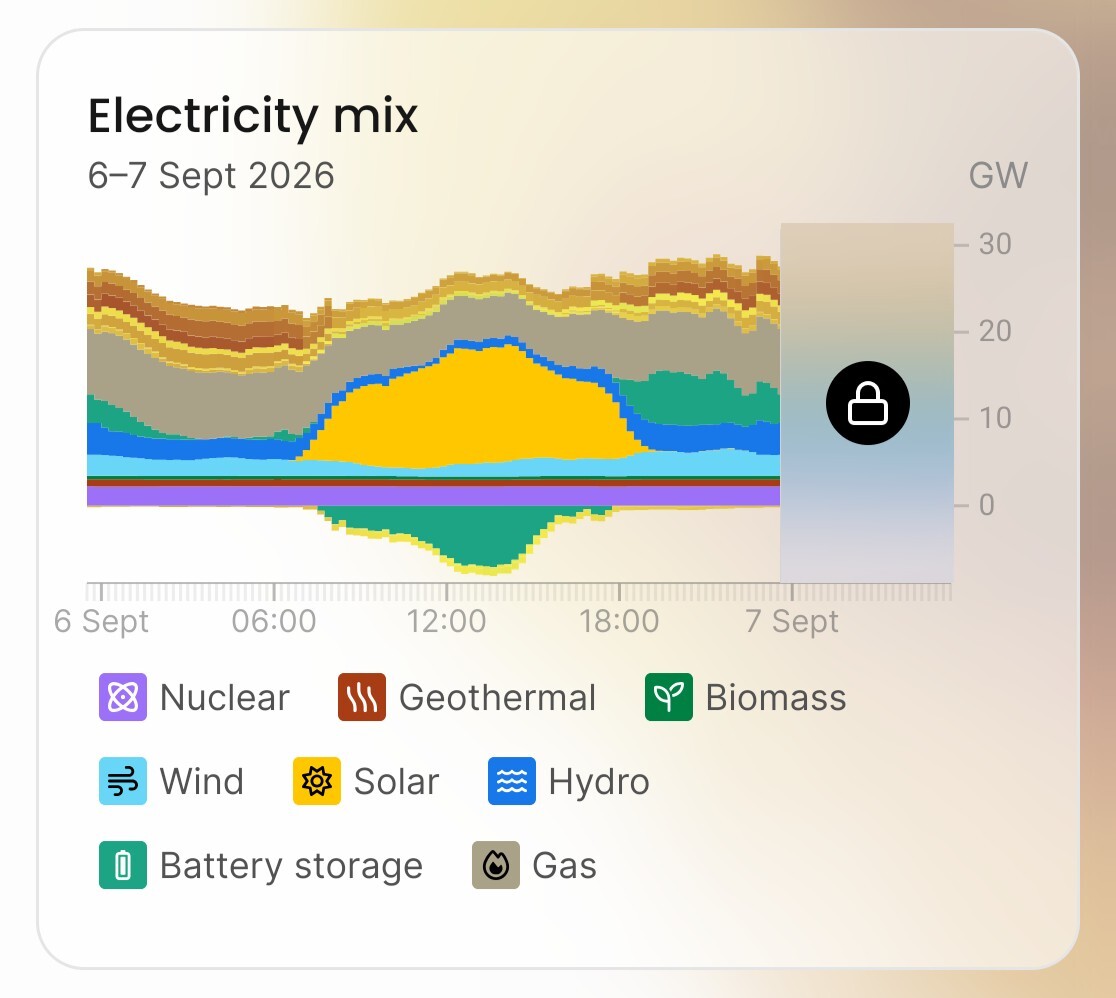
https://app.electricitymaps.com/map/zone/US-CAL-CISO/live/fifteen_minutes
Pumped hydro is better, but not available everywhere.
I expect sodium-ion batteries to be the main type of storage going forward, but who knows?
Pumped hydro is better, but not available everywhere.
Depending on geography, but yes, it’s rare that you have all requirements for it (hill, river etc.)
I expect sodium-ion batteries to be the main type of storage going forward, but who knows?
These certainly seem like the future. There is also fusion, but it won’t be feasible in near future if ever.
I mean, yeah, that’s kinda how it works.