

Not surprising they’re up on renewables. The last time I drove through Minnesota it was windmills off into the horizon for many miles.
I assume this was I-90 west of Rochester, which is where most of the wind is sited. Sadly it is nowhere near enough and still only produces 25% of the state’s electrical needs whereas neighboring South Dakota and Iowa are over 50%.
Solar and wind have very different potentials in the state. Minnesota is at the Northern terminus of the wind corridor which they take advantage of. However, it is one of the worst states for solar irradiance potential.
Sherco solar replaces 2.4 GW base load coal with a planned 910 MW of solar and only 3 GWh of storage. This comes across as insufficient in a snowy winter in a state where conversion to electrical heating is a must.
I90
Not a scenic drive. If you have to drive through, after dark, this is a good place for it.
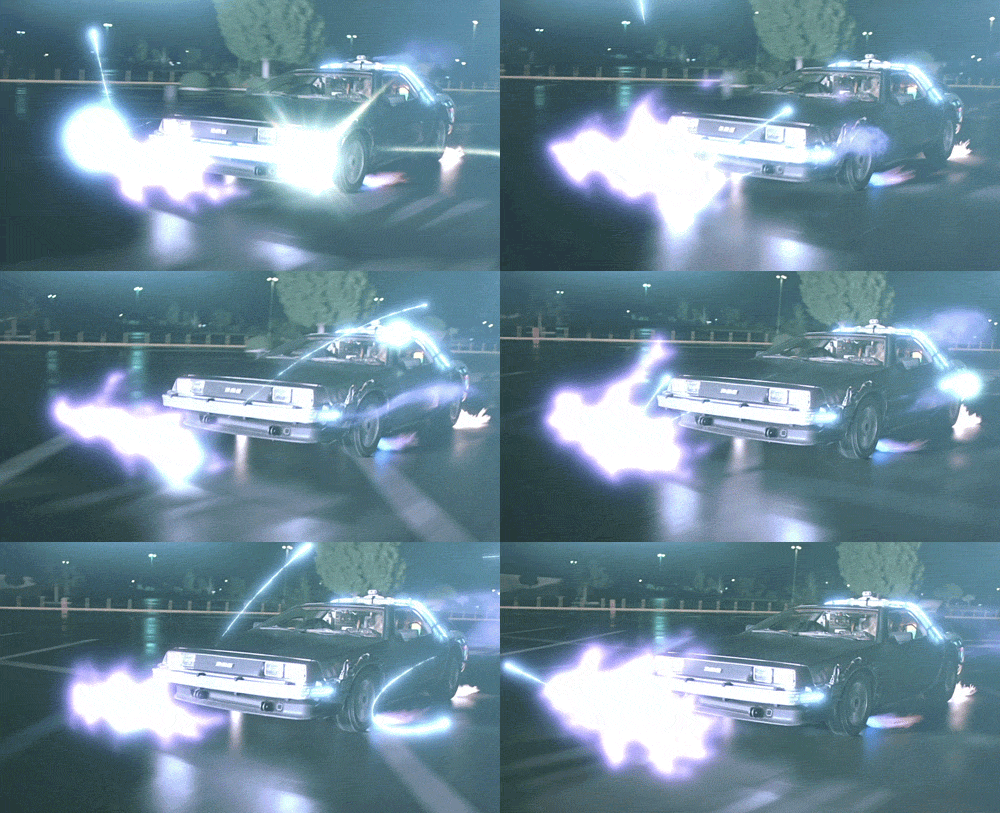
When this baby hits 1.21GW, you’re gonna see some serious shit.
What happens at night? Did they built like 10+++GWh storage as well?
3gwh
Where did you find this info? I found this “Battery storage is planned as well, with as much as 600 megawatts eventually possible if approved” which assuming it’s 600MWh, it’ll provide less than an hour worth of energy. But even 3GWh covers only 4 hours.
Would that not be 4 hours of not consuming non-renewables? Like not burning so much coal is a good thing no?
Are we arguing about the measure of progress in the United States? Cuz buddy I’ll take any progress at this point.
Are we arguing? I thought we were talking 🤷 . Yes, but that also means that the rest of the time the energy has to come from somewhere. Like a coal power plant or similar. So this photovoltaic power plant is not a complete replacement for old power plant, but more like a partial one while still relying of fossil fuel, especially during winter and cloudy days.
We typically use more power during the day (industry, mostly), so the solar helps us reduce carbon based infrastructure need even without batteries. And it’s just a baby step in the progression to renewables. Yes, we have a long way to go.
As all the world has. If we really want to prevent CO2 (and other bad) emissions, we need energy storage and a lot of it. Or nuclear. That said, these are steps (without proper energy storage) in right direction, but only as long as they replace energy from fossil fuel power plants.
Sorry, I might have gotten a little defensive there.
My point is if it supplements their energy consumption with cleaner energy it’s a good thing.
Even if its for a couple minutes or a couple hours its a positive improvement.
No worries. It is, if it replaces fossil fuels. But it soon gets tricky if it is supposed to be a stable source of energy. For that we’d need awful lot of energy storage, probably in some form of batteries (sodium perhaps). Today it’s relatively easy to slap solar panels everywhere, but it’s not that easy to provide energy outside of daylight.
Yes we need to go further but, sometimes it feels like we make perfect the enemy of progress.
I’d love to see a large public works project that aims to increase the energy storage capacity/development across the world.
I don’t feel like we get there by focusing on it not being a complete solution.
@kindtoeveryone in another thread:
The exact figures:
735.5 MW AC 2,942 MWh
Verified from Minnesota PUC and EQB.
Also, overnight you won’t be needing the full output, I would guess. And I’m sure they can draw on other sources.
So it is 3GWh. Better than 600MWh. While the power requirement during nights might be less, it’s still a problem, specially during winter (short days, clouds, heat pumps etc.). And you need to charge those batteries as well which significantly lowers the power output during the day.
I mean, yeah, that’s kinda how it works.