

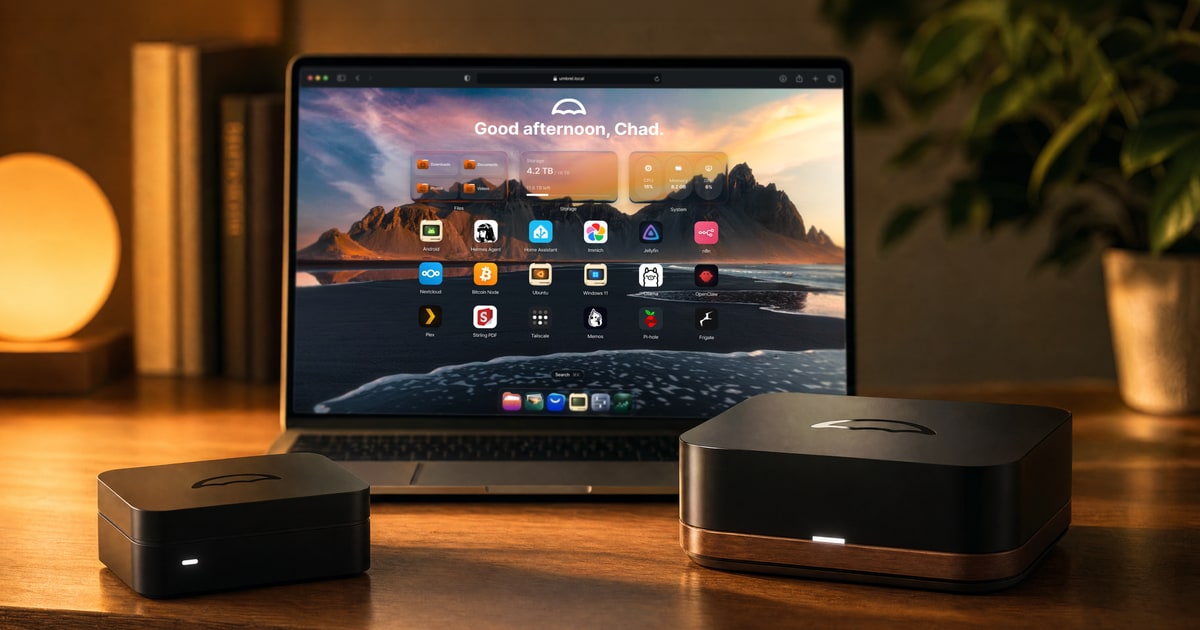
TL:DR - have you used UmbralOS on a non-umbral device? Is it pretty straightforward? Reliable? Easy to use for a simple media server?
THE TL: SO my mini-pc’s M.2 SSD shit the bed, and I’m essentially forced to rebuild my media server from backups, etc. I keep my actual media on USB external drives, and backup my configs/YAML regularly, so not the end of the world. I’ve put in a new SSD and ready to restart… but as they say, each problem is also an opportunity, and I’m considering switching the structure/interface of the server.
Instead of pure, headless CLI ubuntu server, I previously used CasaOS, as, at the time, I was new to hosting, and other users in my household are absolutely allergic to CLI and pretty much always will be. CasaOS is nice because the Debian CLI is there for me if I need it, but running on top is an “Okay” GUI that has familiar things like “apps” and folders with folder structures. Even though I’m much more experienced than I was, say, a year ago, I still think I’d rather not do “pure” CLI docker compose. I only need a couple, simple services, that are easier for other household members to interact with independently if it has a GUI. If you think there’s a compelling reason I should change my mind on that, tell me why.
CasaOS over the past year ish has started to feel very much like abandonware, however, as they’ve moved to ZimaOS (which is waaay more than we need, I’m not running a RAID or trying to set up 20+self-hosted services…Does anyone have experience with UmbralOS (especially on NON-Umbral hardware, and with USB external HDD storage) It’s for a simple media & file hosting experience via Jellyfin, primarily.
We’re running an ARR stack, Jellyseer & Jellyfin with Nextcloud for photos & documents. My mini pc is a GEEKOM Air12 LITE which is not particularly beefy on specs… though I’m going to add another 8 gb of RAM to it when I upgrade. Any thoughts/advice are so greatly appreciated. Thank you!
looks vibecoded and their image with “Good Morning, Chad” also has a vibe (derogatory)
They only have documentation in the form of agent skills…
I don’t get this though, is there a desktop environment if you buy the hdmi one, or is it like a browser in kiosk mode, do all the apps use the same components? How do does transfer between web apps, especially since the docs point app development to be silos?
A lot of interesting ideas for managing a self hosted app stack though.
What would be cool is if they had centralized managed s3 and vebored databases but behind the scenes it was working to a shared cross app system. Then you could set up search indexes and stuff on that.
I’ve installed UmbrelOS on a NUC for my father. He uses Immich and with Umbrel he can manage his instance himself. He’s happy with it. And if something goes wrong, I can probably unfuck it because under the hood it’s just docker.
Use whatever works for you, but I avoid specialized OSs like this. Headless is the way I go. If you want a GUI use Portsiner, or Dockage, or Arcane.
Headless with all of my yml files backed up for easy spinning up on a new install or device.
Don’t use portainer. They are rapidly enshittifying.
Dockge is what I use for Docker. It works alongside existing Docker environments and doesn’t fuck up the structure. Unlike Portainer.
dockhand > Portainer
Try OpenMediaVault. It’s based on Debian and has an active community.
There is a YouTube channel TechnoDadLife which goes over setup.
Started with the beta of CasaOS, really welcoming discord community and all, but when I went from a busted laptop to a purpose-built machine, I dove into the deep end and went with Proxmox.
It can be daunting at first with all that lingo but there are plenty of good tutorials. Can’t recommend enough. Also as a gap closer, there’s proxmox community scripts, which are great to spin new LXCs to tinker with and learn/try new stuff without annoying the family with downtime
If the rest of the household mostly uses the apps themselves rather than the server, the OS underneath matters less than it seems. I run plain Ubuntu Server and manage the containers with Komodo, which I moved to from Portainer: it gives me a web UI to see, restart and update stacks, while the compose files stay ordinary files I can back up. Since you already back up your configs and YAML, keeping compose underneath means the next dead SSD is a reinstall and a redeploy, not a migration out of someone’s app store.
@Profligate_parasite Sounds very promising but who is the company behind it and on which OS is umbrelOS based?
Can’t find any further Informations on their website.
Debian, as always.
It’s always Debian.
And I’m OK with that.
Found their Github. Looks like it’s a custom Linux kernel…? I dunno, it’s really hard to tell directly; I’m inferring from context clues (like tagging Raspberry Pi, mentioning the open Nvidia kernel modules, etc.).
I have tried Umbrella and CasaOS and they are really very similar. That said, learning to use portainer allows you to understand the underlying technology of docker much better and also allowd you to do cool things like making a stack of containers that work together and saving that stack in a single config file. The GUI of Umbrel and CasaOS are basically the same and they only differ a little in their internals, so I would say switching shouldn’t be too hard, but if you have found yourself struggling to get something working on CasaOS you will probably have the same issue on Umbrel.
The web interface with all the links to your services can be achieved with things like Homarr and you can manage storage on the back end with Open Media Vault or something similar to make things more accessible. If you can have your data files accessible on a single BTRFS or similar partition with folder level sharing then you can have files hard linked between your downloading application and your media serving application, say Deluge and Jellyfin. The files download in /share/Downloads and then on completion get linked into /share/Imports and Jellyfin can manage moving them into /share/Movies or /share/TV as needed, and the same would go for something like Subsonic or AudiobookShelf.
Personally I have a wonderful set up with AudiobookShelf which syncs to my phone ereader. I can have books for my ereader with all the metadata and it is accessible via WiFi so I can just pick a book and get the epub delivered directly, no Calibre or USB cable required. It also works nicely for the audiobook side by letting me tell a whole series to download to my phone so I can listen back to back without worrying and I can always make space if I need to by clearing things out. Oh, and I can set my default listen speed to 2.0x and that carries over on other devices, so I don’t have to constantly fuss with it.
Overall, super fun, I would recommend learning about Portainer if that appeals to you, maybe consider setting it up on an old laptop and playing with it there, and if it works out nicely then you can redo your server and get it all working nicely there.
I recently discovered reCasaOS a FOSS fork that’s actively maintained. Might want to give that a shot first before moving everything over to a new OS.
Never heard of this. I use Yunohost (Y You No Host?) After zimaOS let me down.
I have always gone back to the same distribution when my SD card died, or I upgraded my pi setup. So I never have thought about changing distros, however when I found a 2014 Mac mini just hanging out on my desk without a second thought, I downloaded all my itunes purchased music and installed Debian. I thought hey why not, raspberry pi OS is a fork of Debian and I was cool with that. I installed it using the GUI but quickly realized running the GUI on it was pointless so uninstalled it.
Why did I install Debian over Ubuntu? I don’t know maybe because it was one of if not the longest maintained version of Linux. It is still maintained even though Ian passed away so I feel confident that it will stay maintained well into the future, I do not know if Deb has/had anything to do with it.
If you want to try something else to reach higher enlightenment may I suggest TempleOS, it may have internet access now but I do not know how the CLI is? If you want to screw with family members may I suggest Hana Montana or Bieber OS.
Next week I will hopefully be getting a hand me down Mac mini because Apple is no longer supporting it I plan on installing Debian and using it as my Jellyfin set top box with Librewolf adguard and sponsor block for youtube.

