Tanenbaum also believed that the Intel x86 was on the way out, the very CPU that Linux was hard-coded to run on. On the other hand, Minix was ready to adopt the upcoming RISC tech, which Tanenbaum believed would drive the x86 into extinction.
Depends if you count ARM too. I was always confused between RISC and RISC-V, and what ARM has anything to do. As I understand ARM is based on RISC, but its closed source. And RISC-V is based on RISC, but open source. Is that correct?
ARM is absolutely RISC. It stands for Acorn Risc Machines (or maybe it’s “Advanced” now?), and was even then a very cool and promising idea, although it lagged behind in speed for a long time. Until the StrongArm came out, I think.
So is ARM. Every ARM processor is basically uniq, and that makes it efficient. That’s the point of it. RISC as a design philosophy doesn’t take over the industry, its specific implementations. My question is not what RISC is, but if ARM is based on RISC and how close it is in their designs to RISC-V. As I understand the company behind ARM took the RISC philosophy and created a closed source system.
ARM is a well-defined instruction set architecture (ISA), that in order to implement, must comply with that instruction set and be compatible with other implementations from other vendors.
RISC is not any sepcific ISA at all, but is rather a more generic term for any ISA that has a small amount of instructions.
RISC-V, on the other hand, is a well-defined ISA whose implementations are intercompatible with each other. RISC-V is a very specific, royalty-free ISA that comes out of UC Berkeley that adopts the RISC philosophy.
ARM is a well-defined instruction set architecture (ISA), that in order to implement, must comply with that instruction set and be compatible with other implementations from other vendors.
But that’s not true. ARM isn’t well defined and a single standard, like x86 are. ARM devices are not compatible to each other necessarily. I just had the genius idea to lookup online, I should have done that instead wondering what it is. According to Wikipedia: https://en.wikipedia.org/wiki/ARM_architecture_family
ARM (stylised in lowercase as arm)[a] is a family of RISC instruction set architectures for computer processors.
The original Berkeley RISC designs were in some sense teaching systems, not designed specifically for outright performance. To the RISC’s basic register-heavy and load/store concepts, ARM added a number of the well-received design notes of the 6502.
So I was correct after all. Also ARM is around since 41 years.
You mean docent I presume. Universities do not exactly have teachers.
Resident or visiting?
edit: in my country docent is the normal term for people giving lectures at universities. Or prof, but not all of them are actual professors. Seems I - once again - got caught up in translation. You native english speakers do you! But universities - even in english speaking countries - work differently from schools. To put it shortly, it is up to you to teach yourself from the material you get from lecturers. So in a way you are your own teacher.
Besides, I made this comment to reply to a doubtful statement, which the commenter almost immediately retracted (but didn’t delete completely to their credit).
… I’m curious how many more replies this will attract.
You have to know that there are multiple terms for people that teach at a university around the world, and that “docent” is not the only possible term.
Like I’ve never heard a professor referred to as a “docent” in North America. Docents here are information guides in museums and galleries.
But a statement like “Nobody teaches at universities?! Must be a wild place to try to learn.” makes it clear that you do not understand the difference between a school and a university.
You thought that statement was straight, and without any irony? Did you forgot the context of your own statement of “You mean docent I presume. Universities do not exactly have teachers”? Universities definitely teach how to keep context in mind, especially when irony and satire is involved. What happened here?
Docent makes me think of guides at museums. When I was in uni (well, I called it “college”, being from the US), the usual title was “professor”. But if you’d asked who my teacher was for a particular class, I’d have known what you meant.


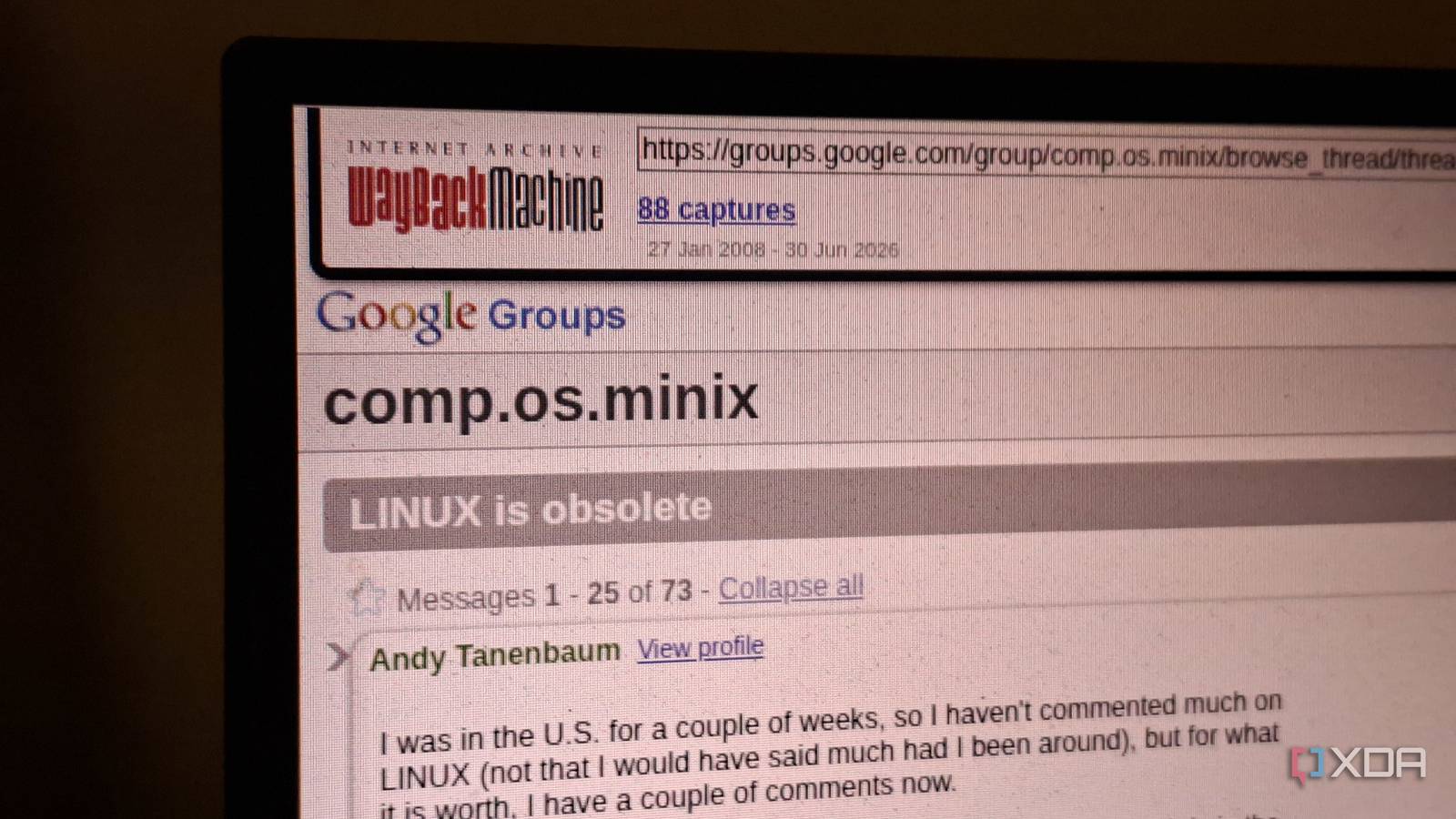
“was called obsolete” - by 1 person who happened to be the developer of a competing OS/kernel.
A genuine Nostradamus, here.
Kinda wish he was right about risc tbh
I would argue he was, but it’s taking far longer than I’d like
Depends if you count ARM too. I was always confused between RISC and RISC-V, and what ARM has anything to do. As I understand ARM is based on RISC, but its closed source. And RISC-V is based on RISC, but open source. Is that correct?
IBM PC and Apple Mac are both based on the same thing: the idea of a personal computer. IBM PC even put “PC” in the name.
You can definitely tell that they were designed with similar principles in mind, but they are not in any way compatible on a technical level.
ARM and RISC-V are both based on the same thing: the idea of a reduced instruction set. RISC-V even put “RISC” in the name.
You can definitely tell that they were designed with similar principles in mind, but they are not in any way compatible on a technical level.
ARM is absolutely RISC. It stands for Acorn Risc Machines (or maybe it’s “Advanced” now?), and was even then a very cool and promising idea, although it lagged behind in speed for a long time. Until the StrongArm came out, I think.
RISC isn’t a specific architecture, but moreso a design philosophy.
So is ARM. Every ARM processor is basically uniq, and that makes it efficient. That’s the point of it. RISC as a design philosophy doesn’t take over the industry, its specific implementations. My question is not what RISC is, but if ARM is based on RISC and how close it is in their designs to RISC-V. As I understand the company behind ARM took the RISC philosophy and created a closed source system.
ARM is a well-defined instruction set architecture (ISA), that in order to implement, must comply with that instruction set and be compatible with other implementations from other vendors.
RISC is not any sepcific ISA at all, but is rather a more generic term for any ISA that has a small amount of instructions.
RISC-V, on the other hand, is a well-defined ISA whose implementations are intercompatible with each other. RISC-V is a very specific, royalty-free ISA that comes out of UC Berkeley that adopts the RISC philosophy.
But that’s not true. ARM isn’t well defined and a single standard, like x86 are. ARM devices are not compatible to each other necessarily. I just had the genius idea to lookup online, I should have done that instead wondering what it is. According to Wikipedia: https://en.wikipedia.org/wiki/ARM_architecture_family
So I was correct after all. Also ARM is around since 41 years.
Interesting read: https://www.dfrobot.com/blog-13483.html
And was Linus’s teacher for Operating Systems in HelsinkiWrite the book on Operating Systems that Torvalds said inspired him to make Linux.
At university?
You mean docent I presume. Universities do not exactly have teachers.
Resident or visiting?
edit: in my country docent is the normal term for people giving lectures at universities. Or prof, but not all of them are actual professors. Seems I - once again - got caught up in translation. You native english speakers do you! But universities - even in english speaking countries - work differently from schools. To put it shortly, it is up to you to teach yourself from the material you get from lecturers. So in a way you are your own teacher.
Besides, I made this comment to reply to a doubtful statement, which the commenter almost immediately retracted (but didn’t delete completely to their credit).
… I’m curious how many more replies this will attract.
Nobody teaches at universities?! Must be a wild place to try to learn.
Tell me you’ve never been to a university without telling me…
You have to know that there are multiple terms for people that teach at a university around the world, and that “docent” is not the only possible term.
Like I’ve never heard a professor referred to as a “docent” in North America. Docents here are information guides in museums and galleries.
That’s fine, I’m not discussing terms.
But a statement like “Nobody teaches at universities?! Must be a wild place to try to learn.” makes it clear that you do not understand the difference between a school and a university.
You thought that statement was straight, and without any irony? Did you forgot the context of your own statement of “You mean docent I presume. Universities do not exactly have teachers”? Universities definitely teach how to keep context in mind, especially when irony and satire is involved. What happened here?
Also that wasn’t my statement.
You went to a teachless university?! That’s certainly a choice.
I think universities do have teachers, but that’s beside the point.
Anyway I misremembered and it was just that Tanenbaum wrote the OS book that Torvalds had during undergrad.
Now, some professors might hate this, but hear me out… If somebody’s teaching, they’re a teacher, how about that?
Docent makes me think of guides at museums. When I was in uni (well, I called it “college”, being from the US), the usual title was “professor”. But if you’d asked who my teacher was for a particular class, I’d have known what you meant.