We need sustainable energy storage, and hydrogen has few alternatives in this regard. However, the demand for green hydrogen can never be met by renewable energies in Europe. This means that it mainly comes from ships from sunny countries.
Hydrogen is terrible for energy storage, and even worse for energy transport. Especially if you’re doing electrolysis to split water that you then re-generate with atmospheric oxygen in order to produce electricity. A battery, flywheel, or just pumping water upstream gets you far better efficiency, and shipping literally any product of a hydrogen reaction is likely to be more efficient than shipping a heavy H2 tank back and forth.
Solar power in the EU seem to be increasing by 20% year-over-year. It’s hard to see a situation where shipping hydrogen to supply thermal energy to an existing factory would be cheaper than just building a local electrolysis plant and the necessary solar panels. (Unless, of course, you’re already invested or employed in selling hydrogen as a direct fossil fuel replacement.)
Theoretically, these are fantastic ideas for storing energy. Realistically, however, it is much more universal to run electrolysis. Many countries do not have mountains to build pumped storage facilities, and large-scale flywheels are difficult to implement. Battery farms are not sufficent.
However, the transport of electrons or hydrogen is already working today. Natural gas networks are in place and can be used. At the moment, expansion is faltering at the European Union and national borders.
In the long term, everything will come down to hydrogen and electricity, and this hydrogen will have to be imported


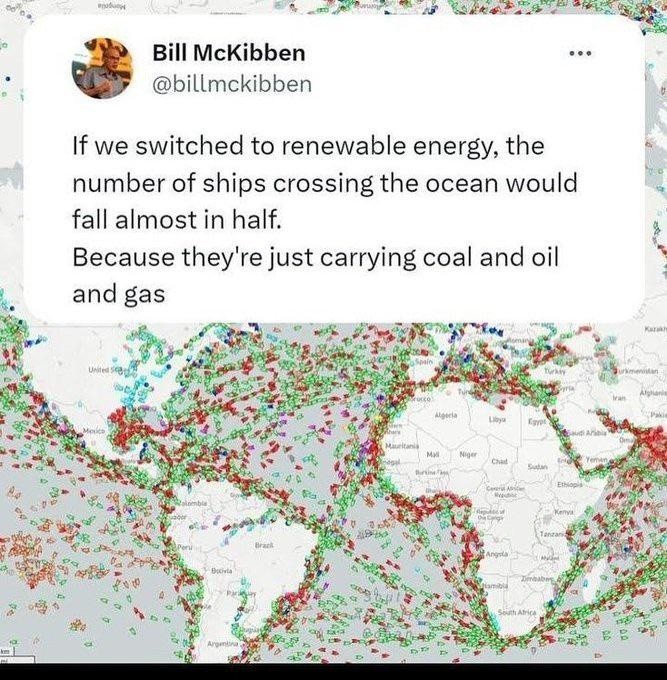
We need sustainable energy storage, and hydrogen has few alternatives in this regard. However, the demand for green hydrogen can never be met by renewable energies in Europe. This means that it mainly comes from ships from sunny countries.
Hydrogen is terrible for energy storage, and even worse for energy transport. Especially if you’re doing electrolysis to split water that you then re-generate with atmospheric oxygen in order to produce electricity. A battery, flywheel, or just pumping water upstream gets you far better efficiency, and shipping literally any product of a hydrogen reaction is likely to be more efficient than shipping a heavy H2 tank back and forth.
Solar power in the EU seem to be increasing by 20% year-over-year. It’s hard to see a situation where shipping hydrogen to supply thermal energy to an existing factory would be cheaper than just building a local electrolysis plant and the necessary solar panels. (Unless, of course, you’re already invested or employed in selling hydrogen as a direct fossil fuel replacement.)
https://ember-energy.org/latest-updates/wind-and-solar-generated-more-power-than-fossil-fuels-in-the-eu-for-the-first-time-in-2025/
Theoretically, these are fantastic ideas for storing energy. Realistically, however, it is much more universal to run electrolysis. Many countries do not have mountains to build pumped storage facilities, and large-scale flywheels are difficult to implement. Battery farms are not sufficent. However, the transport of electrons or hydrogen is already working today. Natural gas networks are in place and can be used. At the moment, expansion is faltering at the European Union and national borders.
In the long term, everything will come down to hydrogen and electricity, and this hydrogen will have to be imported
It’s far cheaper to distribute energy via hydrogen than it is to distribute energy via electricity, especially over long-distance: https://docs.nrel.gov/docs/fy22osti/81662.pdf
We will likely make hydrogen where it is cheap, and then distribute via pipelines or other methods to where it is needed.