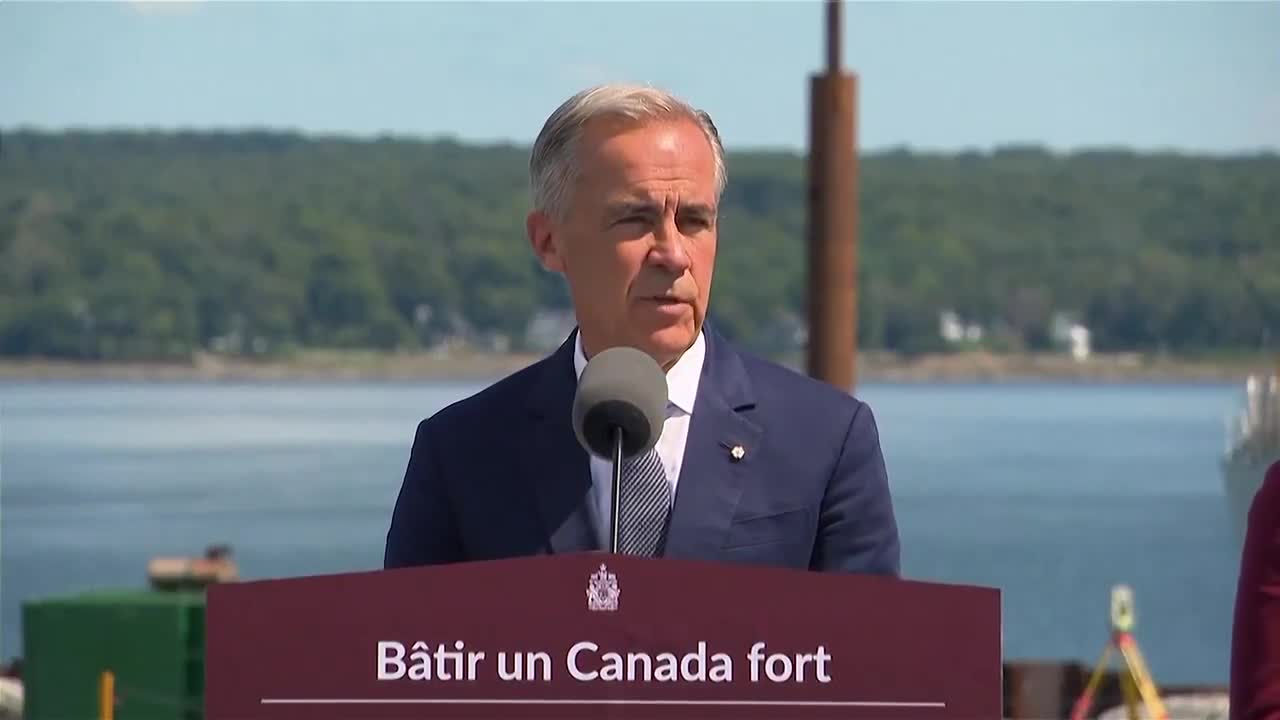
Watch "Canada's PM Carney: "This fall we will begin intense discussions with the European Union, the world's second-largest economy, to build a much stronger and deeper economic and security partnership"" on Streamable.
How long will it take? A lot of water shall flow as the saying goes… maybe 20 years will be enough? Btw, since you should be enjoying the idea, would you prefer to abolish national states and to keep the regions (with the necessary adjustments, i.e. finally merging Tyrol with South Tyrol)?
Voßkuhle, by contrast, spoke of a “gradual transformation into a European federal state.” The political agenda claims that we are still a long way from such a development, but in reality, it is already taking place. “It may be that we are talking about a European federal state as something far off in the future and fail to recognize that we are already living in one.” One must be careful not to set in motion a gradual, unnoticed process “that we cannot control,” the president of the court said.
This was the president of the german constitutional court, and I think that he’s right about the EU sliding into a de-facto federal state faster than we recognize. This is imho. why we should start to quickly organize as one so we have some more control over what the result is instead of ending up in another mess of a de-facto status that is not entirely regulated de-jure.
Federation us not only a political act to cede national soverignity and power to the federation. It is also the founding of a nation. And that requires first and foremost a majority consensus of the EU people that they’re Eu citizens.
I for one doubt that I will see it in my lifetime (still some 60 years I hope).
The details are open to debate, in the end we as citizens will have to agree on something. Personally I would not be opposed to keeping the national states as a form of federal states under the umbrella of a common federal government, but then again I could see a more prominent role for the European Committee of the Regions solving some serious issues.
I’m not a regionalist and not a nationalist, I don’t care in principle if we break national states up into regions and those then reorganize, split or unify however they please and federate into a european state or if the existing national states federate as-is. And because I don’t care I think the people who do care (like the various european seperatist movements) should be allowed to plead their case and make an argument about it.
Personally I am not affected enough by any of this to have a strong opinion and I suspect that, with a European Union that takes on many of the responsibilities and decisions that rest with national states right now, those movements to separate or unify would lose a lot of urgency. Just like (for example) the Troubles basically stopped when both the UK and Northern Ireland were part of the EU, without a rigid border between them.
I find the Europe of Regions conceptually fascinating, I’m just also worried that regionalist or nationalist tendencies could increase if we treat borders more like dividing lines between cultures, ethnicities, languages, religions or histories rather than imaginary lines on a map that only influence administrative divisions.
But I also understand that those things affect people and identity can be very caught up in it, so…
¯\_(ツ)_/¯ make a good case to abolish nations and have regions be the federal states instead and I’ll listen.
Thanks for the reply, definitely food for thought.
make a good case to abolish nations and have regions be the federal states instead and I’ll listen.
I don’t have any, and I fear that having that many entities would complicate things. Borders are imperfect things, but identity is an important concept, so we should strive to build an European one. More than a Europe of nations, we need a Europe in which everyone (ok, most) can identify with (I’m in Italy and I’m under the impression that I’m in the minority that does, not sure of what’s like elsewhere). Then borders won’t have such a strong meaning anymore.
I’m in Italy and I’m under the impression that I’m in the minority that does, not sure of what’s like elsewhere
I’m in Germany, but I live in a fairly leftist, academic bubble. In my bubble the European identity is already way more important than the german one. But I’ve read that Germans in general are, for historical reasons, less caught up in their national and more in their regional identities and since those are already subsumed under a common german one the step to a common european identity is easier than it might be for more centralized nations.
I fear that having that many entities would complicate things
I get that and I share that feeling. For small-scale representation we have the parliament and that’s already a smaller scale than the region. Currently we’re treating the Council of the European Union as an upper house equivalent, representing the member-state governments and in theory the CoR could become an upper house instead. But as you said it would complicate things. Not least because the political power of regions varies vastly among member-states. Bavaria for example has massive budgetary and legislative power at home while regions in highly centralized France don’t.
I think a better way to enforce subsidiarity would be to give binding consultation rights to the Council of Regions. This would mean that while it wouldn’t vote on every law, the EU would legally be prohibited from passing laws affecting local governments without the explicit approval of the regions. Basically veto power if a majority of the regions feel something goes against their interest.
Right now the Council must be consulted, but can then be ignored.


How long will it take? A lot of water shall flow as the saying goes… maybe 20 years will be enough? Btw, since you should be enjoying the idea, would you prefer to abolish national states and to keep the regions (with the necessary adjustments, i.e. finally merging Tyrol with South Tyrol)?
And on the topic of time:
This was the president of the german constitutional court, and I think that he’s right about the EU sliding into a de-facto federal state faster than we recognize. This is imho. why we should start to quickly organize as one so we have some more control over what the result is instead of ending up in another mess of a de-facto status that is not entirely regulated de-jure.
Federation us not only a political act to cede national soverignity and power to the federation. It is also the founding of a nation. And that requires first and foremost a majority consensus of the EU people that they’re Eu citizens.
I for one doubt that I will see it in my lifetime (still some 60 years I hope).
Yes, sadly I have to agree with you
The details are open to debate, in the end we as citizens will have to agree on something. Personally I would not be opposed to keeping the national states as a form of federal states under the umbrella of a common federal government, but then again I could see a more prominent role for the European Committee of the Regions solving some serious issues.
I’m not a regionalist and not a nationalist, I don’t care in principle if we break national states up into regions and those then reorganize, split or unify however they please and federate into a european state or if the existing national states federate as-is. And because I don’t care I think the people who do care (like the various european seperatist movements) should be allowed to plead their case and make an argument about it.
Personally I am not affected enough by any of this to have a strong opinion and I suspect that, with a European Union that takes on many of the responsibilities and decisions that rest with national states right now, those movements to separate or unify would lose a lot of urgency. Just like (for example) the Troubles basically stopped when both the UK and Northern Ireland were part of the EU, without a rigid border between them.
I find the Europe of Regions conceptually fascinating, I’m just also worried that regionalist or nationalist tendencies could increase if we treat borders more like dividing lines between cultures, ethnicities, languages, religions or histories rather than imaginary lines on a map that only influence administrative divisions.
But I also understand that those things affect people and identity can be very caught up in it, so…
¯\_(ツ)_/¯ make a good case to abolish nations and have regions be the federal states instead and I’ll listen.
Thanks for the reply, definitely food for thought.
I don’t have any, and I fear that having that many entities would complicate things. Borders are imperfect things, but identity is an important concept, so we should strive to build an European one. More than a Europe of nations, we need a Europe in which everyone (ok, most) can identify with (I’m in Italy and I’m under the impression that I’m in the minority that does, not sure of what’s like elsewhere). Then borders won’t have such a strong meaning anymore.
I’m in Germany, but I live in a fairly leftist, academic bubble. In my bubble the European identity is already way more important than the german one. But I’ve read that Germans in general are, for historical reasons, less caught up in their national and more in their regional identities and since those are already subsumed under a common german one the step to a common european identity is easier than it might be for more centralized nations.
I get that and I share that feeling. For small-scale representation we have the parliament and that’s already a smaller scale than the region. Currently we’re treating the Council of the European Union as an upper house equivalent, representing the member-state governments and in theory the CoR could become an upper house instead. But as you said it would complicate things. Not least because the political power of regions varies vastly among member-states. Bavaria for example has massive budgetary and legislative power at home while regions in highly centralized France don’t.
I think a better way to enforce subsidiarity would be to give binding consultation rights to the Council of Regions. This would mean that while it wouldn’t vote on every law, the EU would legally be prohibited from passing laws affecting local governments without the explicit approval of the regions. Basically veto power if a majority of the regions feel something goes against their interest.
Right now the Council must be consulted, but can then be ignored.
Re: first paragraph. I think that the difference comes from late unification. Italy was divided into small states too, particularly in the north.
Re CoR: yes, I like your idea, but I don’t know enough about EU institutions to say if it’s redundant or not with regards to the parliament
Also, thanks again for the insightful conversation :)