

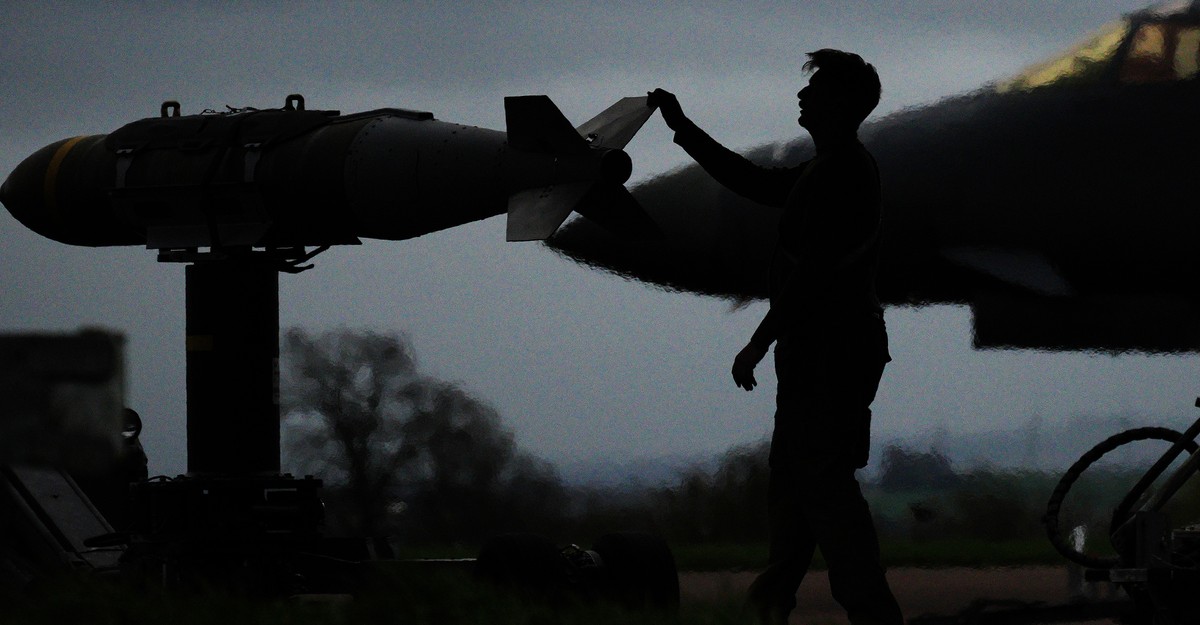
Although the United States has been the world’s preeminent military power for decades, it apparently cannot fight a regional power such as Iran for more than a few months before experiencing an armaments crisis. Since hostilities with Tehran began on February 28, the U.S. has reportedly used up two-thirds of its Patriot missile interceptors, more than a third of its Terminal High Altitude Area Defense (THAAD) interceptors, and a third or more of its prewar stock of Tomahawk cruise missiles. The rate of consumption is all the more striking because a shaky cease-fire had halted most fighting for months. Based on recent production patterns, replenishing the supply of weaponry will take several years.
Making America’s challenge still more daunting is a major shift in war-fighting technology toward cheap, unmanned aerial vehicles. The United States and its allies in the Persian Gulf have been forced to use expensive, advanced air-defense systems—such as Patriot PAC-3 missiles that each cost millions of dollars and have a long production cycle—to shoot down Iranian drones that can be swiftly assembled for about $30,000.
The munitions shortfall doesn’t just affect the current war. It also sends a worrisome message to allies around the world: The United States has been caught off guard by the latest evolution of warfare and lacks the armaments-production capacity to adapt quickly. Suddenly, relying on American military technology looks far less reliable as a security strategy than it did before President Trump went to war with Iran. And in the long run, governments that counted on the United States to equip their military are going to need a Plan B.
And the Pentagon is convinced we’ll never be in a war of attrition ever again. They’re planning like it is still the early 90s and the Gulf War. Completely ignoring what is happening in Ukraine and how even mid-sized armies like Iran can still be functional after high tech strikes. And the orange buffoon isn’t helping by demanding a return of the Battleship instead of millions of cheap air and sea drones.
Between missing the drone wave and the fact that the private sector has massively outsourced our industrial capacity, could we even sustain a war with a near peer? How long before shortages got dire? Few months?
The drone production capacity of China in a true total war scenario is frankly terrifying to imagine. Imagine the Workshop of the World converted to drone production. Little Ukraine is making millions of drones per year. China could make tens of billions.
At sufficient numbers, drones make nuclear weapons obsolete. Nukes are singular expensive objects. It’s always been assumed that nuclear weapons couldn’t be intercepted, but countries around the world have gotten really good at building missile interceptors. And suddenly nukes aren’t so scary if you can launch a hundred interceptors at every incoming nuclear missile. And new interceptor technologies are coming onboard that will allow interceptors to fly back to their launch points if they don’t strike a hit.
We’ve always assumed mutually assured destruction will prevent conflict between great powers, but I worry nukes may not be so scary in the future. Imagine if China built a billion missile interceptors and had them stationed around the country. (If the production can be fully automated, this isn’t an absurd number.) No missile could ever get through. Each one would be swarmed by a million interceptors. And only the interceptors that actually find their target will be consumed. The rest just fly back to their launch pads to refuel. To prevent your cities from getting nuked, a billion autonomous interceptors is not an absurd investment.
At the same time, drones could easily do nuclear bomb levels of destruction at sufficient scale. Imagine if you unleashed a million incendiary drones onto a city with a hundred thousand buildings. Each is programmed to scan for standing structures, land on them, and ignite an incendiary charge. The firebombing of Dresden is the model here.
Or here’s a terrifying weapon. Imagine an autonomous, solar-powered, AI-operated drone swarm. You unleash a million of them on a city. Each drone has an explosive charge in it and a simple mission: find and destroy any vehicle or human being you find within a geo-fenced region. The drones follow a simple algorithm:
They might only get 20 minutes of flying time and require 10 hours to charge, but that wouldn’t matter. You could have the swarm coordinate the charging cycles of the million drones so that there are tens of thousands of them in the air at any given time. The ones on the ground recharging would be completely helpless, but no one could go out and deal with them with tens of thousands of active drones flying around. Plus you could rig them to explode if someone approaches them while they’re in their charging cycle.
We have not even begun to see the horrors of drone warfare.
In 2017, Future of Life Institute made a short film about the possibilities of autonomous killer drones. It seems even more likely now that it did then.
https://en.wikipedia.org/wiki/Slaughterbots
https://youtu.be/9fa9lVwHHqg