

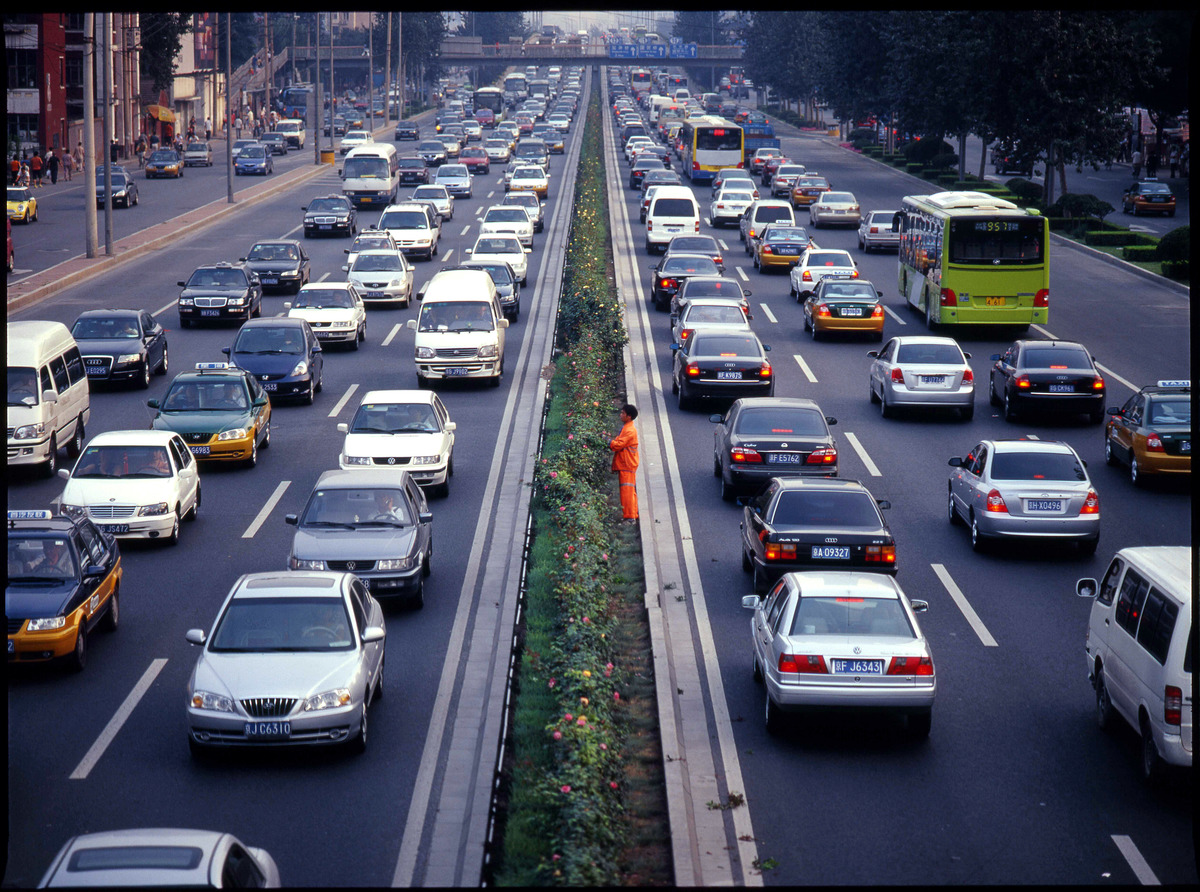
Though progress is often slow, city planners and politicians are gradually waking up to the fact that when cities offer safe and affordable alternatives to cars, we start to travel differently.
More and more young people are choosing bicycles, buses and trains over owning a car out of the sheer cost. In Berlin, it’s public transport, not cars, which is the coolest way of getting around.
In Copenhagen, a city that has a long held reputation for being bike-friendly, a whopping 62% of people choose to cycle their commute.
In the French city of Lyon, the number of cars entering the city has fallen by 20% compared to just a decade ago. As the city’s network of bike hire stations continues to grow, town planners are hoping for a further 20% decline.
In London, where cycle super-highways are becoming popular, the share of journeys made by car has fallen by a quarter since 1990.
Car free days are rising in popularity in many of the world’s largest cities, giving people a taste of what it’s like to live with less noise, traffic and pollution. Bogota was one of the first cities to introduce a car free day, and it’s now become so popular that it’s been extended to a full week.
Bogotá’s Ciclovía is fantastic! I was there in the mid-nineties and they closed a major artery, the Carretera Séptima, on Sundays. Here some pictures.
Running buses in rural areas just doesn’t make economic sense. There are just too few people, buses are running empty most of the time, buses are rare and bus stops are far away. Also, in those rural areas many people don’t have supermarkets within walking distance. Did you ever try to bring an entire shopping cart full of groceries home by bus? Because that’s how much a family can consume in a week.
You are describing the status quo, not the changed system we need. The superb systems of Amsterdam, Copenhagen, Berlin, Vienna, Paris did not appear overnight out of the blue sky. They are result of political decisions, planning, and sustained, persistent efforts.
By the way, the US had in the 1920ies to 1940ies a traffic system based on dense street car, bus, and train connections. Germany in the 1950ies. People had far less money then. It is certainly not uneconomical.
Funny that you ask, last week I went to the beverages market with my bike trailer and because it was hot, I asked my older neighbor whether I should get something for him, too.
I returned with four beer boxes of about 15 kilogram each, which is about 60 kilograms, a full load of the trailer.
If you are in Europe, I can’t recommend the company “hinterher” enough which produces these trailers: Their web site is at https://hinterher.com/ . They are light, extremely sturdy, almost over-engineered, and fully foldable. Not cheap but worth every cent.
Amsterdam, Copenhagen, Berlin, Vienna and Paris are large cities. If you try to run as many buses in a rural area, they will be empty most of the time. If you try to have as many supermarkets as in a large city, they will be empty too.
Also, all of those cities have a mild climate. In a harsh climate, even walking to a bus stop is untenable for some people.
Only in a dominantly car-based system.
Many poorer countries cannot even afford such a car-based system. The use a system based on public transport which already shows that it is more economical.
That’s also a macro-economic argument against cars: They cost a lot of resources and money which is not well spent. Ultimately, money for gas ends up for drilling holes into the ground. For EVs, it is not much better. While a transport system based on bikes and public transport leaves far more money in the local economy.
Because rural areas have smaller population density, there are fewer passengers. In such places, there are usually fewer routes, bigger interval between buses, no service during nights and/or weekends. If you need to go somewhere where there is no direct bus line, you may need to take a long detour. Running buses where there are few passengers is uneconomical: an empty bus uses more fuel than a full car. Bicycles can help, but not everyone is fit enough to ride long distance. Also people don’t want to ride bicycles during rain, snow or heat. In such places, most people have cars. At least there is no shortage of parking space.
Did you try riding uphill with that much load? In hilly places with steep inclines, a bicycle is almost useless, because it is easier to walk uphill than to ride.
Hehe, I lived in Edinburgh which has a couple pretty impressive slopes. My favorite was Princess street down to Dundas street, snd up the Blackford Hill. It is really nice to have a hub gear and hydraulic disk brakes there.
If I did that kind of shopping there, I’d use an eBike.
And no, most larger German cities and their surroundings are pretty flat, because the are situated at large rivers, such as Berlin, Hamburg, Munich, Hannover, Cologne, Frankfurt, Leipzig, Dresden, Bremen, and so on. Stuttgart being an exception.