Also this is goofy. Panels aren’t centralized. You could have tons of panels and wind in Michigan. You wouldn’t transmit Texas power that far unless you really had to, and there’s still ways to do it if you needed
I had Google help me out with this one. For illustrative purposes, let’s take the Tesla Semi (an electric commercial truck) battery. You could transport about 4 MWh worth of electricity. That’s about 4 months worth of electricity for an average American household. Here’s the details:
A single Tesla Semi utilizes an estimated 850 kWh to 1,000 kWh battery pack, which weighs approximately 10,000 to 12,000 lbs. If a trailer were filled strictly with these large, fully integrated packs rather than smaller, individual battery cells, only about 4 to 6 of these high-capacity, 1-megawatt-hour systems could physically fit within the weight limits of a standard trailer.
Battery Capacity & Weight: The Semi uses roughly 1 MWh, which consists of four, high-capacity, smaller packs.
Total Weight: A full 1 MWh pack weighs between 10,000 lbs (4,570 kg) and 12,000 lbs.
Capacity Limit: Due to weight restrictions of 80,000 lbs for a loaded semi (with a 2,000 lb increase for EVs), you cannot simply load 80,000 lbs of batteries into a trailer.
Physical Space: While the trailer has massive volume, the 10,000+ lb per pack weight means the trailer would reach its weight limit long before it is full of, say, Model S packs (if that was the method).
It wouldn’t be done because the energy density of a battery is atrocious compared to oil, something like 100x worse. Half of the input spent in burning oil comes for free in the air around us, so batteries will never likely beat it.
Why be just as bad as the old system? And while I’m not sure, I would expect it would be hugely more inefficient in terms of energy produced compared to energy delivered to the end user.
Michigan is cloudy or overcast most of the winter. It’s a lake-effect thing, it starts once you get over the border from Indiana. Why use panels 4 or 5 months out of the year?


Batteries?
Also this is goofy. Panels aren’t centralized. You could have tons of panels and wind in Michigan. You wouldn’t transmit Texas power that far unless you really had to, and there’s still ways to do it if you needed
I had Google help me out with this one. For illustrative purposes, let’s take the Tesla Semi (an electric commercial truck) battery. You could transport about 4 MWh worth of electricity. That’s about 4 months worth of electricity for an average American household. Here’s the details:
A single Tesla Semi utilizes an estimated 850 kWh to 1,000 kWh battery pack, which weighs approximately 10,000 to 12,000 lbs. If a trailer were filled strictly with these large, fully integrated packs rather than smaller, individual battery cells, only about 4 to 6 of these high-capacity, 1-megawatt-hour systems could physically fit within the weight limits of a standard trailer.
Battery Capacity & Weight: The Semi uses roughly 1 MWh, which consists of four, high-capacity, smaller packs.
Total Weight: A full 1 MWh pack weighs between 10,000 lbs (4,570 kg) and 12,000 lbs.
Capacity Limit: Due to weight restrictions of 80,000 lbs for a loaded semi (with a 2,000 lb increase for EVs), you cannot simply load 80,000 lbs of batteries into a trailer.
Physical Space: While the trailer has massive volume, the 10,000+ lb per pack weight means the trailer would reach its weight limit long before it is full of, say, Model S packs (if that was the method).
Now compare that to high voltage power lines if you’re interested. “HVDC transmission losses are quoted at 3.5% per 1,000 km (620 mi)” (Wikipedia)
deleted by creator
So, driving batteries around the country? Really?
I mean no, because it probably wouldn’t ever need to be done.
But I’m not sure why it would be any worse than trucks full of oil.
It wouldn’t be done because the energy density of a battery is atrocious compared to oil, something like 100x worse. Half of the input spent in burning oil comes for free in the air around us, so batteries will never likely beat it.
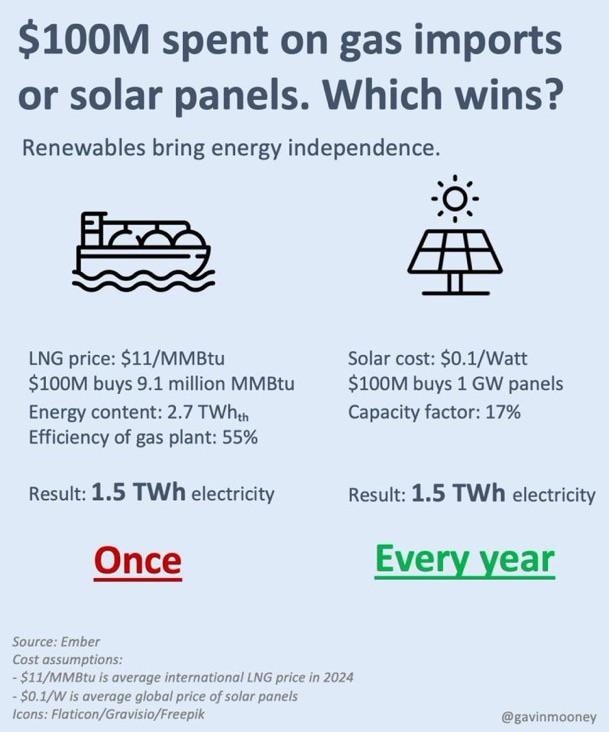
As the parent commenter said, the energy itself wouldn’t need to be delivered. You just deliver the panels once.
Why be just as bad as the old system? And while I’m not sure, I would expect it would be hugely more inefficient in terms of energy produced compared to energy delivered to the end user.
Bud, we drive gas around the country. Thats even stupider.
Lot of propaganda from oil companies is working, I see.
Yeah, I know. That’s why driving electrons around the country isn’t any better.
You don’t need to drive electrons around constantly - just drive the panels there once and you have power there for 20 years.
Michigan is cloudy or overcast most of the winter. It’s a lake-effect thing, it starts once you get over the border from Indiana. Why use panels 4 or 5 months out of the year?