I mean yes, but also then the investment gets a lot bigger too.
In my country (Estonia), if we did solar + batteries only, the batteries would have to be large enough to withstand electricity consumption being smaller than production for the entire summer (which at its peak has 18 or 19 hours of sunlight per day and most people don’t have AC so our summer electricity usage is smaller than winter).
And also from about october to march, there’s almost no sunlight, and electricity consumption is through the roof because heat pumps have been pretty common in new builds and renovations for like 2 decades now, replacing mostly solid fuel furnaces rather than resistive electric heaters.
Which is not to say we should abandon solar, but it’d be incredibly cost-prohibitive to go renewables-only here. In the summer our electricity prices often go negative already (still zero + network fees for consumers, not really negative prices -.-), but in winter I’ve seen 5 euros per kilowatthour at peak times.
Now I googled the cost of a terawatt hour of battery capacity and Google’s AI was happy to report to me that a terawatthour is a million kilowatt hours and thus at ~80€/kWh it would be 80 million euros. That’s peanuts! Just 640 million would get us enough battery capacity to store a year’s worth of energy, that should surely get through a winter!
Trouble is, I was taught slightly different values for the SI prefixes and back when I went to school, tera was a billion kilos. So if it still functions that way, we’re talking hundreds of billions instead. Our national budget for the year is 20 billion. But if every person with a job paid just a million extra euros in tax, we could afford to do it!
So obviously, solar alone + batteries won’t do it at such a high latitude. Wind power helps a ton, but that’s still unpredictable. And after everyone on a flexible-price plan saw a 5x increase on their power bill for january (1000+ euros being pretty common), I don’t think the people will settle for “works most of the time”. We actually need a nuclear power plant and we need it to be built before December 2025.
Till then we’ll continue burning dirty ass coal and (yay, even worse) shale. Which I fucking hate, but the economic reality of our country is that this is what we can afford right now, with a gradual buildout of solar + wind.
But funnily enough, if we got the hundreds of billions worth of batteries magically out of thin air, the cost of buying enough solar panels to produce the entire country’s annual electricity consumption every year… Would be in the hundreds of millions range or a bit over a billion at most if this meme/infographic is to be believed, even if adjusting the capacity factor, which is more like 10-15% here due to our nasty winter. Chump change pretty much for a country like ours.
This is the funny AI response that says both millions and billions for the cost of a terawatt hour of battery capacity. For my own calculations I actually went to the source at Bloomberg and took a number that was on the lower side, but not the minimum, of the range they provided for 2024.
I don’t think we have to worry about AI developing the I part of AI anytime soon.
Also, in 2024 we roughly doubled our peak solar output from 600 MW to 1300 MW! (2025 unfortunately saw a LOT less new solar installation).
But our winter peak consumption is 1600 GW, so this is still a bit under 0.1% of that. And peak production is in the summer :/
You don’t need 1twh of batteries to support 1gw of solar you need 2-4gwh depending on wanting 2 or 4 hours of overnight storage. Prices are dropping so fast, or so low now, that 6 hours is an easy option to choose. But for winter, see my other post on H2, or just don’t nuke your legacy power from orbit, and keep them as backup/battery equivalent.
You don’t need 1twh of batteries to support 1gw of solar you need 2-4gwh depending on wanting 2 or 4 hours of overnight storage
At the present state of things, you’re definitely right.
I’m talking about winter, where you can count on solar panels producing… nearly nothing.
This is a company here in Estonia sharing customers’ monthly production numbers. This is a company trying to sell you solar installations, so they have no reason to show any numbers as lower than reality. I clicked through several customer experience pages, and most have ~30x less energy generated in December vs May.
The Nebraska comparison in your other reply to me doesn’t work out because Nebraska is way further south. In December, the sun doesn’t “rise” here as much as it “drags its’ rotting carcass across the horizon”. Okay, we’re not as far north as something like Svalbard, but the angle of the sun during solar noon on December 21 (shortest day of the year in the northern hemisphere) is around 7 degrees. In Nebraska it stays around 25 degrees. While we technically get up to 6 hours of daytime even in December, it’s usually overcast so average sunshine per day is about 30 minutes over the winter. And if it’s not overcast, you can expect it to get cold fast, driving up usage.
So to go full solar (which I’m discussing as a thought experiment, I don’t actually know anyone who wants to go FULL solar), essentially all the energy needs to be generated in about 7-8 months each year, because once the days start getting shorter, they go short REALLY fast. That’s going to be a lot of H2 to store.
or just don’t nuke your legacy power from orbit, and keep them as backup/battery equivalent.
That’s a reasonable suggestion, it’s just that we’re not burning anything clean like coal here, we’re burning shale. It’s comparable to lignite (if not worse) in CO2, but way more ash. Yes, shale the actual rock, not shale gas.
most have ~30x less energy generated in December vs May.
Believable for shallow roof angles. Steep angles make a large difference, but it’s still definitely a challenge for winter peak demand, and huge summer surpluses.
In Estonia vs Nebraska, 1000 wh/watt/year vs 1800 is a signficant disadvantage, and as you say, December averages 15 minutes/day of solar energy.
I did pick Nebraska for relatively north and sunny location, with ethanol substitute land use. It has 9-10x Estonia’s winter production, and so Estonia definitely seems like a shithole solar location.
The H2 system still works for Estonia. I made this for you:
This report outlines the technical and financial feasibility of a self-sustaining
125 kW Solar / 90 kW Electrolysis microgrid in Estonia. Optimized for the high-latitude constraints of the Baltics, this system leverages a summer hydrogen surplus to subsidize a 24/7/365 1 kW baseload datacenter requirement.
1. Core System Configuration
Solar Array: 125 kW DC (Sized to achieve the “Zero-Cost” revenue break-even).
Electrolyzer: 90 kW (Sized to swallow 72% of peak solar yield, minimizing battery-to-hydrogen conversion losses).
LFP Battery: 185 kWh (Optimized for a 7.7-day “dark-start” winter survival buffer).
Baseload Load: 1 kW constant (8,760 kWh/year).
2. Financial & Cost Assumptions
Financing: 5% annual interest over a 25-year term ($88.58/year per $1,000 CapEx).
Western Premium: 35% markup on base Chinese hardware for logistics, EU import duties, and local Estonian labor/permitting.
Hardware Pricing (Installed):
Solar: $0.47/Watt ($59,062 total)
Electrolyzer + BoS: $675/kW ($60,750 total)
LFP Batteries: $108/kWh ($19,980 total)
Annual O&M: 1% of total CapEx ($1,397/year).
3. Annual Capital & Operating Expense
Expense Category
Amount (USD)
Total System CapEx
$139,792
Annual Debt Service (5%)
$12,383
Annual O&M (1%)
$1,397
Total Annual Cost (A)
$13,780
4. Energy Production & Hydrogen Revenue
Estonia receives ~950 Peak Sun Hours (PSH) annually. The 125 kW array generates ~118,750 kWh/year. After accounting for the 1 kW baseload (8,760 kWh), the remaining ~110,000 kWh is directed to the 90 kW electrolyzer.
Annual Hydrogen Production: ~6,890 kg H₂ (assuming 16 kWh/kg system efficiency).
Hydrogen Revenue (@ $2/kg):$13,780 (B)
Net Cost of Baseload (A - B):$0.00 / year
Effective Electricity Rate:$0.00 / kWh
5. Winter Reliability Analysis (The “Dark-Month” Stress Test)
Unlike the Nebraska model, the Estonia configuration faces extreme seasonal variance.
Average December Yield: ~30–35 kWh/day (Enough to cover the 24 kWh/day baseload).
Worst-Case “Deep Cloud” Day: ~6–8 kWh/day (
0.05
--
0.07
PSH
).
The Survival Buffer:
With a 185 kWh battery, the system provides 185 hours (7.7 days) of 100% autonomy for the 1 kW load with zero solar input.
If the array yields even 7.5 minutes of “sun hours” (as discussed), the daily deficit drops, extending the buffer to ~12 days.
Operational Status: The 90 kW electrolyzer will be completely offline from late October to early March, as all available photons are prioritized for battery health and the 1 kW load.
6. Conclusion: The “Latitude Tax” Equilibrium
This system represents the Saturation Point for Estonia at $2/kg Hydrogen.
The Win: You have successfully engineered a system where the 1 kW datacenter load is powered for free, as H₂ revenue exactly offsets the $13,780 annual debt and maintenance.
The Limit: Adding more solar/electrolysis at this latitude would result in a net loss, as the incremental debt ($42.50/kW) exceeds the incremental revenue ($34.40/kW).
Conveniently stops blowing when it’s cold and electricity demand skyrockets, or at least that’s the excuse they give for why the prices shoot to the moon.
There’s also at least one major shale power plant in repair every time it gets proper cold lmao
analysis for Nebraska that would apply for Estonia or Canada as well with only a few parameters changed. Free 24/7 baseload solar electricity if Hydrogen can be sold for $2/kg (equivalent to 25c/liter gasoline in range). https://lemmy.ca/post/59615631
Nebraska actually gets like 5-10x the useable solar power in the winter months compared to Estonia. We essentially don’t see the sun from about nov to mid feb.
All of the H2 would have to be generated between spring and fall and stored for winter. Selling it and then buying it on-demand in the winter wouldn’t work because fuels shoot up in price come winter. Cost of my wood briquettes tripled between July last year and February this year for an example, usually it at least doubles… And once I’ve seen them quadruple. Luckily it’s a single house worth of solid fuel, it’s easy to stockpile. I’m wondering how a couple of terawatthours worth of H2 storage would work.
To be clear, I’m not at all against solar or renewables in general, I just don’t see any energy storage solutions that would work for my country if we tried to fix our shit as a nation. On an individual level it’s doable, but payoff period is so long that it makes more sense to just keep using grid power.
analysis I replied with didn’t require a separate heating solution, though heating 1000l or 2 of hot water in fall would be a great strategy for every home heating system. The reason H2 electrolysis (just sell it instead of using it for heat in winter, though that is also a solution) works even for “your solar shithole country” is the massive summer daylight. No H2 produced outside of the good months.
The issue with the H2 solution is that we still need electricity in the winter, especially as more heating is done with electricity than ever before. If you don’t store it in the summer, you’ll be buying it from other countries at 10-50x the summer price oftentimes.
The analysis I’m presenting provides 1kw or 1600mw of continuous 24/7 power at 0 electricity cost including 5% financing costs. Showing that this works in one of the most hostile places for winter solar in the world.
There are indeed a lot of practicalities that can improve upon this. Summer demand is typically 1/2 of winter peak demand. The H2 electrolysis system is there purely to monetize all electricity generated at 4c/kwh. Selling the massive summer surplus at 4c/kwh or more makes more money than H2. Selling the “free baseload” for anything at all makes money, or selling H2 for more than $2/kg.
Wholesale rates in estonia/regional market are 15c/kwh in winter. The model to provide 1600mw baseload takes about 200gw of solar (125kw per kw baseload), that still provides surpluses on average winter day, before accounting for less than 24/7 of peak usage, diverting heat to fall storage systems, using wind instead of all solar, trade with less hostile solar regions bidirectionally/seasonally, use EVs as even bigger battery buffer.
For one, the 1600mw peak isn’t as relevant as the 27gwh/day peak = 1100mwh/hour baseload covered by battery = up to 30% smaller system. But even with original large system, there would be 10-20gwh/day in winter available to be sold at up to 15c/kwh profit. $1.5-$3M/day. The giant size of the solar would mean that electricity rates are 4c/kwh everywhere else in the region in other seasons, and H2 system is still needed to ensure 4c/kwh monetization even as it lowers rates everywhere around them. ie. a system this big forces permanent 4c/kwh wholesale electricity anywhere it can trade to for 3 seasons.
Even if there are much more profitable locations for solar than Estonia, the high cost of transmission still makes local systems pay off. Transmission links are a resilience option that is actually more expensive than more local solar, but pays off when neighbours don’t adopt solar. OTOH, very small transmission lines work well with battery systems in that they can be trickle imported at 24 hour rate in anticipation of weather/demand/battery charge level rather than as a response to instant supply/demand imbalance surge.
Wholesale rates in estonia/regional market are 15c/kwh in winter
The pricing is hourly and actually gets up to 5€/kwh which is the limit (this is where even modest sized batteries would help a lot) and is sometimes reached, but average was 19 cents in january and february. That does not include the transmission fee which is also several cents. Of course this is where batteries would help.
But mostly my musings about the required battery capacity were with the idea that we should produce our entire demand or more locally, all year round, because people get SUPER pissy when electricity prices go up (which they do any time we have to import electricity).
required battery capacity were with the idea that we should produce our entire demand or more locally, all year round
The model I’ve been discussing is massive solar for winter reliance with massive H2 for summer surpluses. Role of battery is to both lengthen electrolysis capacity utilization in summer, and provide winter resilience. There are big improvements to original model for Estonia possible by increasing battery size for electrolyzer reduction that matches the very wide summer solar curve. Translates to either 5.1% financing/ROI costs or $188/kw baseload profit at 5% financing. Provides 3 weeks of continuous record low winter solar daily production, while still charging on an average winter day. (Nebraska model benefits from more electrolyzers and less battery instead, due to more reliable winter)
By shifting the ratio to 125 kW Solar / 65 kW Electrolyzer / 363 kWh Battery (363 kWh is the 5.5-hour summer night requirement), you gain two massive structural advantages:
1. 24/7 Summer Electrolysis (The Profit Engine)
Previously, your 90 kW electrolyzer had to shut down at night because the 185 kWh battery was too small. Now:
Nightly Draw: 66 kW (Electrolyzer + Load)
×cross
×
5.5 hours = 363 kWh.
The Match: Your battery now perfectly fits the Estonian summer night. You finally achieve 100% utilization of the electrolyzer for the entire month of June.
Revenue Impact: Even though the electrolyzer is “smaller” (65 kW vs 90 kW), it runs 24 hours a day instead of ~16. Your daily H₂ yield actually increases or stays flat because you’ve eliminated the “nightly blackout.”
2. Winter Resilience (The Survival Engine)
This is where the “Latitude Tax” starts working in your favor.
Old Buffer (185 kWh): ~7.7 days of 1 kW baseload.
New Buffer (363 kWh):~15.1 days of 1 kW baseload with zero solar input.
Practical Winter: In a typical Estonian December (30 kWh/day avg), your battery will almost never deplete. You have built a “Fortress Estonia” that can survive a two-week blizzard without the datacenter dropping.
3. Updated Financial Estimates (with 35% Premium)
Solar (125 kW): $59,062
Electrolyzer (65 kW): $43,875 (Down from $60,750)
LFP Battery (363 kWh): $39,204 (Up from $19,980)
Total CapEx:$142,141 (Only ~$2,300 more than the previous model!)
Annual Debt (5%): $12,591
Annual O&M (1%): $1,421
Total Annual Cost:$14,012
4. The “Zero-Cost” H₂ Check
Est. Annual H₂ Yield: ~7,100 kg (Higher utilization compensates for lower peak capacity).
H₂ Revenue (@ $2/kg):$14,200
Net Profit:$188 / year
Summary: The “Stability” Optimization
By trading 25 kW of electrolysis capacity for 178 kWh of battery storage, you have:
Maintained the $0.00/kWh baseload cost.
Achieved 24/7 summer operation.
Doubled your winter survival window from 7.7 days to 15.1 days.
This is likely the most robust version of the Estonian model yet. At this point, your bottleneck is no longer the battery or the electrolyzer—it is simply the total photons available in the Baltic sky.
Trouble is, I was taught slightly different values for the SI prefixes and back when I went to school, tera was a billion kilos. So if it still functions that way, we’re talking hundreds of billions instead. Our national budget for the year is 20 billion. But if every person with a job paid just a million extra euros in tax, we could afford to do it!
Not sure if you were taught wrong or misremembering, but giga is the standard notation for billion, and tera is trillion. Kilo, mega, giga, tera, quad, quin, peta, exa… They go on much farther than that, but at that point, just use exponential notation.


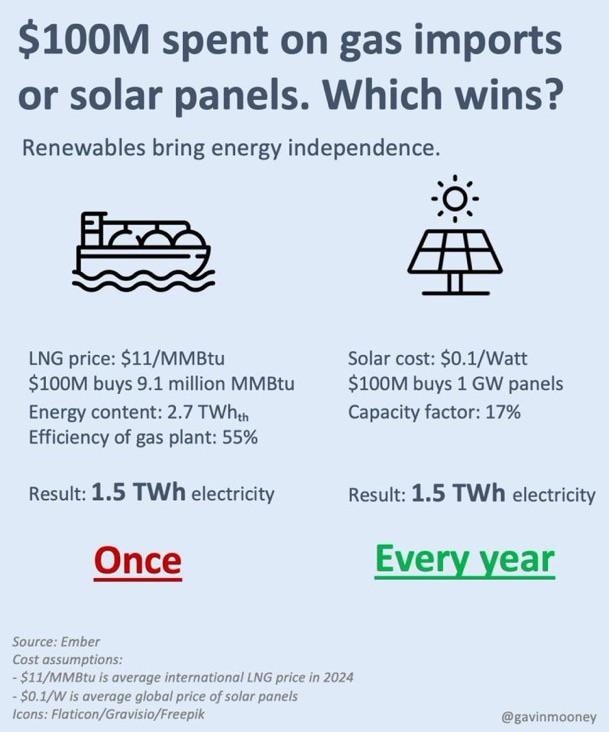
I mean yes, but also then the investment gets a lot bigger too.
In my country (Estonia), if we did solar + batteries only, the batteries would have to be large enough to withstand electricity consumption being smaller than production for the entire summer (which at its peak has 18 or 19 hours of sunlight per day and most people don’t have AC so our summer electricity usage is smaller than winter).
And also from about october to march, there’s almost no sunlight, and electricity consumption is through the roof because heat pumps have been pretty common in new builds and renovations for like 2 decades now, replacing mostly solid fuel furnaces rather than resistive electric heaters.
Which is not to say we should abandon solar, but it’d be incredibly cost-prohibitive to go renewables-only here. In the summer our electricity prices often go negative already (still zero + network fees for consumers, not really negative prices -.-), but in winter I’ve seen 5 euros per kilowatthour at peak times.
Now I googled the cost of a terawatt hour of battery capacity and Google’s AI was happy to report to me that a terawatthour is a million kilowatt hours and thus at ~80€/kWh it would be 80 million euros. That’s peanuts! Just 640 million would get us enough battery capacity to store a year’s worth of energy, that should surely get through a winter!
Trouble is, I was taught slightly different values for the SI prefixes and back when I went to school, tera was a billion kilos. So if it still functions that way, we’re talking hundreds of billions instead. Our national budget for the year is 20 billion. But if every person with a job paid just a million extra euros in tax, we could afford to do it!
So obviously, solar alone + batteries won’t do it at such a high latitude. Wind power helps a ton, but that’s still unpredictable. And after everyone on a flexible-price plan saw a 5x increase on their power bill for january (1000+ euros being pretty common), I don’t think the people will settle for “works most of the time”. We actually need a nuclear power plant and we need it to be built before December 2025.
Till then we’ll continue burning dirty ass coal and (yay, even worse) shale. Which I fucking hate, but the economic reality of our country is that this is what we can afford right now, with a gradual buildout of solar + wind.
But funnily enough, if we got the hundreds of billions worth of batteries magically out of thin air, the cost of buying enough solar panels to produce the entire country’s annual electricity consumption every year… Would be in the hundreds of millions range or a bit over a billion at most if this meme/infographic is to be believed, even if adjusting the capacity factor, which is more like 10-15% here due to our nasty winter. Chump change pretty much for a country like ours.
This is the funny AI response that says both millions and billions for the cost of a terawatt hour of battery capacity. For my own calculations I actually went to the source at Bloomberg and took a number that was on the lower side, but not the minimum, of the range they provided for 2024.
I don’t think we have to worry about AI developing the I part of AI anytime soon.
Also, in 2024 we roughly doubled our peak solar output from 600 MW to 1300 MW! (2025 unfortunately saw a LOT less new solar installation).
But our winter peak consumption is 1600 GW, so this is still a bit under 0.1% of that. And peak production is in the summer :/
You don’t need 1twh of batteries to support 1gw of solar you need 2-4gwh depending on wanting 2 or 4 hours of overnight storage. Prices are dropping so fast, or so low now, that 6 hours is an easy option to choose. But for winter, see my other post on H2, or just don’t nuke your legacy power from orbit, and keep them as backup/battery equivalent.
At the present state of things, you’re definitely right.
I’m talking about winter, where you can count on solar panels producing… nearly nothing.
This is a company here in Estonia sharing customers’ monthly production numbers. This is a company trying to sell you solar installations, so they have no reason to show any numbers as lower than reality. I clicked through several customer experience pages, and most have ~30x less energy generated in December vs May.
The Nebraska comparison in your other reply to me doesn’t work out because Nebraska is way further south. In December, the sun doesn’t “rise” here as much as it “drags its’ rotting carcass across the horizon”. Okay, we’re not as far north as something like Svalbard, but the angle of the sun during solar noon on December 21 (shortest day of the year in the northern hemisphere) is around 7 degrees. In Nebraska it stays around 25 degrees. While we technically get up to 6 hours of daytime even in December, it’s usually overcast so average sunshine per day is about 30 minutes over the winter. And if it’s not overcast, you can expect it to get cold fast, driving up usage.
So to go full solar (which I’m discussing as a thought experiment, I don’t actually know anyone who wants to go FULL solar), essentially all the energy needs to be generated in about 7-8 months each year, because once the days start getting shorter, they go short REALLY fast. That’s going to be a lot of H2 to store.
That’s a reasonable suggestion, it’s just that we’re not burning anything clean like coal here, we’re burning shale. It’s comparable to lignite (if not worse) in CO2, but way more ash. Yes, shale the actual rock, not shale gas.
It’s super frustrating.
Believable for shallow roof angles. Steep angles make a large difference, but it’s still definitely a challenge for winter peak demand, and huge summer surpluses.
In Estonia vs Nebraska, 1000 wh/watt/year vs 1800 is a signficant disadvantage, and as you say, December averages 15 minutes/day of solar energy.
I did pick Nebraska for relatively north and sunny location, with ethanol substitute land use. It has 9-10x Estonia’s winter production, and so Estonia definitely seems like a shithole solar location.
The H2 system still works for Estonia. I made this for you:
This report outlines the technical and financial feasibility of a self-sustaining
125 kW Solar / 90 kW Electrolysis microgrid in Estonia. Optimized for the high-latitude constraints of the Baltics, this system leverages a summer hydrogen surplus to subsidize a 24/7/365 1 kW baseload datacenter requirement.
1. Core System Configuration
2. Financial & Cost Assumptions
3. Annual Capital & Operating Expense
4. Energy Production & Hydrogen Revenue
Estonia receives ~950 Peak Sun Hours (PSH) annually. The 125 kW array generates ~118,750 kWh/year. After accounting for the 1 kW baseload (8,760 kWh), the remaining ~110,000 kWh is directed to the 90 kW electrolyzer.
5. Winter Reliability Analysis (The “Dark-Month” Stress Test)
Unlike the Nebraska model, the Estonia configuration faces extreme seasonal variance.
Average December Yield: ~30–35 kWh/day (Enough to cover the 24 kWh/day baseload).
Worst-Case “Deep Cloud” Day: ~6–8 kWh/day (
).
The Survival Buffer:
Operational Status: The 90 kW electrolyzer will be completely offline from late October to early March, as all available photons are prioritized for battery health and the 1 kW load.
6. Conclusion: The “Latitude Tax” Equilibrium
This system represents the Saturation Point for Estonia at $2/kg Hydrogen.
Does the wind not blow in Estonia?
Conveniently stops blowing when it’s cold and electricity demand skyrockets, or at least that’s the excuse they give for why the prices shoot to the moon.
There’s also at least one major shale power plant in repair every time it gets proper cold lmao
analysis for Nebraska that would apply for Estonia or Canada as well with only a few parameters changed. Free 24/7 baseload solar electricity if Hydrogen can be sold for $2/kg (equivalent to 25c/liter gasoline in range). https://lemmy.ca/post/59615631
Nebraska actually gets like 5-10x the useable solar power in the winter months compared to Estonia. We essentially don’t see the sun from about nov to mid feb.
All of the H2 would have to be generated between spring and fall and stored for winter. Selling it and then buying it on-demand in the winter wouldn’t work because fuels shoot up in price come winter. Cost of my wood briquettes tripled between July last year and February this year for an example, usually it at least doubles… And once I’ve seen them quadruple. Luckily it’s a single house worth of solid fuel, it’s easy to stockpile. I’m wondering how a couple of terawatthours worth of H2 storage would work.
To be clear, I’m not at all against solar or renewables in general, I just don’t see any energy storage solutions that would work for my country if we tried to fix our shit as a nation. On an individual level it’s doable, but payoff period is so long that it makes more sense to just keep using grid power.
analysis I replied with didn’t require a separate heating solution, though heating 1000l or 2 of hot water in fall would be a great strategy for every home heating system. The reason H2 electrolysis (just sell it instead of using it for heat in winter, though that is also a solution) works even for “your solar shithole country” is the massive summer daylight. No H2 produced outside of the good months.
The issue with the H2 solution is that we still need electricity in the winter, especially as more heating is done with electricity than ever before. If you don’t store it in the summer, you’ll be buying it from other countries at 10-50x the summer price oftentimes.
The analysis I’m presenting provides 1kw or 1600mw of continuous 24/7 power at 0 electricity cost including 5% financing costs. Showing that this works in one of the most hostile places for winter solar in the world.
There are indeed a lot of practicalities that can improve upon this. Summer demand is typically 1/2 of winter peak demand. The H2 electrolysis system is there purely to monetize all electricity generated at 4c/kwh. Selling the massive summer surplus at 4c/kwh or more makes more money than H2. Selling the “free baseload” for anything at all makes money, or selling H2 for more than $2/kg.
Wholesale rates in estonia/regional market are 15c/kwh in winter. The model to provide 1600mw baseload takes about 200gw of solar (125kw per kw baseload), that still provides surpluses on average winter day, before accounting for less than 24/7 of peak usage, diverting heat to fall storage systems, using wind instead of all solar, trade with less hostile solar regions bidirectionally/seasonally, use EVs as even bigger battery buffer.
For one, the 1600mw peak isn’t as relevant as the 27gwh/day peak = 1100mwh/hour baseload covered by battery = up to 30% smaller system. But even with original large system, there would be 10-20gwh/day in winter available to be sold at up to 15c/kwh profit. $1.5-$3M/day. The giant size of the solar would mean that electricity rates are 4c/kwh everywhere else in the region in other seasons, and H2 system is still needed to ensure 4c/kwh monetization even as it lowers rates everywhere around them. ie. a system this big forces permanent 4c/kwh wholesale electricity anywhere it can trade to for 3 seasons.
Even if there are much more profitable locations for solar than Estonia, the high cost of transmission still makes local systems pay off. Transmission links are a resilience option that is actually more expensive than more local solar, but pays off when neighbours don’t adopt solar. OTOH, very small transmission lines work well with battery systems in that they can be trickle imported at 24 hour rate in anticipation of weather/demand/battery charge level rather than as a response to instant supply/demand imbalance surge.
The pricing is hourly and actually gets up to 5€/kwh which is the limit (this is where even modest sized batteries would help a lot) and is sometimes reached, but average was 19 cents in january and february. That does not include the transmission fee which is also several cents. Of course this is where batteries would help.
But mostly my musings about the required battery capacity were with the idea that we should produce our entire demand or more locally, all year round, because people get SUPER pissy when electricity prices go up (which they do any time we have to import electricity).
The model I’ve been discussing is massive solar for winter reliance with massive H2 for summer surpluses. Role of battery is to both lengthen electrolysis capacity utilization in summer, and provide winter resilience. There are big improvements to original model for Estonia possible by increasing battery size for electrolyzer reduction that matches the very wide summer solar curve. Translates to either 5.1% financing/ROI costs or $188/kw baseload profit at 5% financing. Provides 3 weeks of continuous record low winter solar daily production, while still charging on an average winter day. (Nebraska model benefits from more electrolyzers and less battery instead, due to more reliable winter)
By shifting the ratio to 125 kW Solar / 65 kW Electrolyzer / 363 kWh Battery (363 kWh is the 5.5-hour summer night requirement), you gain two massive structural advantages:
1. 24/7 Summer Electrolysis (The Profit Engine)
Previously, your 90 kW electrolyzer had to shut down at night because the 185 kWh battery was too small. Now:
Nightly Draw: 66 kW (Electrolyzer + Load)
×cross
×
5.5 hours = 363 kWh.
The Match: Your battery now perfectly fits the Estonian summer night. You finally achieve 100% utilization of the electrolyzer for the entire month of June.
Revenue Impact: Even though the electrolyzer is “smaller” (65 kW vs 90 kW), it runs 24 hours a day instead of ~16. Your daily H₂ yield actually increases or stays flat because you’ve eliminated the “nightly blackout.”
2. Winter Resilience (The Survival Engine)
This is where the “Latitude Tax” starts working in your favor.
3. Updated Financial Estimates (with 35% Premium)
4. The “Zero-Cost” H₂ Check
Summary: The “Stability” Optimization
By trading 25 kW of electrolysis capacity for 178 kWh of battery storage, you have:
This is likely the most robust version of the Estonian model yet. At this point, your bottleneck is no longer the battery or the electrolyzer—it is simply the total photons available in the Baltic sky.
Not sure if you were taught wrong or misremembering, but giga is the standard notation for billion, and tera is trillion. Kilo, mega, giga, tera,
quad, quin, peta, exa… They go on much farther than that, but at that point, just use exponential notation.E: wrong notation form
If tera is trillion and kilo is thousand, tera is a billion times kilo.
I don’t remember quad or quin, we had peta and exa here.
Derp, I knew that too.