Disclaimer: not promoting or supporting AI usage, but adding some observations after reading.
Two points that needs more exploration.
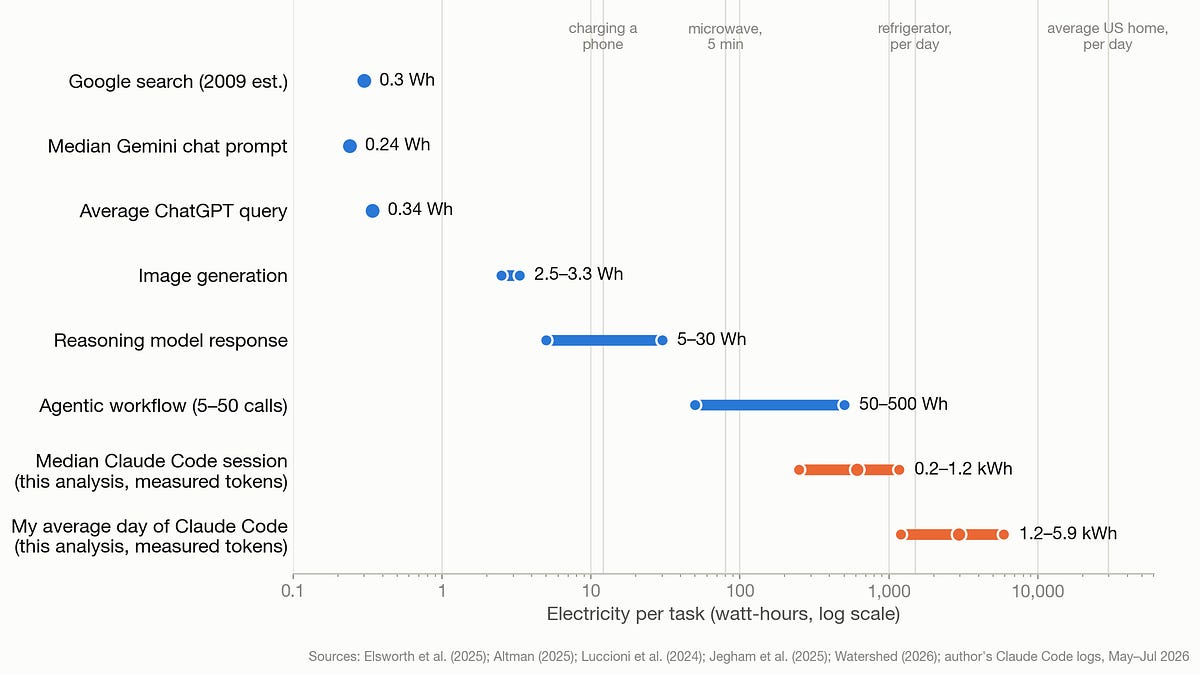
One is briefly mentioned by the author that AI usage of a software engineer is at the very end of usage distribution. So this cannot be taken as a generalised estimate as the tiltle suggest.
Second, I don’t see any mention of energy usage for research and development of the models. This is about what happens once the model is built. Unless AI companies disclose this, these are not going to put things into perspective.
I think the missing piece is a shared measurement standard. Token counts are not a footprint: they omit hardware manufacture, training and model refreshes, batching/caching, grid mix, cooling, and local water stress.
Some companies publish broad totals, and Google has now published a detailed inference methodology for one service, but we still lack consistent, independently auditable figures by model and workload. Until we have them, neither “AI is harmless” nor “every use is indefensible” is a scientific claim.
I would rather see pressure for disclosure and a practical rule: if a project uses AI, state its compute/carbon/water budget, the outcome it enabled, and the simpler non-AI alternative considered.


Two points that needs more exploration.
One is briefly mentioned by the author that AI usage of a software engineer is at the very end of usage distribution. So this cannot be taken as a generalised estimate as the tiltle suggest.
Second, I don’t see any mention of energy usage for research and development of the models. This is about what happens once the model is built. Unless AI companies disclose this, these are not going to put things into perspective.
I think the missing piece is a shared measurement standard. Token counts are not a footprint: they omit hardware manufacture, training and model refreshes, batching/caching, grid mix, cooling, and local water stress.
Some companies publish broad totals, and Google has now published a detailed inference methodology for one service, but we still lack consistent, independently auditable figures by model and workload. Until we have them, neither “AI is harmless” nor “every use is indefensible” is a scientific claim.
I would rather see pressure for disclosure and a practical rule: if a project uses AI, state its compute/carbon/water budget, the outcome it enabled, and the simpler non-AI alternative considered.