
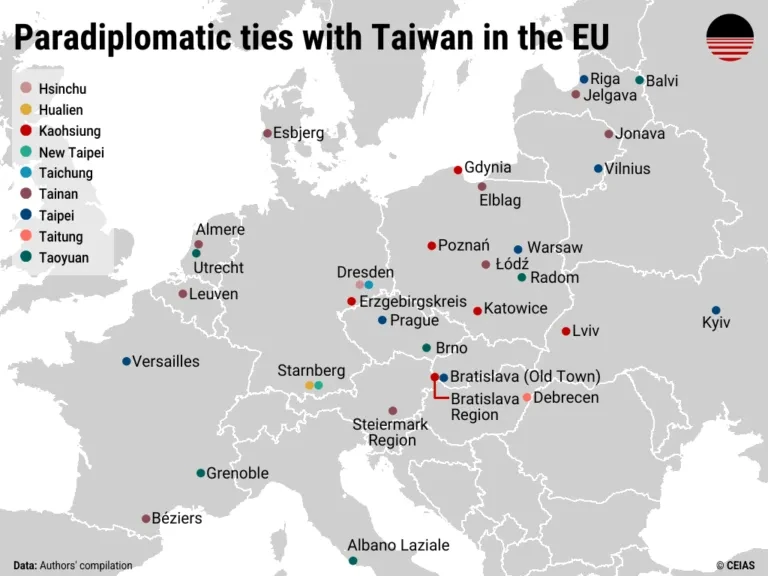
Source: Jun 2026 report from CEIAS (Central European Institute of Asian Studies): Sister cities, strategic gaps: Taiwan’s uneven paradiplomacy in Europe.
Via this post.
A few interesting tidbits from the report:
On the Taiwanese side, the most active cities are Tainan (nine European partners), Kaohsiung (7), Taoyuan (6), and Taipei (6). Hsinchu, Hualien, New Taipei, Taichung, and Taitung also maintain singular ties with local or regional governments in Europe. On the European side, Poland is the most active, with seven cities (Elblag, Gdynia, Katowice, Łódz, Poznań, Radom, and Warsaw) having partnerships with Taiwanese counterparts. This is followed by Germany, where three municipalities (Dresden, Erzgebirgskreis, and Starnberg) have as many as five ties to Taiwan. Paradiplomatic relations are also found in France (3), Latvia (3), Czechia (2), Lithuania (2), the Netherlands (2), Slovakia (2), Ukraine (2), Belgium (1), Denmark (1), Hungary (1), and Italy (1). The Nordic countries and Southern Europe remain notable gaps in Taiwan’s current paradiplomatic outreach.
For Taiwan, these paradiplomatic ties complement broader outreach efforts by creating an additional channel for international engagement amid constraints in the formal diplomatic system. They can create additional opportunities for engagement with European actors. Sister-city partnerships can facilitate cooperation with European local economies and governance networks through cooperation in areas such as innovation, the green transition, urban planning, or public health. Repeated exchanges and joint initiatives may also help normalize Taiwan’s presence as a capable partner, even if such cooperation remains politically sensitive in certain contexts.
(…) officials in many European cities operate under the impression that pursuing cooperation with Taiwanese partners may lead to boycotts by Chinese tourists and other forms of Chinese retaliation, which is one reason Edinburgh pre-emptively shelved a friendship agreement with Kaohsiung in 2024.
By contrast, other European cities, including Prague, have been more willing to absorb or dismiss such risks. In 2019, the city moved to terminate its sister-city agreement with Beijing over a dispute concerning the “One-China” clause and, in 2020, signed a new partnership with Taipei. The move triggered a series of retaliatory measures from China: Shanghai canceled its agreement with Prague, Chinese authorities blocked or discouraged Czech cultural performances and tours in China, and Chinese officials issued repeated diplomatic warnings to Czech counterparts. Despite these actions, Prague not only maintained but further deepened its engagement with Taiwan, suggesting a willingness to absorb reputational and diplomatic costs in pursuit of a values- and interest-driven partnership.
The Pact was established in 2019 by four Central European capitals—Bratislava, Budapest, Prague, and Warsaw—to share best practices in urban development and municipal governance, as well as to resist illiberal and populist practices of their respective central governments. Since then, the regional platform has expanded to cover municipalities across Europe, such as Berlin, Paris, Riga, and Vienna, and across North America, including Los Angeles, Boston, Seattle, and Chicago. It currently boasts 45 members. In 2021, the Taiwanese cities of Taipei and Taoyuan became the Pact’s first, and so far only, members from East Asia.
Solidarity with Ukraine, and parallels between Russian aggression of the country with potential future invasion of Taiwan by China, has also sped up engagements between Taiwan and Ukraine. Even if Ukraine’s central government remains wary of official contacts so as not to spur even more Chinese support for Russia, on the subnational level relations are taking off. Taipei and Kyiv signed a cooperation memorandum in 2023, while Lviv and Kaohsiung established ties in 2025.