

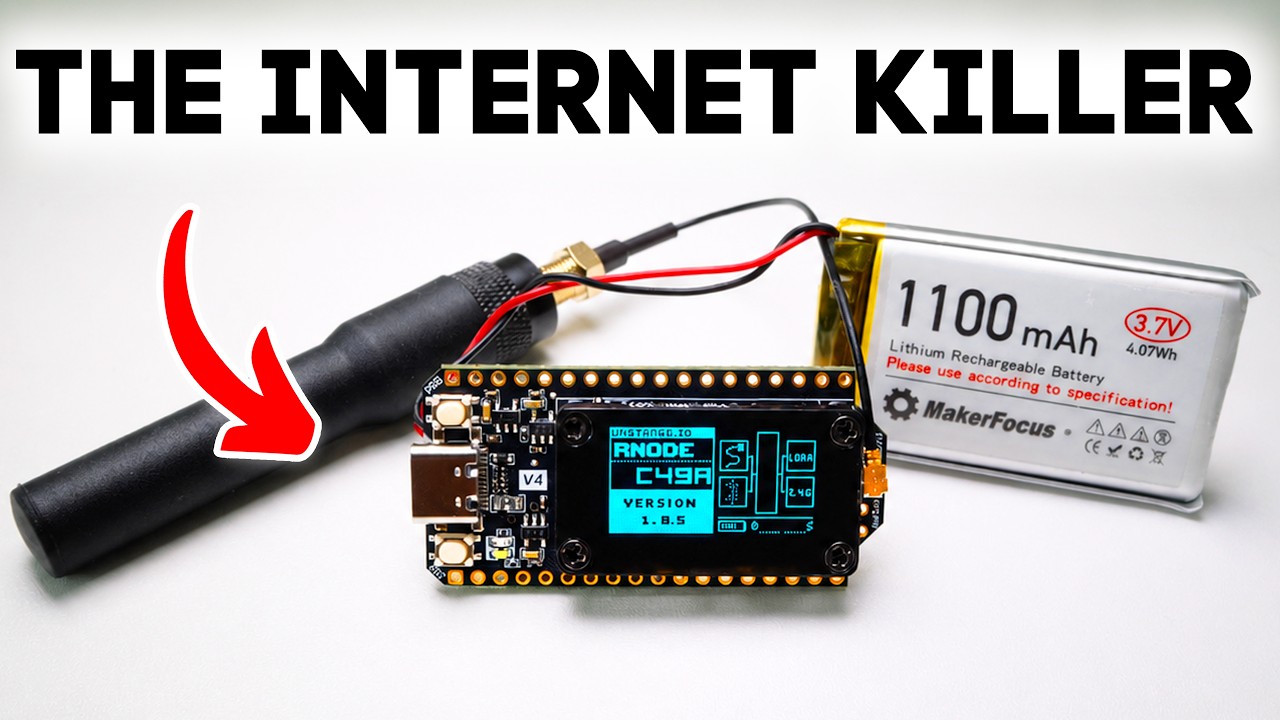
No internet required… In this video, I build a public Reticulum node and test whether it can bridge completely different networks into one encrypted communication path. I send messages from a normal phone over LTE, through the internet and Starlink, then off-grid over LoRa—eventually using a $20 drone-mounted relay to reach a phone with no internet connection at all.
My local ham club treats that ultramarathon as an emergency preparedness drill. It requires us to bring radio equipment out into the woods away from power outlets and cell phone coverage and spend a day communicating by VHF FM over rugged wooded terrain. It’s a pretty solid simulation of setting up an ad hoc communications system during a disaster scenario such as a hurricane, no? We’re there so that we can figure out when a runner has gone missing, approximately where on the trail, find them, and maybe call for help if they’re hurt. That’s not dissimilar to our mission when we man the emergency shelters for the purposes of “do you have enough diapers” or “is this missing person at your shelter?”
“Ad hoc disaster communications” can mean anything from keeping in touch with your party if you have to split up to getting news from the outside world to calling for help from the outside world. Frankly I think any of those LoRa networks are next to useless for that. The hardware is kind of pathetic, from my hands-on experience, and in a wooded area it’s almost designed to not work.
For getting news from the outside world, an AM radio receiver as installed in every car can hear for a few hundred miles during the day and a thousand miles at night. Commercial broadcast FM radio has a range of 50 miles or so assuming a receiving antenna at about chest height. I might recommend having and knowing how to use a television antenna. Powering a modern television from a generator and receiving over the air broadcasts might just get you a news conference with the governor or something.
This part is US centric: NOAA operates a network of radio transmitters in the 160MHz range broadcasting weather updates. If you don’t own one of those receivers, get one. They’re cheap, easy and useful.
Communicating with your own group, a family or neighbors or whatever your situation is, GMRS or MURS is a better solution. Both allow 20+ times the power than LoRa. MURS is VHF, just above the 2 meter ham band, it punches through foliage a lot better but is limited to simplex only. GMRS is UHF, just below the amateur 70cm band, not as easy to push through the trees but repeaters are allowed. Depending on your situation and what other folks in your area are doing, those are likely better choices.
Reaching out for help…the problem with something like LoRa for this is you’re relying on a bunch of very cheap, shoddy little radios to relay a message to…someone. CB might be a choice here, it’s a standard in the trucking industry and you might get some propagation, but being or knowing a ham is probably your best bet. Emergency comms is one of the stated purposes for creating the amateur radio service, that’s what the ARES service is for, if you’re really interested in emergency comms you should probably look into it.