

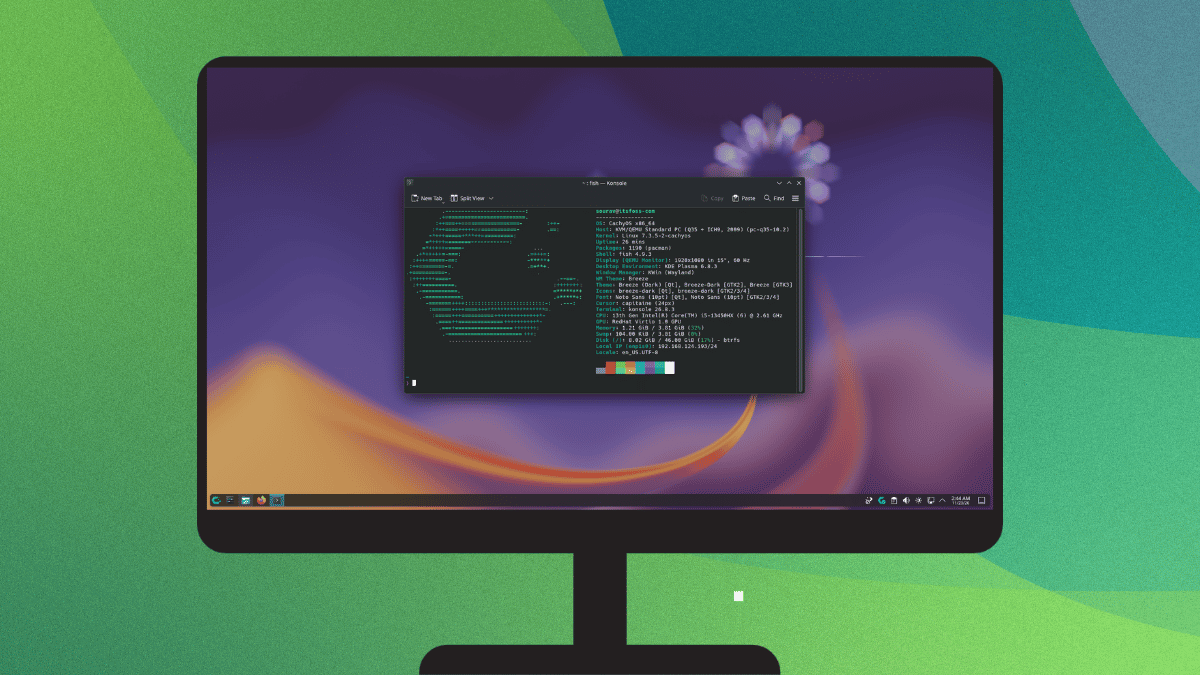
CachyOS is a distro pick that suits both power users and gamers alike. The installer offers 17+ desktop environments to pick from, and gamers get a Handheld Edition for devices like the Steam Deck and ROG Ally.
Based on Arch Linux, it ships its own kernel and package builds for specific CPUs, while the installer comes as a GUI or a command-line version.
CachyOS has now put out its sixth release of the year, and this one changes how the system boots, recovers, and installs software.
The November Release
CachyOS now has a dedicated kernel for games that use Epic’s Easy Anti-Cheat (EAC) Linux v2. EAC checks the boot chain before it lets a game run, and the new
linux-cachyos-eac
kernel is signed with the CachyOS key.
Don’t worry, it gets a dedicated boot entry, while your regular ones stay untouched, with the
eac-setup
script handling the bootloader configuration. Because DKMS modules don’t load on this kernel, NVIDIA, ZFS and r8125 come as prebuilt packages for it.
Then there’s
cachyos-recovery
, a rescue image that lives on the EFI partition and can be launched from the bootloader menu or directly from UEFI without a live USB.
From its menu, you can boot any Btrfs snapshot with a writable root to check it first and roll back once you’re happy with it. The rollback also runs from a desktop notification.
It works without Snapper and supports LUKS-encrypted disks. The package is
cachyos-recovery
, with a
cachyos-recovery-legacy
variant specifically for BIOS machines.
Similarly, Package Installer, the software manager, reaches v2.0 with a new UI. It can now handle AUR, Flatpak and AppImage packages, and each one is opt-in.
Before an AUR build runs, you can read the PKGBUILD and install scripts, and a static analysis step highlights what deserves a closer look. Updates come with a diff against the installed version.
CachyOS Settings, the package holding CachyOS’s tuning configs, brings
backsystemd-oomd
, the out-of-memory killer, and enables it by default. It steps in based on swap usage and skips the user session.
The new
cachyos-drm-awaiter
helper replaces early KMS and the
nvidia-module-loader.
Early KMS used to initialize the graphics driver during the boot process, allowing CachyOS to switch to the display’s native resolution much earlier.
Now, the helper holds the login screen back until the graphics driver has loaded, and that applies to any driver rather than only NVIDIA’s. If loading fails, a QR code shows up on screen.
chwd
, the hardware detection tool, drops early KMS to match, and existing users need to run sudo
sudo chwd -a -f
after updating to apply the change.
Calamares (the GUI installer) uses the CLI installer’s gucc library for the initramfs, machine-id, and post-install steps, and the rest is being moved over step by step. The CLI installer itself was refactored onto the same library.
Plymouth, the boot splash, is now optional, and the rEFInd + AI SDK bootloader option is gone. CachyOS can also run on the Windows Subsystem for Linux now through a new image.
And finally, the kernel moves to Linux 7.3.5, with NVIDIA 620.73.04 and Mesa 26.3.1 also being included. The full changelog is available in the release blog post.
Download CachyOS
The Desktop Edition ISOs have been updated to reflect the changes in this new release. If you are looking to try it for the first time, then this is the pick for you.
Existing users can upgrade to this release by running the following command:
sudo pacman -Syu
This isn’t anything kernel level from Epic. Epic wants to prevent users from using kernel level cheats by mandating that certain software and hardware security features like Secure Boot and TPM are enabled. And trusted distros sign the kernel to help make sure anything tempered can be detected.
The proprietary anti-cheat, to my knowledge, is all userspace. I know there’s a systemd service component, not sure what else, if anything. It’s not like Windows where you are loading their code into the kernel.
That also means if you really don’t want to use that kernel, you can just configure your system to have both the regular kernel and easy anti cheat compatible kernel. And only boot the easy anti cheat kernel if you want to play games.
Also, I recommend reading through this thread. The particular user I linked did a good job explaining what the EAC update does, and it’s not good.
Except rebooting to swap kernels is a pain in the ass. It’s why a lot of people don’t want to dual-boot Windows for the same functionality.
It’s adding friction to Linux to get people to just stay on the AC kernel all the time. You know what that’s called? Enshittification.
And what’s going to happen when a bunch of games that already require it on Windows but not on Linux switch to requiring it on Linux too? Once it grabs hold, it’s only going to spread.
If this is the ideology that spreads, I’d be fine with that. I would much rather have this than actual kernel-level anticheat. At least this way I know what’s running in my kernel.
Come to think of it, I don’t really see any better way Epic could have implemented a client-side anticheat. Server-side would have been the best case for us, but no game developer is going to buy that from Epic.
maybe you could kexec if you were feeling spicy. but agree it’s a pain
Literally, literally kernel-level.
you should reread everything. the kernel has no EAC code in it here.
To my understanding, Epic is mandating standard Linux security security features. Those features and a signed kernel is just saying that the kernel level is untampered with.
But no “kenel-level” code from Epic is being run. Epic’s code is userspace.
I mean, you can make the argument that since it is relying on the kernel in this way, it’s kernel space, but I think that’s a poor argument. All userspace code is interacting with the kernel in some way. Like, I wouldn’t say that Wine is kernel level because it uses Linux syscalls and NTSync.