Fake. The only RAM ENIAC ever had was 100-word magnetic core memory since 1953. That means 4×100 ferrite cores, each a few mm, wired in a matrix, likely 10×10 for each of the 4 bits since the computer used a kind of binary-coded-decimal system (Excess-3). The address decoding and R/W logic made of vacuum tubes definitely took up lots of space but the memory itself was likely very small and not worth making modular beyond separating the 4 bitplanes because of all the wires in the matrix and high reliability compared to tubes and electromechanical parts.
To be fair, the picture allegedly shows 8 out of 400 (1/50) of all bits available to the ENIAC, and I wouldn’t be surprised if the memory expansion’s logic took 50x the space of the module pictured. Maybe it’s a register for the currently accessed memory address (8 bits)? Still, those things are called “registers” and not “RAM” for a reason: they’re usually fixed-purpose and not sequentially addresible.



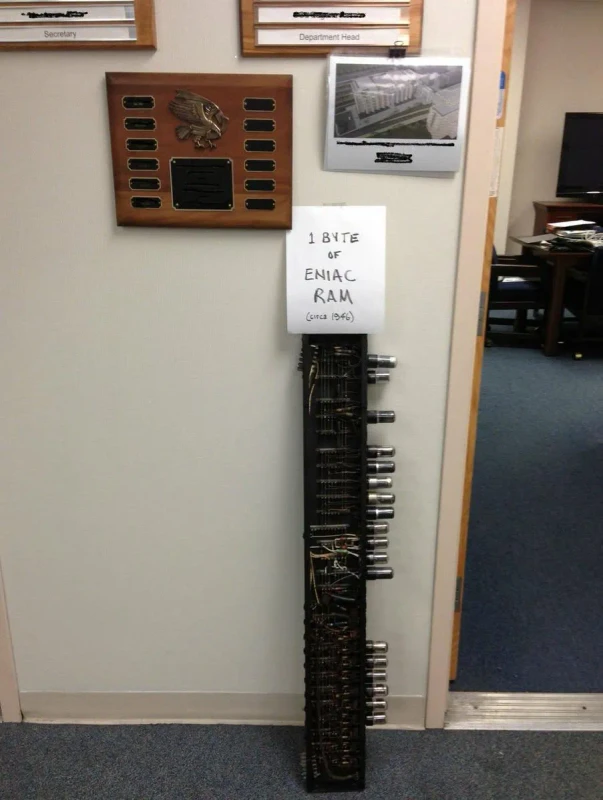
Fake. The only RAM ENIAC ever had was 100-word magnetic core memory since 1953. That means 4×100 ferrite cores, each a few mm, wired in a matrix, likely 10×10 for each of the 4 bits since the computer used a kind of binary-coded-decimal system (Excess-3). The address decoding and R/W logic made of vacuum tubes definitely took up lots of space but the memory itself was likely very small and not worth making modular beyond separating the 4 bitplanes because of all the wires in the matrix and high reliability compared to tubes and electromechanical parts.
To be fair, the picture allegedly shows 8 out of 400 (1/50) of all bits available to the ENIAC, and I wouldn’t be surprised if the memory expansion’s logic took 50x the space of the module pictured. Maybe it’s a register for the currently accessed memory address (8 bits)? Still, those things are called “registers” and not “RAM” for a reason: they’re usually fixed-purpose and not sequentially addresible.
Those old ferrite memory cores are so cool. I got an old one I keep meaning to put in a frame or something.