Wikipedia says the computer had no working memory per se, only storing data on tape, until the 1953 addition of 100-word magnetic core RAM. That means 4×100 ferrite cores, each a few mm, wired in a matrix, likely 10×10 for each of the 4 bits since the computer used a kind of binary-coded-decimal system (Excess-3, as you mentioned). The address decoding and R/W logic made of vacuum tubes definitely took up lots of space but the memory itself was likely very small and not worth making modular because of all the wires in the matrix and high reliability compared to tubes and electromechanical parts, so the label is probably incorrect not just by year.



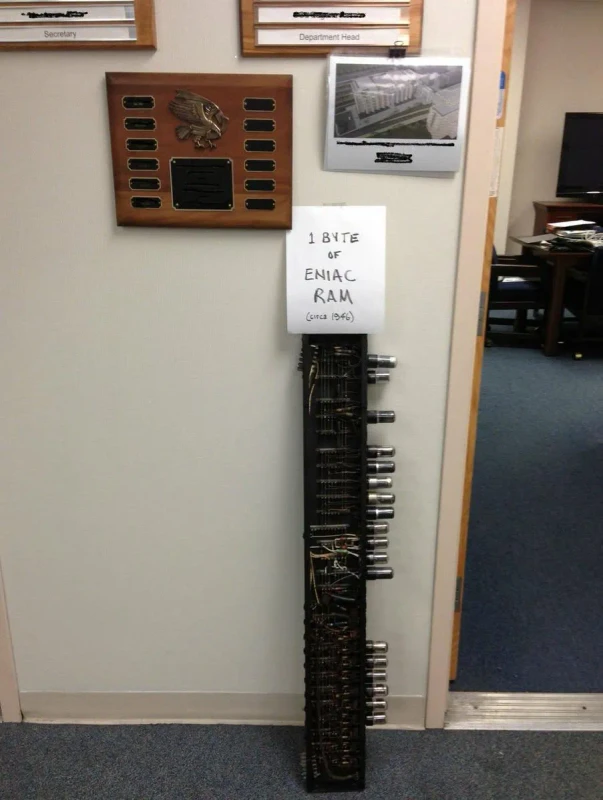
And I’m pretty sure it only actually stores 4 bits (https://en.wikipedia.org/wiki/Excess-3), so half a modern byte.
Judging from wikipedia, it was also built as an upgrade for the original computer in 1953 (not 1946).
That would be a nibble.
https://en.wikipedia.org/wiki/Nibble
Also known as a nibble.
Wikipedia says the computer had no working memory per se, only storing data on tape, until the 1953 addition of 100-word magnetic core RAM. That means 4×100 ferrite cores, each a few mm, wired in a matrix, likely 10×10 for each of the 4 bits since the computer used a kind of binary-coded-decimal system (Excess-3, as you mentioned). The address decoding and R/W logic made of vacuum tubes definitely took up lots of space but the memory itself was likely very small and not worth making modular because of all the wires in the matrix and high reliability compared to tubes and electromechanical parts, so the label is probably incorrect not just by year.