

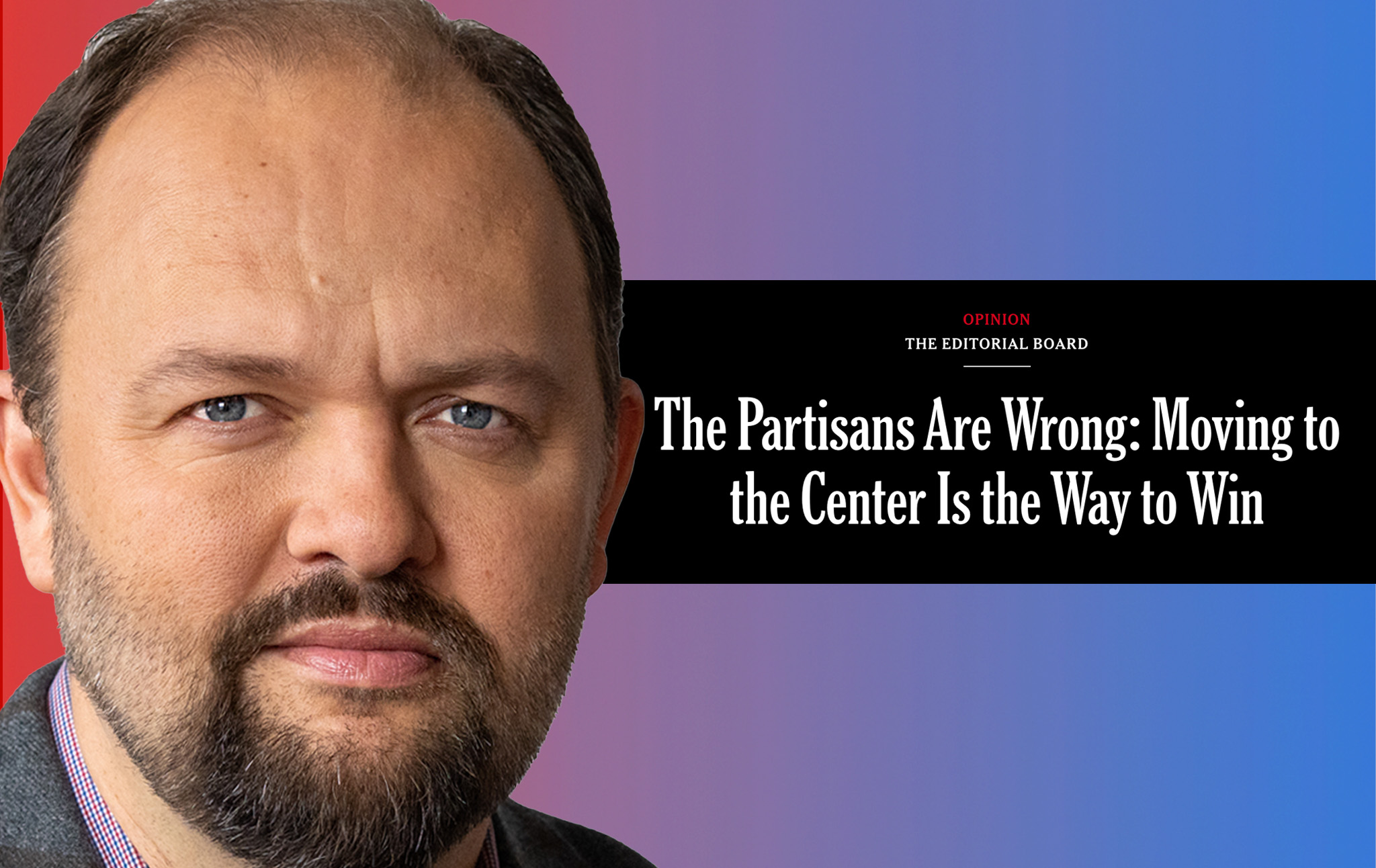
The New York Times editorial board is wrong. Principled progressive politics on the Bernie Sanders model is still the path forward.
There is a very simple political narrative, repeated ad nauseum, that goes something like this:
The average American does not like “extreme” politicians of the right or left. As the right becomes more extreme, Democrats should “occupy the center lane,” offering “moderate” solutions with broad appeal. If they become too “extreme,” they will alienate the average voter. They should therefore retreat from excessively “progressive” positions, proving themselves to be the “reasonable” alternative to the right. When Democrats lose, it is because they have “gone too far left,” and they must return to the sensible, careful, reasonable center in order to win.
(I use quotes because I think all of these terms need to be questioned rather than accepted at face value.)
This is, roughly, the thesis of the New York Times editorial board’s recent article “The Partisans Are Wrong: Moving to the Center Is the Way to Win,” which makes a forceful argument that Democrats must abandon progressivism for the sake of stopping Donald Trump. Not only is centrism pragmatic, the Times argues, but the need to stop the right is so urgent that Democrats have no choice but to embrace centrism. There is simply no alternative.
The case the Times editorial board makes for the political efficacy of centrism is unpersuasive, which I will get to. But before I do, let me first object to the terms of the debate. The question the Times answers is, effectively: are Democrats more likely to win elections on centrist or progressive platforms? The unstated premise of the piece is that Democrats should do whatever makes them most likely to win elections, and so if the answer to that question is “they are more likely to win on centrist platforms,” that means they should run on centrist platforms. Whenever we consider a political position, they want us to ask ourselves “how does it poll?”, and not “is it right?” or “is it true?”
This may sound so obviously correct that it does not require defending—what, you don’t want to win elections?—but that is not so. Imagine we are in the year 1960, and a hotly debated political question is whether it should be legal for companies to discriminate on the basis of race. Now imagine we pose the question: “Are Democrats more likely to win elections if they endorse full racial equality or if they hedge on it?” We might find out that Democrats are more likely to win elections if they decline to endorse full equality, because much of the American public is still outright racist.
But that would not lead us to the automatic conclusion that Democrats should not endorse racial equality. In fact, such a conclusion would be highly morally questionable, because it would suggest that vital moral principles are not worth defending if they make it even slightly harder to get elected. To use a more extreme hypothetical, what if the data showed us that candidates who engaged in explicitly racist messaging were more likely to win, because demagoguery works? Would the Times recommend going full racist in order to win? (To be honest, they might.)
The Times argues that the data show “moderate candidates fare a few percentage points better, on average, than otherwise similar candidates,” and because “a few” points can be the difference between winning and losing, this is a sound argument for consistently remaining centrist. But that is so only if you don’t care much about the stances you are abandoning by embracing centrism. This is easy for the Times, because they hold centrist values, and do not appear to feel any inner conflict about abandoning, say, immigrants and trans people for the sake of winning elections. But to those of us who think immigrant rights and trans rights are important in the same way as Black civil rights, showing that defending the marginalized might cost “a few” percentage points in swing districts does not provide proof that we should ditch the issue. Instead, accepting the empirical finding would lead us to a different conclusion: we simply have to work harder to win elections, because the path of justice is more challenging than the path of expedience.
Lmao, did you get me confused with the other guy you were talking to?
Wait… Yeah, apparently. My bad
I don’t really read names, usually I just kinda remember their shape? It usually works, even if it makes no sense to anyone else
Yeah, so, I agree with you that the messaging on this topic is generally terrible, lmao.
This past election cycle, I have seen absolutely zero politicians talking favorably about it. I’ve heard El Sayed and Bernie have said something, but I can’t find any infographics or anything written at a 3rd grade reading level that I could share with low-education/low-information voters. I try to look for it, and the DuckDuckGo search mostly gives me anti-M4A shit.
So I was trying to ask if you had anything.
Nah, I don’t have anything like that on hand. I think El-Sayed and Bernie are both good speakers that break it down as well as you really can, but ultimately it’s a bunch of numbers
You might try to find a YouTube breakdown on it, the guy who does the gorilla/banana explanations is really good at dumbing down financial bullshittery,I wonder if he’s made one. I think “how money works” does really clean explanations with infographics, but it’s less dumbed down and more just clearly illustrated… I’m not certain if either of them have such a video, but I’d be a little surprised if they didn’t
You could also look for Bernie’s slide decks, they have to be floating around somewhere and have hard figures
Ultimately, I just don’t think it’s good messaging though. We live in a world of feelings over facts (especially by people who claim the opposite). It’s really easy to ignore these big numbers or to attack the credibility of the presenter
I think it’s more effective to argue two things. First, a society that allows preventable deaths can’t call itself civilized. Second, most wealthy countries spend less, have better health outcomes, and have taxes similar or lower to the US
While it’s true that we would literally save money with any of these solutions (and I think M4A is worse than single payer or nationalizing healthcare, it’s just simpler because the structure is already in place), unconvinced people just will not believe we can essentially do it for free.
We have a cultural skepticism about “a free lunch”, so I think it’s better to first convince people that it’s something we are morally obligated and/or that our healthcare system is uniquely broken and desperately needs some kind of reform
I’ll keep an eye out and try to pass it along if I come across something like you’re looking for, search is just really bad these days or I’d try to grab you something
Yeah, I think part of the problem is that we kneejerk so hard away from using appeals to emotion, that we forget people check out with lists of dry facts. It feels like homework, and the average American is barely literate to begin with. We’re already busy trying to balance our household budgets, and nobody wants to do more math that the government should be doing for us anyways.
I don’t know if the civilized angle would land, tbh. I grew up in Oklahoma, and it just feels like something that’d set people off down there. People respond poorly to moral arguments if it’s not a position they already agree with, or coming from an authority they already trust. Now, if we could get pastors to make that argument from the megachurch pulpit, or the evangelical television channel, it might be different, but good fucking luck with that, lmao.
I think this would go a long way if it were in infographic form, coupled with a political campaign about lowering the cost of healthcare.
I think it’d also be beneficial to do more framing of insurance companies as greedy middlemen, which a lot of working-class people hate here. I don’t understand why there isn’t more hammering on the fact that private insurance takes your money and doesn’t cover fuck all. Like, why does the opposition get to talk about fictional death panels, but we can’t even run ads about insurance companies using AI to jack up prices, deny claims, and make record profits? Please!
Thanks, I appreciate it!