From what I understand it’s a pheromone(?) reaction that causes the grass to send water and nutrients lower down into the plant, so they can more easily survive being grazed on / lawnmowered.
There are evolutionary mechanisms that let many plants excrete foul tasting or smelling compounds when they’re alerted to nearby danger, from their other leaves being eaten, or those nearby that release warning compounds.
Plants also work in tandem with fungus and other microbial life to sort of message needs to get support for survival, possibly defense as well.
Plants absolutely “feel” things, they can sense gravity and the sun, some plants respond directly to touch (Venus flytrap, shameplant), there’s tons of research on their ability to “hear” (check out buzz pollination and beach evening primrose, super interesting). They have vibrational and chemical communication abilities we’re only just beginning to understand. If you mean they don’t feel human emotions, well yeah, they’re not human. But to say they don’t feel is simply inaccurate.
I think people liken it to human consciousness because that’s what they know, but I think most people understand that’s an abstraction and the reality is much more sciencey and nuanced
Paywall so I can’t actually read the whole article but from the abstract:
Based on a survey of the brain anatomy, functional complexity, and behaviors of a broad spectrum of animals, criteria were established for the emergence of consciousness.
“We’ve drawn an arbitrary line around ‘consciousness’ and have decided what’s on either side” isn’t exactly the concrete dismissal they seem to think it is.
While you can just make shit up in definitions, you don’t get to claim that others use your definition. All you’re actually doing here is destroying words.
Not arbitrary: consciousness is a defined word with historical meaning. “Consciousness comes from the Latin word conscious, which means “knowing with” or “having joint knowledge.” The term evolved in English during the 17th century, with its modern meaning relating to awareness of one’s own mind first appearing in the late 1600s.”
You have arbitrarily redefined consciousness, implicitly by context to include any response to the environment. What good is epistemology if a plant’s hormonal action implies self awareness?
Edit: Imagine, if you will, that the stream of consciousness using language to tie a plant’s hormonal action to self awareness, e.g., words like “plants know when” is just as much of a cognitive and emotional hallucination as the most sublime sounding gibberish produced by an LLM.
The typical smell from cut grass is actually microbes. The soil is very much disturbed by the way we cut grass (not talking about reaping hay/wheat/etc here, just your typical suburbanite with a lawn mower). I can’t remember what they are now for the life of me, but the microbiology professor at my college loved explaining to the younguns that the reason the local water tasted/smelled bad (compared to most places) was that the same variety of microbe responsible for the cut grass smell was present in high concentrations in the source for the city water. Once he pointed it out, you could pick out the similarity.

The smell of grass cutting is a warning to other grass.
A warning to do what? Run?
To get their affairs in order
A lot of plants put out those smells as a way of saying ‘something’s eating me!’ to the local predators.
Alternatively it can be to store more energy in the roots.
Spring forth, loyal protector, and save me!
From what I understand it’s a pheromone(?) reaction that causes the grass to send water and nutrients lower down into the plant, so they can more easily survive being grazed on / lawnmowered.
There are evolutionary mechanisms that let many plants excrete foul tasting or smelling compounds when they’re alerted to nearby danger, from their other leaves being eaten, or those nearby that release warning compounds.
Plants also work in tandem with fungus and other microbial life to sort of message needs to get support for survival, possibly defense as well.
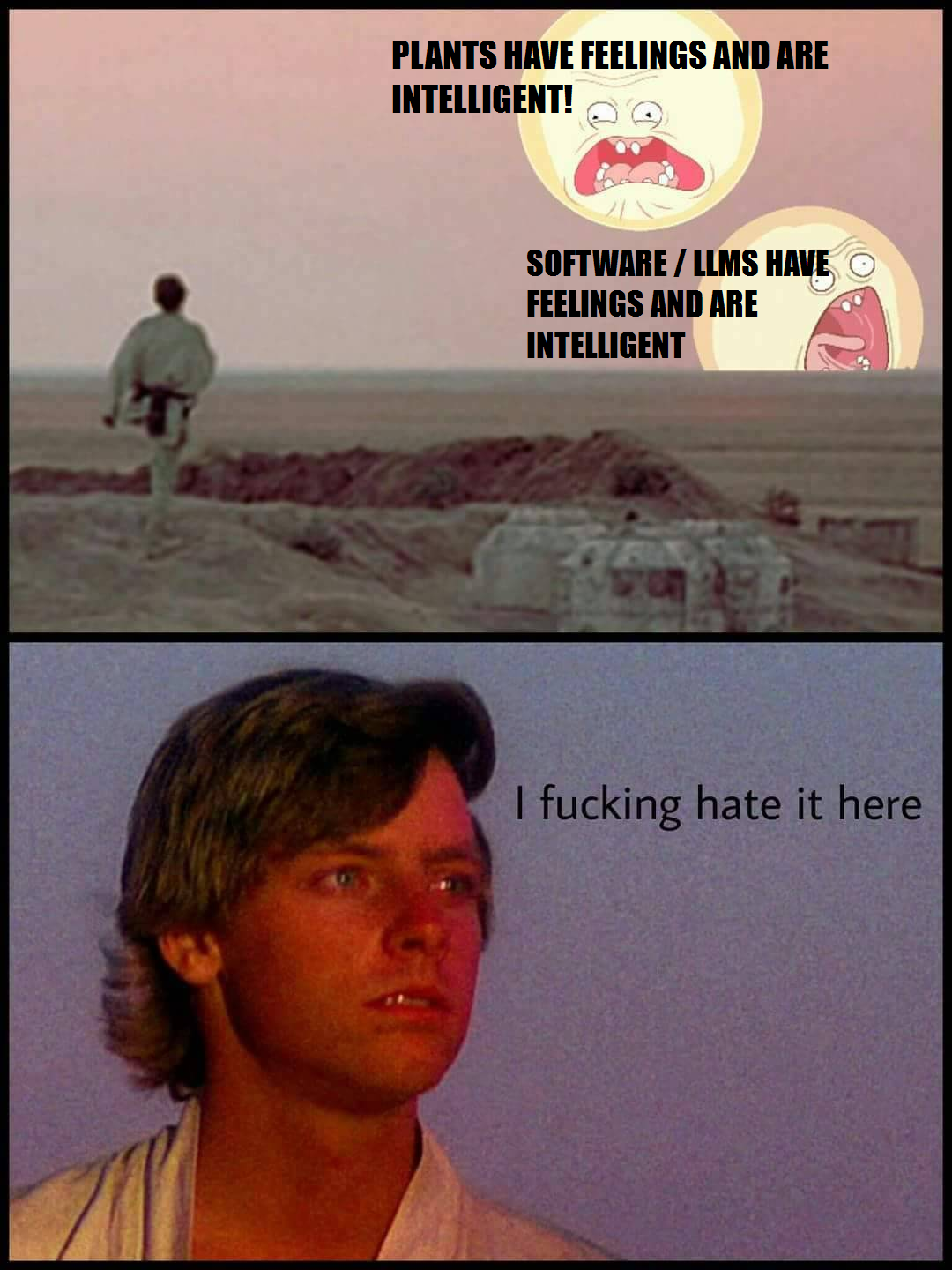
There are a bunch of people who’ve bought into the enchanting myth that plants feel things and “scream in pain”.
It’s not really surprising since most people don’t know botany or plant psychology, but love a nice TED talk.
Plants Neither Possess nor Require Consciousness: Trends in Plant Science
Plants absolutely “feel” things, they can sense gravity and the sun, some plants respond directly to touch (Venus flytrap, shameplant), there’s tons of research on their ability to “hear” (check out buzz pollination and beach evening primrose, super interesting). They have vibrational and chemical communication abilities we’re only just beginning to understand. If you mean they don’t feel human emotions, well yeah, they’re not human. But to say they don’t feel is simply inaccurate.
I think people liken it to human consciousness because that’s what they know, but I think most people understand that’s an abstraction and the reality is much more sciencey and nuanced
Paywall so I can’t actually read the whole article but from the abstract:
“We’ve drawn an arbitrary line around ‘consciousness’ and have decided what’s on either side” isn’t exactly the concrete dismissal they seem to think it is.
While you can just make shit up in definitions, you don’t get to claim that others use your definition. All you’re actually doing here is destroying words.
Not arbitrary: consciousness is a defined word with historical meaning. “Consciousness comes from the Latin word conscious, which means “knowing with” or “having joint knowledge.” The term evolved in English during the 17th century, with its modern meaning relating to awareness of one’s own mind first appearing in the late 1600s.”
You have arbitrarily redefined consciousness, implicitly by context to include any response to the environment. What good is epistemology if a plant’s hormonal action implies self awareness?
Edit: Imagine, if you will, that the stream of consciousness using language to tie a plant’s hormonal action to self awareness, e.g., words like “plants know when” is just as much of a cognitive and emotional hallucination as the most sublime sounding gibberish produced by an LLM.
https://en.wikipedia.org/wiki/Consciousness#Problem_of_definition
Yeah, none of those issues contradict anything I said.
Ok.
It might be (is!) a scam but at least we got some good music out of it.
https://en.wikipedia.org/wiki/Stevie_Wonder's_Journey_Through_"The_Secret_Life_of_Plants"
Plant psychology 🤣
The typical smell from cut grass is actually microbes. The soil is very much disturbed by the way we cut grass (not talking about reaping hay/wheat/etc here, just your typical suburbanite with a lawn mower). I can’t remember what they are now for the life of me, but the microbiology professor at my college loved explaining to the younguns that the reason the local water tasted/smelled bad (compared to most places) was that the same variety of microbe responsible for the cut grass smell was present in high concentrations in the source for the city water. Once he pointed it out, you could pick out the similarity.
I too love the smell of suffering.