

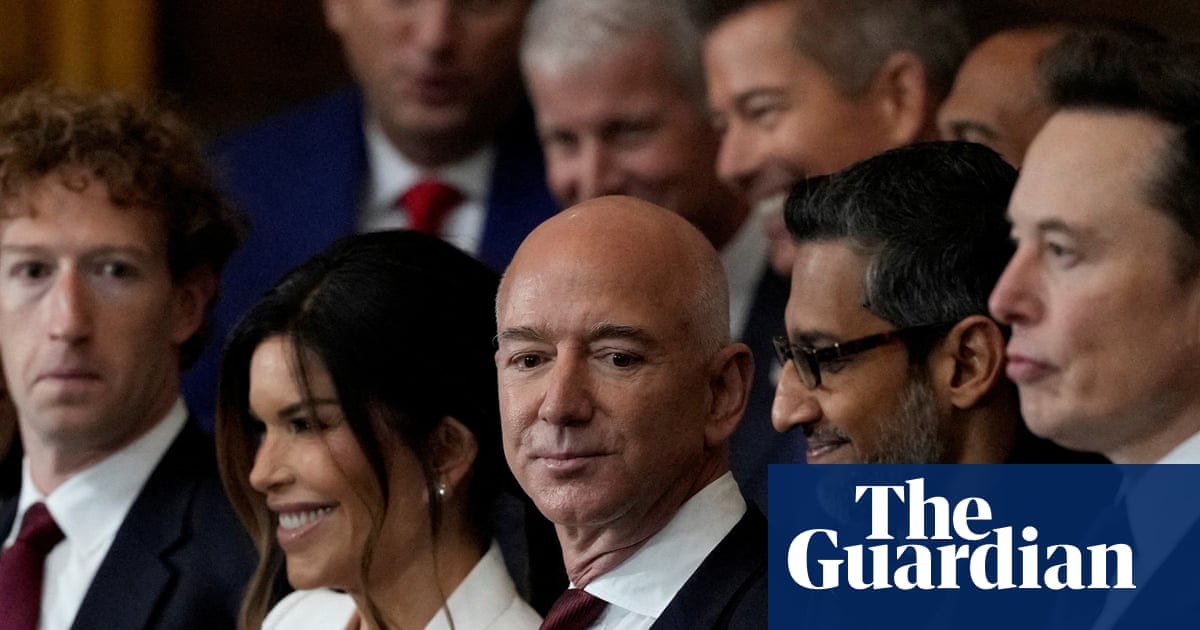
Already the most disliked man in America, Zuckerberg will show with his next era whether he believes in anything as much as he does power. Was his interest in jiu-jitsu mixed martial arts authentic or a way to ingratiate himself with the manosphere’s podcast hosts? We may know by the time he faces his first inquest. Perhaps he’ll return to the liberal roots of his former public image like founding a pro-immigration nonprofit, as he did a decade ago.
I like a lot these ideas but like you suggest, it should be left up to debate amongst a community of people to represent the time, age and level of technology and capabilities of the times they are debated in.
One core thing I often suggest when I debate these things is the idea of wealth and wealth distribution … it is a hotly debated subject whenever I suggest it because it is always clouded by the prospect or suggestion of communism or socialism and by extension totalitarianism and authoritarianism.
Of everything that could or couldn’t be done about government or society, I think instituted wealth equality would make the greatest difference to human development. And it’s a simple idea but an idea so controversial that most people disagree with it, question it or just don’t even want to think about it.
The idea that an UPPER WEALTH LIMIT should be instituted and permanently set into society. And the limit would still be a high ceiling … for instance, set it at $100 million … how could it be unreasonable to think that anyone could live without wealth beyond that limit? In one lifetime? And the governing system would essentially remain the same, no authoritarian system, no big changes to rights of people, no big changes to how society functions or operates, just that one change - to enact a system where wealth of any one person is capped to an upper limit.
Because many of the problems of developing, redeveloping, reshaping, reconstructing, renewing or upgrading government systems or laws … are all affected and influenced by those with wealth … and the more wealth any individual or individuals have, the more they are likely to change or affect changes for better or for worse. And conversely, once wealth is better distributed to more people, the more likely it is to develop better, more representative laws and regulations because everyone (or more people) would be able to better represent themselves and influence control.
If we removed the insatiable greed of individual people from the system, then it would more likely be able to better represent everyone as a whole … rather than always lopsidely represent only those few people with money and power.
Unless the issue of wealth, especially ultra wealth, is addressed … the problems of developing any kind of new or old government system will always be crippled by those who want to hold onto or protect their wealth and power.
I like your approach. I think a reason why a lot of people resist the idea is that they’re afraid of losing what they have. No working-class person should lose their nest egg in order to redistribute the wealth. Nor do any need to. Because the problem isn’t the middle class or even the upper-middle class. The problem is the upper-upper class, the owner-caste, the plutocrats, the zaibatsu, the financial oligarchs.
So when we talk about it, our rhetoric needs to highlight that we’re not after any doctors or lawyers or professors emeritus. Those aren’t the people siphoning and hoarding the lifeblood of society; they’re not the ones who are appropriating the surplus value of labor in order to generate exorbitant personal wealth to the detriment of everything and everyone around them.
We need to communicate better about working-class solidarity, and how that includes the middle classes, yes, even up to and including the upper-middle class. They can keep their mcmansions and their corvettes. That’s not the means of production that needs to be seized.
Personal possessions are fine. It’s privately-owned business empires that need to die. And the “public” stock market should be nationalized, and governed by democratic civil institutions, like a hybrid between a union and a bureau, or something along those lines.
Especially–and starting with–public utilities and other infrastructure, which honestly needs to include communications infrastructure such as cell towers & satellites, internet, and even social media. But there I’m starting to get a little radical, and I don’t know if the broader social conscience is ready for that leap quite yet. The key idea is that these things should be treated as public goods rather than commodities to be exploited for profit by individuals or business entities.
And yeah, there definitely needs to be an upper wealth limit. $100 million seems reasonable. You reach that, you win. Nobody needs more than that, so at any point if a person’s net worth goes over it, every dollar over should be taxed at 100%.
I’d caution against applying wealth tax to anything under that limit though, because the thing about wealth is that it’s a static amount unlike income, so a recurring wealth tax would actually tax the same wealth redundantly. So it’s probably best to only apply it to any amount over the upper limit.
And lastly, but arguably most importantly, capital gains need to be taxed more fairly. Currently, in the US at least, the highest tax bracket for capital gains is taxed at a rate comparable to the income tax bracket of about a $40,000 salary. It’s so bullshit.
Personally, I honestly just believe in starting at the wealth cap.
If we could all just work for that one thing to happen, everything else could more easily come after that. It’s like trying to build a house … we’re all just talking about what colour paint to use, what kind of blinds to install, the type of sink taps, the colour of the furniture or the type of light fixtures we’d like to see … when we should really be talking about what kind of structure to build first to hold the roof and support the walls, just to get the building started.
If we keep talking about everything else without addressing the elephant in the room that is the problem of ultra wealth in small groups of people, everything that is ever discussed in politics, no matter how informed, debated, discussed or researched it might be, will never matter because everything will always be railroaded by those with money … those people who want to keep their money and their power.
So unless we can find a way to deal with ultra wealth first and foremost, nothing else matters no matter how much it makes sense.
You’re right, and if we can accomplish that in one go, it would be for the better. But it may take a phased approach.
For instance, in order to garner enough support to make it happen, we need to demonstrate tangibly to the average voter that it is indeed in their best interest. There is a lot of corporate propaganda/astroturfing/psyops and manipulation/brainwashing to overcome in that regard, and it won’t happen merely by making promises. We need to deliver on those promises.
So we might need to build out more robust social programs first so that people can see and feel the benefits. We can start by taxing capital gains fairly in order to fund projects that help everyone. Healthcare, education, housing, utilities, transportation and other civil infrastructure, retirement/disability, vocational training, nutritional assistance, etc…
And of course regulating commerce/industry better so that people can feel the results to their health, wellbeing, finances, environment, and so many other things.
Then once people see that reaganomics were a lie from the start, we can try something bolder. Maybe that will look like a $1 billion dollar wealth cap at first, and every dollar above that amount gets taxed at 100% at the end of each fiscal year.
Eventually that can be lowered to $100 million, but that might be a harder sell for some people who think they might reach it. A billion dollars though is so clearly out of reach to anyone who wasn’t born already-wealthy, that anyone who’s being honest with themselves should be able to accept it as the limit.
I agree though in general that reducing wealth disparity needs to be a key priority, and so many other goals (including restoration of genuine democracy) are contingent upon that.