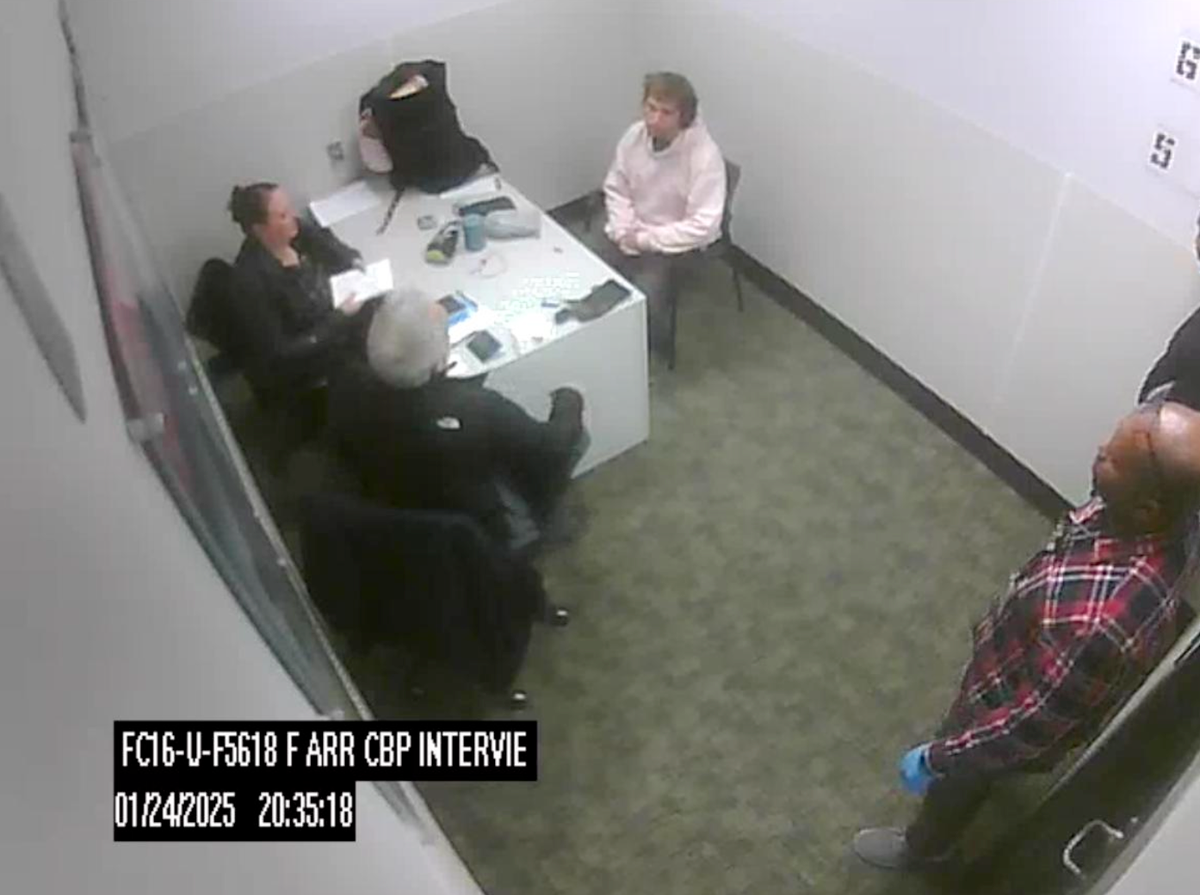
When a Department of Homeland Security official sent out an alert to stop Samuel Tunick, a Stop Cop City activist, at an airport in January 2025, they said the reason was because he was suspected of “terrorist activities,” according to new filed court records which include a screenshot of the alert and photos of Tunick’s interrogation.
Tunick ultimately provided Customs and Border Protection (CBP) officials with a code that, when entered, wiped his security- and privacy-focused GrapheneOS phone. Tunick is now being criminally charged for that alleged act, in one of the most high profile technology civil rights cases in recent memory.
The court records also showed that CBP officials lied to Tunick during his interrogation. Instead of saying he was being targeted for suspected terrorism — although this search happened just at the start of the second Trump administration, it has dramatically broadened what organizations or people may be considered such — they said they needed his phone to look for “kiddie porn.”
“Good afternoon,” an email sent from a Homeland Security Investigations (HSI) official, part of Immigration and Customs Enforcement (ICE), to CBP and other officials reads. “The following subject is scheduled to arrive in ATL [Hartsfield-Jackson Atlanta International Airport] today via DL 1778 @ 1930 Hours. TUNICK is under investigation by HSI/JTTF for suspected terrorist activities.” The email includes a photo of Tunick, and asks the officials to direct him to secondary inspection, retain all of his electronics, and collect their passcodes.
As 404 Media first revealed in December, Tunick was charged because he allegedly “did knowingly destroy, damage, waste, dispose of, and otherwise take any action to delete the digital contents of a Google Pixel cellular phone, for the purpose of preventing and impairing the Government’s lawful authority to take said property into its custody and control.” Matthew Dodge, one of Tunick’s lawyers, previously told 404 Media he only found one other case using the same obscure law, a drug trafficking case. “This is extraordinarily rare,” Dodge said.
Tunick was part of the Stop Cop City movement in Atlanta, which broadly protested the building of a large police training center, and which authorities investigated for arson, vandalism, and doxing. Tunick is not suspected of any crime beyond the alleged wiping of the phone, and has previously put his current prosecution in the context of the wide spanning cases against other Stop Cop City protesters.
The newly filed court record, in which Tunick’s lawyers argue that evidence should be thrown out, include new photos and descriptions of the airport encounter. The CBP officials asked Tunick if they were going to find “kiddie porn” on his phone, which Tunick immediately denied. “As the evidentiary hearing made clear, these unfounded accusations were nothing more than pretext for a fishing expedition into the depths of Mr. Tunick’s devices,” the lawyers wrote. They added, “Officer Findley acknowledged that officers had no reason whatsoever to believe Mr. Tunick possessed child pornography,” referring to one of the officials.
Tunick faces a maximum of five years in federal prison for allegedly wiping the phone.
“I hope people understand that the charges against me are meant to intimidate people against protecting their data and their privacy, and the government hopes to set a precedent that no one has the right to privacy,” Tunick previously told 404 Media.
daamn. they would do that…
So, GrapheneOS should have a function that replaces the content of the phone with a vanilla set of apps and a clean account, instead of wiping it, on receiving the distress code.
That is very hard to make. Also would taken a while for the new profile to be setup and at the same time destroy what was their. Now it just wipes the encryption key. So the data is actually still their but no one can access it. That action takes Mere secconds instead of potentially minutes or longer.
Doesn’t seem that difficult. Say the phone boots automatically with the public profile. Then you go to the calculator app and punch in the code to go to the private profile. The os loads the hidden encrypted partition with that code and now loads the private profile.
From a regular inspection, it looks just like someone using a new phone. And you can still have a duress code that loads again the public profile. Maybe just show an “updating apps” message while doing so. The phone opens the clean profile while in the background it starts a wipe of that hidden partition in the background.
Thing like that exist and are not new. TrueCrypt had such a function 15 years (or longer) ago already.
The trick is basically to have two partitions in the encrypted volume and depending which key you enter it opens one or the other. The filesystem needs to be given fake data about available free space to hide the “other” one.
It would require a reboot, though.
You could approximate this by simple having the main profile be left as a dummy profile and users use secondary profiles for their data. Then when you put the special code in it discretely deletes all but the main profile, leaving your dummy profile intact however you have set it up, and they’d have no idea your other profiles were where the data really was. They’d just unlock the phone, see the dummy profile, and think that was the phone.
Not surprising. Protecting Kids & Fighting Terrorism are always the reasons to violate our rights and it’s rarely ever actually about that.
If protecting kids is one of their main goals, I wonder why they did not start with the Epstein friends?
Officer Findley
doesn’t find shit
what did he mean by this?
Called bullshit as soon as I read they were accusing him of kiddie stuff.
This is why GrapheneOS’s passcode feature is more likely to land you in trouble - it’s too “hostile”
I’d rather it load an empty profile while it wipes everything in the background.
The idea itself is good… But his defense strategy is even better: they are denying that he even had the duress code configured. The accusation must be able to prove he had, and I think proving it will be very hard to do.
When you enter the wipe passcode, iirc the screen flashes and the phone reboots / wipes - that’s how they were clued in that he ‘did something’ and that’s why he’s being charged and faces 5y in prison for the act.
A hidden wipe would have prevented this.
That’s what they said happened. We have no idea if it actually happened, and based on the report here, there’s no reason we (or a jury) should believe what they say.
Do they have video? Not that we’ve seen, from what I’ve read, but maybe it exists.
This sounds overly optimistic bordering on delusional. There are countless examples of courts siding with authorities based on nothing but their say so and this case is a perfect candidate to ‘make an example’ out of someone uncooperative with said authorities. It’s easy to discount the stress of having a potential 5 year term hanging over you when you’re not on the receiving end of it.
Unless you’re deliberately looking to fight the fight (unlike the majority of people who find themselves in this situation), the plausible deniability provided by a more discrete wipe would keep both your data and you personally safe.
Passcodes should be covered by the fifth amendment: when asked to provide them, say “I am exercising my right to remain silent.”
Biometrics, however, are not covered, and cops can point your phone at your face or grab your hand to unlock the device
It should add a biometric duress option so that when cops do this it shoots themselves in the foot
yes, and use the middle finger as the duress biometric code
They should! Also then they can’t blame the phone owner for giving them a duress password to wipe the phone, because they didn’t.
Iirc this happened at a border crossing outside of American jurisdiction where the officers argued that those laws do not apply (while insisting that the american laws he is being charged for breaking do)
Passcodes are not “private info” everywhere, AFAIK in the UK if you refuse to give up your passcode you could get up to 5yrs of jail time.
Hands duress code
oops, you should’ve been more specific
I mean clearly destroying evidence is also illegal.
While that’s good information to know, this is a case in the US, so it’s kind of irrelevant.
This specific case is kind of a clusterfuck of questions regarding jurisprudence. He might slip away on a technicality because law enforcement has gotten sloppy under feelings of invulnerability these days.
In general though, I doubt they are going to protect the right to destroy data on a device that is or is about to be legally seized. Any reasonable person would expect that the device includes the data on board, and therefore taking action that results in the destruction of that data would be destroying evidence.
Use burners when traveling.
He didn’t destroy anything. The customs officer did by entering the “destroy data” key. He wasn’t under any obligation to give them the correct one, because no court had told him to provide his data.
If he’d just committed a heinous crime I could understand them being allowed to legally seize and search his devices after getting a warrant, but he wasn’t being criminally charged with anything, right? Do they have the right to scroll anyone’s private photos who passes through customs?
That’s one of several questions this case will likely set precedent for. I’m guessing the answer will end up being yes.
Society will be forced to move to polaroid nudes only :(
Most probably only the USian “society”, tho. I know they’re too insular brained but still. The difference is important. Most of us don’t live under a Patriot Act, for instance. Crazy, right?
Seize devices yes, but after they have it, it’s not going anywhere. There’s no sign of imminent danger either. So they can apply for a warrant just like for any other search.
What’s the difference between destroying data and encrypting it with a random key? And is it okay to destroy/randomly-encrypt data through a scheduled dead-man’s switch instead of by giving out a duress code?
If the cops express interest in your data and then you take active steps to conceal or erase said data, they might charge you with Obstruction.
If there is an automated system, the charge is less likely to be brought, and unlikely to stick, because you were not responding to something that just happened.
(And I’m not saying the guy in this situation actually did what they said he did. Cops lie constantly. Video or it didn’t happen.)
I thought about this too, but I think you’d still be charged (IANAL).
If you look at what he was charged with:
Tunick was charged because he allegedly “did knowingly destroy, damage, waste, dispose of, and otherwise take any action to delete the digital contents of a Google Pixel cellular phone, for the purpose of preventing and impairing the Government’s lawful authority to take said property into its custody and control.”
So, even if you nuked your phone before going through security or even at home before your flight, I imagine you could still be prosecuted for “knowingly… delete the digital contents… for the purpose of preventing… lawful authorities to take said property into its custody”.
It’s all based on your intent behind the action and this is what the prosecution and defense would argue.
edit: typo
This is what they’ll always do to make privacy impossible.