

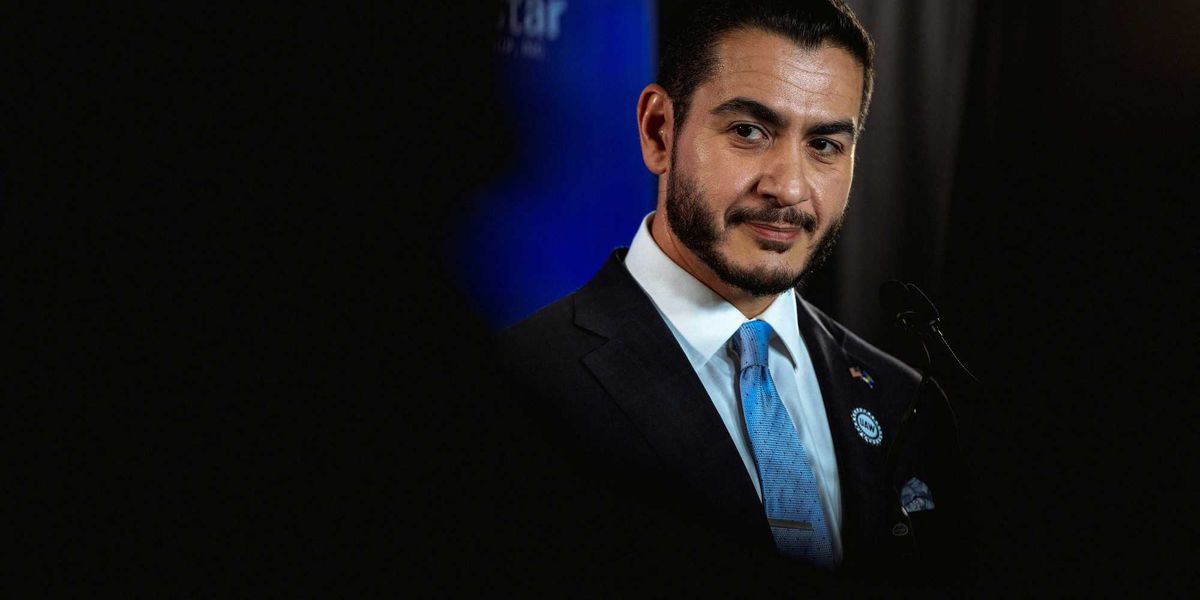
The attendee who pressed Democratic Senate nominee Abdul El-Sayed to disavow the Muslim Brotherhood at a tense town hall this weekend was exposed as a former GOP staffer with “Christian nationalist ties,” journalist Marisa Kabas reported.
As first reported by Kabas on her Substack The Handbasket, Tommy was actually Thomas Teepell, who previously served as operations director for Sen. Josh Hawley (R-MO) until February of this year.
Teepell’s father is Timmy Teepell, a GOP strategist who worked for former Louisiana Gov. Bobby Jindal through his climb from congressman to governor. Jindal is the founder of America Next, a conservative PAC that, according to The Michigan Daily, offered Republican college students $200 to travel to an El-Sayed event to “heckle” the Democratic candidate and ask provocative questions.
I should know better than to argue with you about linguistics (because I remember you have an advanced degree in it from a previous conversation), but…
I’m going to go ahead and put my foot down and say that using “weary” to mean “wary” is just wrong usage. Like saying “it would be hoo of you” instead of “it would behoove you.” It’s just bone-apple-tea seen in the wild.
Now I will agree with point 2 in that it isn’t grounds to look down on someone or treat them poorly. If it’s in a context where it can be gently corrected without patronizing, it should be. Otherwise we should just let it go. But that doesn’t make it any less incorrect.
Any attempt by phd candidates to retrofit an explanation for it is just “explaining away” and reflects more the overly-permissiveness of modern academia and the hesitancy (especially in humanities fields where subjectivity is like water to a fish) to make firm corrections, especially in cases where cultural relativity might be argued.
I mean sure, language evolves and theoretically a dialect could emerge in which words that previously meant some things could take on completely different meanings. But if we accept that as the official “correct” stance in the field of linguistics, then the field of linguistics itself loses relevancy. Because if nothing can be wrong, then nothing can be correct either. Words will lose their meanings over time and it will become impossible to communicate across cultural barriers. You can already see this phenomenon if you pay attention to words that have taken on euphemistic meanings, especially in the contexts of intergenerational communication, which I would argue is a form of cultural barrier. For instance, “pussy” still means “cat” to many people of a certain age. That’s an extreme example, but that sort of thing can create miscommunications. Especially when it comes to more obscure innuendos or newer ones that aren’t as widely familiar to people.
The phenomenon isn’t limited to innuendo though. The whole basis of language is a mutual understanding of represented meanings. If we lose that consensus, then language itself begins to break down and become no longer an effective basis for communication. Carried to extremes, we find ourselves returning to meaningless/inarticulate grunts (not that we’re likely to reach that extreme, especially not within the lifetime of anyone living today; but it’s about the trajectory).
First of all, thanks for the response! I love talking about this stuff, and will do so every chance I get!
Language as a system is inherently a constant, mass negotiation among its users. Its relationship to meaning is (with a tiny number of exceptions) completely arbitrary, which means that if speakers unconsciously agree to use “it would bee hoo of you” to mean “it would behoove you”, then that is literally the correct usage. Merriam-Webster agrees with me - language is defined by usage, not by an obsolete code of speakers priviledged enough to have access to the secret knowledge of “correct grammar”.
There is an argument that using “weary” in this way is still marginal, and so is still ungrammatical for most speakers (myself included), but it’s definitely widespread enough for a linguist to consider it correct for many younger speakers (even if it irks me to admit it).
This depends on your perspective, I suppose. Few people actually understand how language works, and even fewer are willing to be non-discriminatory in practice, which means that, unfortunately, using a word that others perceive as “incorrect”, even when they’re wrong about that (which is pretty much always, including here), can have negative social consequences.
For this reason, and this reason alone, I can support the idea of gentle correction.
However, if by some miracle humans become less tribalistic, and start treating language descriptively and objectively, then there will no longer be a reason to “correct”, because we will have realized that there was nothing to correct in the first place.
(Note that this obviously excludes children and second language learners - they do produce ungrammatical sentences, but this is categorically different than saying “weary” instead of “wary”.)
I was a (non-tenured) professor of linguistics for almost a decade, not just a PhD candidate.
Also, this isn’t “explaining away”. Linguists have known that this is how language works since at least the late 1800s, and especially by the time of de Saussure’s “Course in General Linguistics” in the early 1910s, so I’m not sure where you’re getting “the permissiveness of modern academia”.
Language is a system built on usage, and it’s been known that that was the case for the majority of the time that we’ve been studying it scientifically. See Merriam-Webster’s article above - this is a fact that is universally accepted not only by linguists, but also by lexicographers. Merriam-Webster does have a disambiguation page on “weary vs. wary”, but I can guarantee you than within a decade they will have updated their definition to reflect usage.
This is a fundamental misunderstanding of the study of linguistics (which is understandable, since it’s unfortunately not a commonly understood field among laypeople). Linguistics is the study of the human capacity to produce a system that we call language. The only thing we care about is accurately describing the nature of that system and how it exists in the mind of a speaker.
We have no interest in what people think is “right” or “wrong”, because these value judgments are subjective and do not in any way reflect linguistic reality - we only care about the nature of the system itself as it is actually spoken by humans, and this has always been the case.
However, we do make a distinction between utterances that are grammatical and those that are ungrammatical. This is defined, of course, by usage, and it is naturally consistent and rule-governed in all languages/dialects, both standard and nonstandard. A grammatical utterance is one that would be unconsciously produced by the linguistic apparatus of a native speaker of a language, and an ungrammatical utterance is one that would not be produced by that system.
In fact, linguistically defined, if it takes conscious effort for you to not split infinitives or end sentences with prepositions, then speaking “correctly” is actually ungrammatical!
Since the dawn of recorded history old curmudgeons who have seen their language change around them have decried how the youth are destroying language, how it will devolve into meaningless grunts and how we will lose all ability to communicate. This seems to be a human universal, from the ancient Greeks to the ancient Japanese.
However, after literally thousands of years of this “devolution”, we still haven’t seen this happen.
Why? Is it because we have righteous grammar warriors who fight the good fight of enforcing archaic and arbitrary restrictions?
Nope. It’s because all dialects, etc., still have self-organizing, well-defined rules of about the same general complexity. There is no “devolution” because language is an innate, universal human behavior that follows specific types of rules and general patterns. That is, linguistic systems’ interactive and negotiative nature means that they naturally self-correct - they don’t need anyone to do it for them.
As for the idea that English will splinter into unintelligible dialects, this is again countered by the facts of language usage. It’s currently valuable and important to English speakers across the world that they be able to communicate successfully with each other, and as long as this pressure exists, they will continue to be able to do so.
Once again, this isn’t because there’s a universal English police enforcing outdated rules like not splitting infinitives - it’s because the (incredibly large) speech community benefits from continuing to communicate, and so they will naturally, because that’s how humans are programmed.
To do so, of course, “English” defined broadly has already had a sort of lingua franca version of itself develop naturally, and each English-speaking place in the world already has their own variation of this organic “standard”, and yet they’re all still able to communicate among each other simply because it is necessary that they do so. Once again, this is not because of internet grammar Nazis, but because that’s literally how language works.
As for your example of intergenerational miscommunication, this will inevitably occur anyway due to language change. Miscommunication and ambiguity is inherent to language and cannot be legislated away, because, again, it’s inherent to the system.
Instead, when there is (inevitably) a miscommunication, the solution is quite simple. It’s the same solution older generations and younger generations have been using since the dawn of humankind: both speakers can simply explain what they meant, or define new terminology, and communication can proceed just as well as it did previously.
This is correct, but as long as speakers are in communication with each other, this cannot happen, because that’s the nature of language. Language is communication, and its systemic nature is defined by that communication. This means that as long as communication continues to happen between the groups, their language will continue to be understandable.
Now, it is of course the case that if all communication suddenly ceased for a few hundred years, then yes, the two groups of speakers would likely lose the ability to communicate with each other. But in our modern world of super interconnectivity, that’s incredibly unlikely to happen among the vast majority of English speakers.
As explained above (and as demonstrated by thousands of years of human history), this trajectory does not exist, because that’s not how language works.
I hope this has been understandable and informative. I’m busy for the next four or so hours, but let me know if there’s anything that doesn’t make sense, or anything you’d like more detailed explanation of, and I’ll be happy to respond.
Again, I love talking about this stuff and will answer literally any question about linguistics that you’ll let me! :)