This seems to be basted of statistical averages, so I’m so sure it can necessarily be translated to 4 in 5 people in a real empirical sense.
It’s not entirely clear though - I didn’t try to find any sources.
I’d expect a skewed distribution with more deaths concentrated in certain areas and impacting some people more.
This might seem an anal point, but it might help explain voting behaviour and crowd responses and such.
If you’re speaking to a room of 100 random 40-year olds it might be way less than 80 who agree that they know someone who died in a crash. It might be just 20 who knew 4 people die. That sort of skew in people’s experiences might be helpful for advocates to understand as the dynamic of a minority with more trauma vs a majority none could be different - especially if the majority are callous self interested fuckfaces.
Yeah, that’s a good observation. There are definitely clusters. Similarly, I’ve known a depressingly large number of close acquaintances who died of overdoses, AIDS and suicide. I was playing music, living in big cities and socializing with artists, musicians and dancers. The 80s, to me, were a bloodbath. But I think it’s fair to say that most people who went though that decade didn’t experience the same degree of loss, desolation and survivor’s guilt. It’s hard to explain to someone who didn’t go through it. The experience shaped my world view, my politics and how I live my life.
I realized I ADHD rambled in my post. tl;dr: I totally agree
It for sure is a statistical average. Like one in four women in your life have been sexually assaulted (can’t remember the exact statistic, but whatever it is, it’s bad).
To your point about some people being more affected than others, you are absolutely correct. Adding to this, some people don’t realize how many on their own life, like friends and family, have been affected by automotive accidents. Traffic injuries and deaths are so so normalized. Just anecdotally, the more I think about it, the more I remember people who have been injured, myself included. I just thought of a family friend, right now, while typing this, that was killed in a drunk driver hit and run, while she was jogging on a paved bike path in a park. My cousin and his wife were killed on a motorcycle when a truck pulled out in front of them illegally. Another cousin’s best friend died in a car accident in high school.
But when I first read the statistic my first thought was “I don’t think I know anyone who has died that way.” Stunning. I have a relatively high level of empathy and it took a fair amount of introspection to remember those who died. Partly because they weren’t immediate family or friends, but rather, once removed. No wonder, as you say, those callous, self-interested bastards don’t allow statistics like the OP to move them toward change.
Without knowing any real details, this is a type of accident where the perpetrator may not be held liable (because accident), and there’s really no technical solution (except maybe self-driving). Pulling out without seeing traffic is far too easy for a human to do by mistake, and no amount of road engineering or stop signs can change that
(Certainly roundabouts can help, and getting rid of stroads, but there’s still “pulling out”)
Behaving illegally and causing someone’s death as a consequence should be treated as a criminal matter. It’s a homicide, compounded by “reckless disregard.”
there’s really no technical solution (except maybe self-driving)
A lower threshold for taking dangerous drivers off the road would help. And don’t believe the self-driving hype: self-driving car makers’ stats should not be trusted unless corroborated by peer-reviewed, third-party science, where the people doing the analysis have no conflict of interest.
It’s also critical to understand the datasource. If we’re computing average by crash data, I’m sure I’m not average, but also “know” more people who have died than I am aware of
If their data was from personal surveys, my answer might be 2. The real number is likely higher, and the average is not predictive
Yep.
Averages are just statistics, not real peoples experience. They’re far from useless, but
a nice rich, (ideally) random or otherwise re[presentative sample has way more diverse things to say about the world than a single summary statistic ever can.


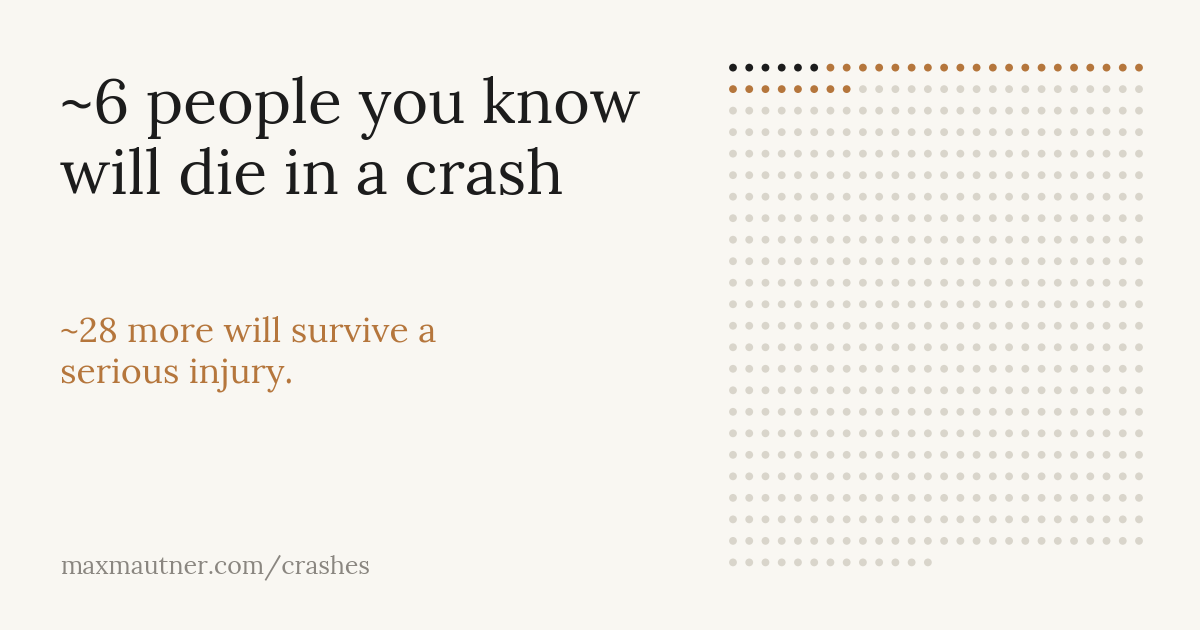
This seems to be basted of statistical averages, so I’m so sure it can necessarily be translated to 4 in 5 people in a real empirical sense. It’s not entirely clear though - I didn’t try to find any sources.
I’d expect a skewed distribution with more deaths concentrated in certain areas and impacting some people more.
This might seem an anal point, but it might help explain voting behaviour and crowd responses and such.
If you’re speaking to a room of 100 random 40-year olds it might be way less than 80 who agree that they know someone who died in a crash. It might be just 20 who knew 4 people die. That sort of skew in people’s experiences might be helpful for advocates to understand as the dynamic of a minority with more trauma vs a majority none could be different - especially if the majority are callous self interested fuckfaces.
Yeah, that’s a good observation. There are definitely clusters. Similarly, I’ve known a depressingly large number of close acquaintances who died of overdoses, AIDS and suicide. I was playing music, living in big cities and socializing with artists, musicians and dancers. The 80s, to me, were a bloodbath. But I think it’s fair to say that most people who went though that decade didn’t experience the same degree of loss, desolation and survivor’s guilt. It’s hard to explain to someone who didn’t go through it. The experience shaped my world view, my politics and how I live my life.
I realized I ADHD rambled in my post. tl;dr: I totally agree
It for sure is a statistical average. Like one in four women in your life have been sexually assaulted (can’t remember the exact statistic, but whatever it is, it’s bad).
To your point about some people being more affected than others, you are absolutely correct. Adding to this, some people don’t realize how many on their own life, like friends and family, have been affected by automotive accidents. Traffic injuries and deaths are so so normalized. Just anecdotally, the more I think about it, the more I remember people who have been injured, myself included. I just thought of a family friend, right now, while typing this, that was killed in a drunk driver hit and run, while she was jogging on a paved bike path in a park. My cousin and his wife were killed on a motorcycle when a truck pulled out in front of them illegally. Another cousin’s best friend died in a car accident in high school.
But when I first read the statistic my first thought was “I don’t think I know anyone who has died that way.” Stunning. I have a relatively high level of empathy and it took a fair amount of introspection to remember those who died. Partly because they weren’t immediate family or friends, but rather, once removed. No wonder, as you say, those callous, self-interested bastards don’t allow statistics like the OP to move them toward change.
Without knowing any real details, this is a type of accident where the perpetrator may not be held liable (because accident), and there’s really no technical solution (except maybe self-driving). Pulling out without seeing traffic is far too easy for a human to do by mistake, and no amount of road engineering or stop signs can change that
(Certainly roundabouts can help, and getting rid of stroads, but there’s still “pulling out”)
Behaving illegally and causing someone’s death as a consequence should be treated as a criminal matter. It’s a homicide, compounded by “reckless disregard.”
A lower threshold for taking dangerous drivers off the road would help. And don’t believe the self-driving hype: self-driving car makers’ stats should not be trusted unless corroborated by peer-reviewed, third-party science, where the people doing the analysis have no conflict of interest.
👏 fuck 👏 every 👏 single 👏 car 👏
That sounds painful. And what about electric cars? There’s no exhaust to stick the benis in 🤔
It’s also critical to understand the datasource. If we’re computing average by crash data, I’m sure I’m not average, but also “know” more people who have died than I am aware of
If their data was from personal surveys, my answer might be 2. The real number is likely higher, and the average is not predictive
Yep. Averages are just statistics, not real peoples experience. They’re far from useless, but a nice rich, (ideally) random or otherwise re[presentative sample has way more diverse things to say about the world than a single summary statistic ever can.