

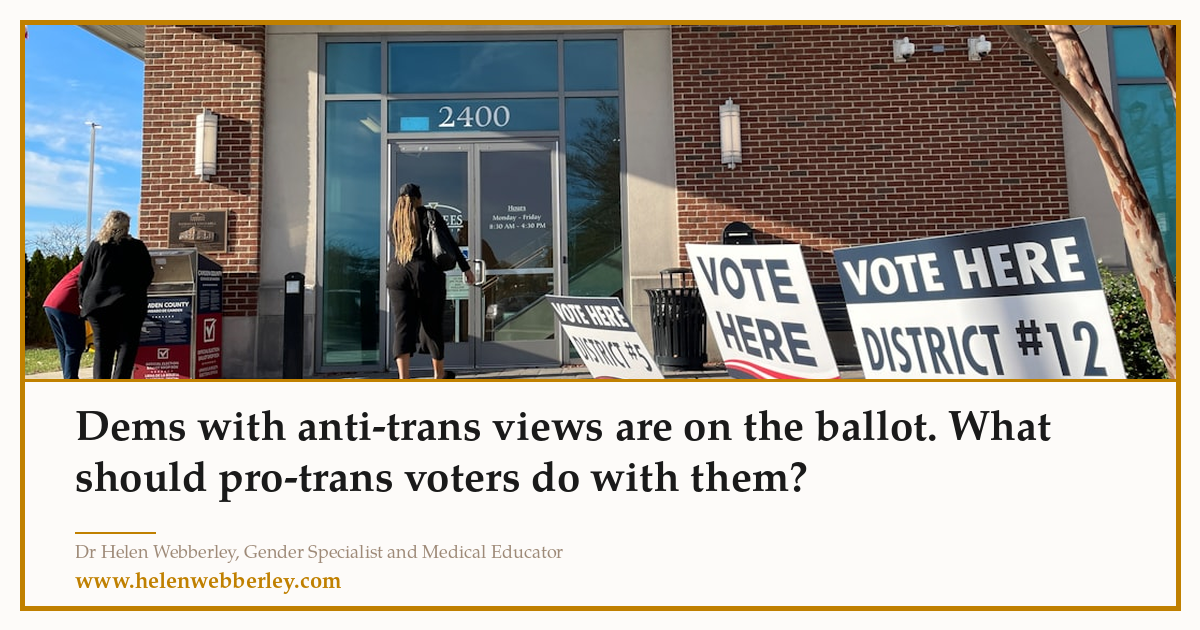
Trans journalist Erin Reed has published a list of Democratic midterm candidates with anti-trans records, and the question she is forcing is one the party would rather not answer: if trans voters keep rewarding Democrats who harm them, what signal does that send? The calculation is real, the stakes are high, and there is no clean answer.
No issue is a strict binary - there are many degrees of transphobia, just as there are many degrees of any bigotry, as well as many degrees of non-human-rights issues, like support for public schools or privatization of health care. I would imagine that in almost every case where there is an anti-trans democrat running against an anti-trans republican, there is a significant difference both in terms of how rabidly transphobic the candidate is and which specific anti-trans policies they will support. There is also likely to be a big difference whether or not there is any potential for them to see the error of their ways. While most anti-trans democrats are likely on the wrong side of trans participation in sports, they are not likely to support criminalizing trans existence or encouraging violence against trans people, while many republicans are. They also will face pressure from pro-trans members of their own party, and from significant pro-trans constituencies, which republicans will not.
In FPTP voting systems, we rarely have the luxury of voting for candidates who have our full-throated support in the general election. Even if one issue is massively more important to you than the rest (and when that issue is a matter of survival, that is 100% valid), there is almost always a greater and lesser evil on that issue alone. Voting shouldn’t be viewed as a matter of identity or even as an endorsement, but rather as a practicality. It is a method of weighing in as to which of the limited options available is more tolerable (or less intolerable). Does that suck? Absolutely. Does it make sense to vote any other way within such a system? Not at all - because if the more tolerable side loses, the only lesson they are likely to take from that loss is to become more like the winning, intolerable side.